|
|
|
|
|
|
|
|
|
|
|
|
|
|
|
|
|
|
|
|
|
|
|
|
|
|
|
|
|
|
|
|
|
|
|
|
|
|
|
|
|
|
|
|
|
|
|
|
|
|
|
|
|
|
|
|
Table of Contents
UNITED STATES
SECURITIES AND EXCHANGE COMMISSION
WASHINGTON, DC 20549
FORM 10-K
(Mark One)
| x | ANNUAL REPORT PURSUANT TO SECTION 13 OR 15(d) OF THE SECURITIES EXCHANGE ACT OF 1934 |
For the fiscal year ended December 31, 2014
| ¨ | TRANSITION REPORT PURSUANT TO SECTION 13 OR 15(d) OF THE SECURITIES EXCHANGE ACT OF 1934 |
For the transition period from to
Commission File Number 000-08467
WESBANCO, INC.
(Exact name of Registrant as specified in its charter)
| WEST VIRGINIA | 55-0571723 | |
|
(State or other jurisdiction of incorporation or organization) |
(IRS Employer Identification No.) |
|
| 1 Bank Plaza, Wheeling, WV | 26003 | |
| (Address of principal executive offices) | (Zip Code) | |
Registrant’s telephone number, including area code: 304-234-9000
Securities registered pursuant to Section 12(b) of the Act:
|
Title of each class |
Name of each Exchange on which registered |
|
| Common Stock $2.0833 Par Value | NASDAQ Global Select Market |
Securities registered pursuant to Section 12(g) of the Act: None
Indicate by check mark if the registrant is a well-known seasoned issuer, as defined in Rule 405 of the Securities Act. Yes þ No ¨
Indicate by check mark if the registrant is not required to file reports pursuant to Section 13 or 15 (d) of the Act. Yes ¨ No þ
Indicate by check mark whether the registrant (1) has filed all reports required to be filed by Section 13 or 15 (d) of the Securities Exchange Act of 1934 during the preceding 12 months (or for such shorter period that the registrant was required to file such reports), and (2) has been subject to such filing requirements for the past 90 days. Yes þ No ¨
Indicate by check mark whether the registrant has submitted electronically and posted on its corporate Web site, if any, every Interactive Data File required to be submitted and posted pursuant to Rule 405 of Regulation S-T (section 232.405 of this chapter) during the preceding 12 months (or for such shorter period that the registrant was required to submit and post such files). Yes þ No ¨
Indicate by check mark if disclosure of delinquent filers pursuant to Item 405 of Regulation S-K (section 229.405 of this chapter) is not contained herein, and will not be contained, to the best of registrant’s knowledge, in definitive proxy or information statements incorporated by reference in Part III of this Form 10-K or any amendment to this Form 10-K. þ
Indicate by check mark whether the registrant is a large accelerated filer, an accelerated filer, a non-accelerated filer or a smaller reporting company. See definitions of “large accelerated filer,” “accelerated filer,” and “smaller reporting company” in Rule 12b-2 of the Exchange Act:
| Large accelerated filer þ | Accelerated filer ¨ | |
| Non-accelerated filer ¨ | Smaller reporting company ¨ | |
| (Do not check if a smaller reporting company) |
Indicate by check mark whether the registrant is a shell company (as defined in Rule 12b-2 of the Act.) Yes ¨ No þ
The aggregate market value of the registrant’s outstanding voting and non-voting common stock held by non-affiliates on June 30, 2014, determined using a per share closing price on that date of $31.04, was $843,146,163.
As of February 20, 2015, there were 38,481,049 shares of WesBanco, Inc. common stock $2.0833 par value per share, outstanding.
DOCUMENTS INCORPORATED BY REFERENCE
Certain specifically designated portions of WesBanco, Inc.’s definitive proxy statement which will be filed by April 30, 2015 for its Annual Meeting of Shareholders (the “Proxy Statement”) to be held in 2015 are incorporated by reference into Part III of this Form 10-K.
Table of Contents
ANNUAL REPORT ON FORM 10-K
TABLE OF CONTENTS
|
ITEM # |
ITEM |
Page No. | ||||
| Part I | ||||||
|
1 |
Business | 3 - 12 | ||||
|
1A |
Risk Factors | 13 - 20 | ||||
|
1B |
Unresolved Staff Comments | 21 | ||||
|
2 |
Properties | 21 | ||||
|
3 |
Legal Proceedings | 21 - 22 | ||||
|
4 |
Mine Safety Disclosures | 22 | ||||
| Part II | ||||||
|
5 |
23 - 25 | |||||
|
6 |
26 - 28 | |||||
|
7 |
Management’s Discussion and Analysis of Financial Condition and Results of Operations |
29 - 72 | ||||
|
7A |
Quantitative and Qualitative Disclosures about Market Risk | 73 - 75 | ||||
|
8 |
78 - 132 | |||||
|
9 |
Changes in and Disagreements with Accountants on Accounting and Financial Disclosure |
133 | ||||
|
9A |
Controls and Procedures | 133 | ||||
|
9B |
Other Information | 134 | ||||
| Part III | ||||||
|
10 |
Directors, Executive Officers and Corporate Governance | 135 | ||||
|
11 |
135 | |||||
|
12 |
Security Ownership of Certain Beneficial Owners and Management and Related Stockholder Matters |
135 | ||||
|
13 |
Certain Relationships and Related Transactions, and Director Independence | 135 | ||||
|
14 |
Principal Accounting Fees and Services | 136 | ||||
| Part IV | ||||||
|
15 |
Exhibits and Financial Statement Schedules | 137 - 142 | ||||
| Signatures | 143 | |||||
2
Table of Contents
| ITEM 1. | BUSINESS |
GENERAL
WesBanco, Inc. (“WesBanco”), a bank holding company incorporated in 1968 and headquartered in Wheeling, West Virginia, offers a full range of financial services including retail banking, corporate banking, personal and corporate trust services, brokerage services, mortgage banking and insurance. WesBanco offers these services through two reportable segments, community banking and trust and investment services. For additional information regarding WesBanco’s business segments, please refer to Note 21, “Business Segments” in the Consolidated Financial Statements.
At December 31, 2014, WesBanco operated one commercial bank, WesBanco Bank, Inc. (“WesBanco Bank” or the “Bank”), through 120 offices, one loan production office and 107 ATM machines located in West Virginia, Ohio, and western Pennsylvania. Total assets of WesBanco Bank as of December 31, 2014 approximated $6.3 billion. WesBanco Bank also offers trust and investment services and various alternative investment products including mutual funds and annuities. The market value of assets under management of the trust and investment services segment was approximately $3.8 billion as of December 31, 2014. These assets are held by WesBanco Bank in fiduciary or agency capacities for its customers and therefore are not included as assets on WesBanco’s Consolidated Balance Sheets.
On February 10, 2015, WesBanco completed the acquisition of ESB Financial Corporation (“ESB”), a Pennsylvania thrift holding company based in Ellwood City, Pennsylvania with $1.9 billion in assets and 23 branches. The transaction has expanded WesBanco’s franchise in the Pittsburgh and western Pennsylvania region. Post-acquisition, WesBanco operates through 143 offices and 130 ATMs with total assets of approximately $8.3 billion. For more information regarding acquisition please refer to Note 23, “Subsequent Events” in the Consolidated Financial Statements.
WesBanco offers additional services through its non-banking subsidiaries, WesBanco Insurance Services, Inc. (“WesBanco Insurance”), a multi-line insurance agency specializing in property, casualty, life and title insurance, and benefit plan sales and administration for personal and commercial clients; and WesBanco Securities, Inc. (“WesBanco Securities”), a full service broker-dealer, which also offers discount brokerage services.
WesBanco Asset Management, Inc., which was incorporated in 2002, holds certain investment securities and loans in a Delaware-based subsidiary.
WesBanco Properties, Inc. holds certain commercial real estate properties. The commercial property is leased to WesBanco Bank and to certain non-related third parties.
WesBanco has eight capital trusts, nine including ESB, which will still be active as of closing, which are all wholly-owned trust subsidiaries formed for the purpose of issuing trust preferred securities (“Trust Preferred Securities”) and lending the proceeds to WesBanco. For more information regarding WesBanco’s issuance of trust preferred securities please refer to Note 10, “Junior Subordinated Debt Owed to Unconsolidated Subsidiary Trusts” in the Consolidated Financial Statements.
WesBanco Bank’s Investment Department also serves as investment adviser to a family of mutual funds, namely the “WesMark Funds”. The fund family is composed of the WesMark Growth Fund, the WesMark Balanced Fund, the WesMark Small Company Growth Fund, the WesMark Government Bond Fund, and the WesMark West Virginia Municipal Bond Fund.
As of December 31, 2014, none of WesBanco’s subsidiaries were engaged in any operations in foreign countries, and none had transactions with customers in foreign countries.
3
Table of Contents
EMPLOYEES
There were 1,448 full-time equivalent employees employed by WesBanco and its subsidiaries at December 31, 2014. None of the employees were represented by collective bargaining agreements. WesBanco believes its employee relations to be satisfactory.
WEB SITE ACCESS TO WESBANCO’S FILINGS WITH THE SECURITIES AND EXCHANGE COMMISSION
All of WesBanco’s electronic filings for 2014 filed with the Securities and Exchange Commission (the “SEC”), including this Annual Report on Form 10-K, Quarterly Reports on Form 10-Q, Current Reports on Form 8-K and amendments to these reports filed or furnished pursuant to Section 13(a) or 15(d) of the Securities Exchange Act of 1934, are made available at no cost on WesBanco’s website, www.wesbanco.com, in the “About Us” section through the “Investor Relations” link as soon as reasonably practicable after WesBanco files such material with, or furnishes it to, the SEC. WesBanco’s SEC filings are also available through the SEC’s website at www.sec.gov.
Upon written request of any shareholder of record on December 31, 2014, WesBanco will provide, without charge, a printed copy of this 2014 Annual Report on Form 10-K, including financial statements and schedules, as required to be filed with the SEC. To obtain a copy of this report, contact: Linda Woodfin, WesBanco, Inc., 1 Bank Plaza, Wheeling, WV 26003 (304) 234-9201.
COMPETITION
Competition in the form of price and service from other banks, including local, regional and national banks and financial companies such as savings and loans, internet banks, payday lenders, money services businesses, credit unions, finance companies, brokerage firms and other non-banking companies providing various regulated and non-regulated financial services and products, is intense in most of the markets served by WesBanco and its subsidiaries. WesBanco’s trust and investment services segment receives competition from commercial banks, trust companies, mutual fund companies, investment advisory firms, law firms, brokerage firms and other financial services companies. As a result of consolidation within the financial services industry, mergers between, and the expansion of, financial institutions both within and outside of WesBanco’s major markets have provided significant competitive pressure in those markets. Many of WesBanco’s competitors have greater resources and, as such, may have higher lending limits and may offer other products and services that are not provided by WesBanco. WesBanco generally competes on the basis of superior customer service and responsiveness to customer needs, available loan and deposit products, rates of interest charged on loans, rates of interest paid for deposits, and the availability and pricing of trust, brokerage and insurance services. As a result of WesBanco’s expansion into certain larger Ohio and Pennsylvania metropolitan markets, it has faced entrenched larger bank competitors with an already existing customer base that may far exceed WesBanco’s initial entry position into those markets. As a result, WesBanco may be forced to compete more aggressively for loans, deposits, trust and insurance products in order to grow its market share, potentially reducing its current and future profit potential from such markets.
SUPERVISION AND REGULATION
As a bank holding company and a financial holding company under federal law, WesBanco is subject to supervision and examination by the Board of Governors of the Federal Reserve System (“Federal Reserve Board”) under the Bank Holding Company Act of 1956, as amended (the “BHCA”), and is required to file with the Federal Reserve Board reports and other information regarding its business operations and the business operations of its subsidiaries. WesBanco also is required to obtain Federal Reserve Board approval prior to acquiring, directly or indirectly, ownership or control of certain voting shares of other banks, as described below. Since WesBanco is both a bank holding company and a financial holding company, WesBanco can offer customers virtually any type of service that is financial in nature or incidental thereto, including banking and activities closely related to banking, securities underwriting, insurance (both underwriting and agency) and merchant banking.
4
Table of Contents
As indicated above, WesBanco presently operates one bank subsidiary, WesBanco Bank. The Bank is a West Virginia banking corporation and is not a member bank of the Federal Reserve System. It is subject to examination and supervision by the Federal Deposit Insurance Corporation (the “FDIC”) and the West Virginia Division of Banking. The deposits of WesBanco Bank are insured by the Deposit Insurance Fund of the FDIC. WesBanco’s non-bank subsidiaries are subject to examination and supervision by the Federal Reserve Board and examination by other federal and state agencies, including, in the case of certain securities activities, regulation by the SEC, the Financial Institution Regulatory Authority (“FINRA”), the Municipal Securities Rulemaking Board and the Securities Investors Protection Corporation. WesBanco Bank maintains one designated financial subsidiary, WesBanco Insurance, which, as indicated above, is a multi-line insurance agency specializing in property, casualty and life insurance, and benefit plan sales and administration, for personal and commercial clients.
WesBanco is also under the jurisdiction of the SEC and certain state securities commissions for matters relating to the offering and sale of its securities. WesBanco is subject to the disclosure and regulatory requirements of the Securities Act of 1933, as amended, and the Securities Exchange Act of 1934, as amended, as administered by the SEC. WesBanco is listed on the NASDAQ Global Select Market (the “NASDAQ”) under the trading symbol “WSBC” and is subject to the rules of the NASDAQ for listed companies.
Under the Riegle-Neal Interstate Banking and Branching Efficiency Act of 1994, as amended (the “Riegle-Neal Act”), a bank holding company may acquire banks in states other than its home state, subject to certain limitations. The Riegle-Neal Act also authorizes banks to merge across state lines, thereby creating interstate banking. Under the Dodd-Frank Wall Street Reform and Consumer Protection Act (the “Dodd-Frank Act”), banks are also permitted to establish de novo branches across state lines to the same extent that a state-chartered bank in each host state would be permitted to open branches.
Under the BHCA, prior Federal Reserve Board approval is required for WesBanco to acquire more than 5% of the voting stock of any bank. In determining whether to approve a proposed bank acquisition, federal banking regulators will consider, among other factors, the effect of the acquisition on competition, the public benefits expected to be received from the acquisition, the projected capital ratios and levels on a post-acquisition basis, and the acquiring institution’s record of addressing the credit needs of the communities it serves, including the needs of low and moderate income neighborhoods, consistent with safe and sound operation of the bank, under the Community Reinvestment Act, as amended (the “CRA”).
HOLDING COMPANY REGULATIONS
As indicated above, WesBanco has one state bank subsidiary, WesBanco Bank, as well as non-bank subsidiaries, which are described further in “Item 1. Business—General” section of this Annual Report on Form 10-K. The subsidiary bank is subject to affiliate transaction restrictions under federal law, which limit “covered transactions” by the subsidiary bank with the parent and any non-bank subsidiaries of the parent, which are referred to in the aggregate in this paragraph as “affiliates” of the subsidiary bank. “Covered transactions” include loans or extensions of credit to an affiliate (including repurchase agreements), purchases of or investments in securities issued by an affiliate, purchases of assets from an affiliate, the acceptance of securities issued by an affiliate as collateral for a loan or extension of credit, the issuance of a guarantee, acceptance or letter of credit on behalf of an affiliate, certain transactions that involve borrowing or lending securities, and certain derivative transactions with an affiliate. Such covered transactions between the subsidiary bank and any single affiliate are limited in amount to 10% of the subsidiary bank’s capital and surplus, and, with respect to covered transactions with all affiliates in the aggregate, are limited in amount to 20% of the subsidiary bank’s capital and surplus. Furthermore, such loans or extensions of credit, guarantees, acceptances and letters of credit, and any credit exposure resulting from securities borrowing or lending transactions or derivatives transactions, are required to be secured by collateral at all times in amounts specified by law. In addition, all covered transactions must be conducted on terms and conditions that are consistent with safe and sound banking practices.
5
Table of Contents
The Dodd-Frank Act requires a bank holding company to act as a source of financial strength to its subsidiary bank. Under this source of strength requirement, the Federal Reserve Board may require a bank holding company to make capital infusions into a troubled subsidiary bank, and may charge the bank holding company with engaging in unsafe and unsound practices for failure to commit resources to such a subsidiary bank. A capital infusion conceivably could be required at a time when WesBanco may not have the resources to provide it.
PAYMENT OF DIVIDENDS
Dividends from the subsidiary bank are a significant source of funds for payment of dividends to WesBanco’s shareholders. For the year ended December 31, 2014, WesBanco declared cash dividends to its common shareholders of approximately $25.7 million.
As of December 31, 2014, WesBanco Bank was “well capitalized” under the definition in Section 325.103 of the FDIC Regulations. Therefore, as long as the Bank remains “well capitalized” or even becomes “adequately capitalized,” there would be no basis under Section 325.105 to limit the ability of the Bank to pay dividends because it had not become undercapitalized, significantly undercapitalized or critically undercapitalized. Beginning January 1, 2016, WesBanco Bank and WesBanco will be subject to “capital buffer” rules, which will require WesBanco and WesBanco Bank to have capital levels above the regulatory minimums in order to pay dividends (discussed below in connection with the Basel III initiative under “Item 1. Business—Capital Requirements”).
All financial institutions are subject to the prompt corrective action provisions set forth in Section 38 of the Federal Deposit Insurance Act (the “FDI Act”) and the provisions set forth in Section 325.105 of the FDIC Regulations. Immediately upon a state non-member bank receiving notice, or being deemed to have notice, that the bank is undercapitalized, significantly undercapitalized, or critically undercapitalized, as defined in Section 325.103 of the FDIC Regulations, the bank is precluded from being able to pay dividends to its shareholders based upon the requirements in Section 38(d) of the FDI Act, 12. U.S.C. § 1831o(d).
In addition, with respect to possible dividends by the Bank, under Section 31A-4-25 of the West Virginia Code, the prior approval of the West Virginia Commissioner of Banking would be required if the total of all dividends declared by the Bank in any calendar year would exceed the total of the Bank’s net profits for that year combined with its retained net profits of the preceding two years. Further, Section 31A-4-25 limits the ability of a West Virginia banking institution to pay dividends until the surplus fund of the banking institution equals the common stock of the banking institution and if certain specified amounts of recent profits of the banking institution have not been carried to the surplus fund.
If, in the opinion of the applicable regulatory authority, a bank under its jurisdiction is engaged in or is about to engage in an unsafe or unsound practice which, depending on the financial condition of the bank, could include the payment of dividends, such authority may require, after notice and hearing, that such bank cease and desist from such practice. The Federal Reserve Board has issued policy statements which provide that insured banks and bank holding companies should generally only pay dividends out of current operating earnings. Under applicable law, bank regulatory agency approval is required if the total of all dividends declared by a bank in any calendar year exceeds the available retained earnings or exceeds the aggregate of the bank’s net profits (as defined by regulatory agencies) for that year and its retained net profits for the preceding two years. As of December 31, 2014, under FDIC regulations, WesBanco could receive, without prior regulatory approval, a dividend of up to $28.5 million from WesBanco Bank. Additional information regarding dividend restrictions is set forth in Note 19, “Regulatory Matters,” in the Consolidated Financial Statements.
On February 24, 2009, the Federal Reserve Division of Banking Supervision and Regulation issued a letter providing direction to bank holding companies on the payment of dividends, capital repurchases and capital redemptions. Although the letter largely reiterates longstanding Federal Reserve supervisory policies, it
6
Table of Contents
emphasizes the need for a bank holding company to review various factors when considering the declaration of a dividend or taking action that would reduce regulatory capital provided by outstanding financial instruments. These factors include the potential need to increase loan loss reserves, write down assets and reflect declines in asset values in equity. In addition, the bank holding company should consider its past and anticipated future earnings, the dividend payout ratio in relation to earnings, and adequacy of regulatory capital before any action is taken. The consideration of capital adequacy should include a review of all known factors that may affect capital in the future.
In certain circumstances, defined by regulation relating to levels of earnings and capital, advance notification to, and in some circumstances, approval by the regulator could be required to declare a dividend or repurchase or redeem capital instruments.
FDIC INSURANCE
FDIC insurance premiums are assessed by the FDIC using a risk-based approach that places insured institutions into categories based on capital and risk profiles. In 2014, WesBanco Bank paid deposit insurance premiums less than those paid in 2013 and 2012, despite having a higher assessment base. The decrease was due to WesBanco Bank’s improving capital, net income and loan quality financial ratios used to calculate the assessment rate which gradually decreased assessment expense from $3.5 million in 2012, to $3.4 million in 2013 and to $3.0 million in 2014.
CAPITAL REQUIREMENTS
The Federal Reserve Board has issued risk-based capital ratio and leverage ratio guidelines for bank holding companies. The risk-based capital ratio guidelines establish a systematic analytical framework that makes regulatory capital requirements more sensitive to differences in risk profiles among banking organizations, takes off-balance sheet exposures into explicit account in assessing capital adequacy, and minimizes disincentives to holding liquid, low-risk assets. Under the guidelines and related policies, bank holding companies must maintain capital sufficient to meet both a risk-based asset ratio test and a leverage ratio test on a consolidated basis. The risk-based ratio is determined by allocating assets and specified off-balance sheet commitments into four weighted categories, with higher weightings being assigned to categories perceived as representing greater risk. A bank holding company’s capital is then divided by total risk-weighted assets to yield the risk-based ratio. The leverage ratio is determined by relating core capital to total assets adjusted as specified in the guidelines. The Bank is subject to substantially similar capital requirements.
Generally, under the applicable guidelines, a financial institution’s capital is divided into two tiers. “Tier 1,” or core capital, includes common equity, qualifying noncumulative perpetual preferred stock, and minority interests in equity accounts of consolidated subsidiaries, less goodwill and, with certain limited exceptions, all other intangible assets. In addition, bank holding companies may include certain restricted capital instruments, including qualifying cumulative perpetual preferred stock and qualifying trust preferred securities, in their Tier 1 capital, up to a limit of 25% of Tier 1 capital. (See below within this section for more information regarding the capital treatment of trust preferred securities.)
“Tier 2,” or supplementary capital, includes, among other things, portions of trust preferred securities and cumulative perpetual preferred stock not otherwise counted in Tier 1 capital, as well as perpetual preferred stock, intermediate-term preferred stock, hybrid capital instruments, perpetual debt, mandatory convertible debt securities, term subordinated debt, unrealized holding gains on equity securities, and the allowance for loan and lease losses, all subject to certain limitations. “Total capital” is the sum of Tier 1 and Tier 2 capital. The amount of Tier 2 capital that exceeds the amount of Tier 1 capital must be excluded from the total capital calculation.
The Federal Reserve Board and the other federal banking regulators require that all intangible assets, with certain limited exceptions, be deducted from Tier 1 capital. Under the Federal Reserve Board’s rules, the only
7
Table of Contents
types of intangible assets that may be included in (i.e., not deducted from) a bank holding company’s capital are readily marketable mortgage servicing assets, non-mortgage servicing assets, and purchased credit card relationships, provided that, in the aggregate, the amount of these items included in capital shall be the lesser of 90% of their fair value or 100% of their book value. The unamortized balance of mortgage servicing rights was approximately $0.7 million at both December 31, 2014 and 2013, respectively.
Under the risk-based guidelines, financial institutions are required to maintain a risk-based ratio, which is total capital to risk-weighted assets, of at least 8%, of which at least 4% must be Tier 1 capital. The appropriate regulatory authority may set higher capital requirements when an institution’s circumstances warrant.
The Federal Reserve Board has established a minimum ratio of Tier 1 capital to total assets of 3.0% for strong bank holding companies rated composite “1” under the RFI/C (D) (“Risk Management,” “Financial Condition,” “Impact,” “Composite Rating” and “Depository Institution”) components rating system for bank holding companies, and for certain bank holding companies that have implemented the Federal Reserve Board’s risk-based capital measure for market risk. For all other bank holding companies, the minimum ratio of Tier 1 capital to total assets is 4.0%. Banking organizations with supervisory, financial, operational, or managerial weaknesses, as well as organizations that are anticipating or experiencing significant growth are expected to maintain capital ratios well above the minimum levels. Moreover, higher capital ratios may be required for any bank holding company if warranted by its particular circumstances or risk profile. In all cases, bank holding companies should hold capital commensurate with the level and nature of the risks, including the volume and severity of problem loans, to which they are exposed. The Federal Reserve Board has also indicated that it will consider a “tangible Tier 1 capital ratio” (deducting all intangibles) and other indications of capital strength in evaluating proposals for expansion or new activities. In its February 24, 2009 supervisory letter, the Federal Reserve Board noted that a bank holding company’s predominant form of tangible capital should be common equity.
Failure to meet applicable capital guidelines could subject a financial institution to a variety of enforcement remedies available to the federal regulatory authorities, including limitations on the ability to pay dividends, the issuance by the regulatory authority of a capital directive to increase capital, and the termination of deposit insurance by the FDIC, as well as to the measures described below under “Prompt Corrective Action” as applicable to undercapitalized institutions.
As of December 31, 2014, WesBanco’s Tier 1 and total capital to risk-adjusted assets ratios were 13.76% and 14.81%, respectively. As of December 31, 2014, WesBanco Bank also had capital in excess of the minimum requirements. Neither WesBanco nor the Bank had been advised by the appropriate federal banking regulator of any specific leverage ratio applicable to it. As of December 31, 2014, WesBanco’s leverage ratio was 9.88%.
As of December 31, 2014, WesBanco had $106.2 million in junior subordinated debt on its Consolidated Balance Sheets presented as a separate category of long-term debt. For regulatory purposes, Trust Preferred Securities totaling $103.0 million underlying such junior subordinated debt were included in Tier 1 capital as of December 31, 2014, in accordance with regulatory reporting requirements. On March 1, 2005, the Federal Reserve Board adopted a rule retaining trust preferred securities in Tier 1 capital, but with stricter quantitative limits and clearer qualitative standards. Under this rule, the aggregate amount of trust preferred securities and certain other capital elements is limited to 25% of Tier 1 capital elements, net of goodwill. The amount of trust preferred securities and certain other elements in excess of the limit could be included in Tier 2 capital, subject to restrictions.
In 2013, the federal banking agencies amended capital requirements to generally exclude trust preferred securities from Tier 1 capital. A grandfather provision, however, permits bank holding companies with consolidated assets of less than $15 billion, such as WesBanco, to continue counting existing trust preferred securities as Tier 1 capital until they mature. For more information regarding trust preferred securities, please refer to Note 10, “Junior Subordinated Debt Owed to Unconsolidated Subsidiary Trusts” in the Consolidated Financial Statements.
8
Table of Contents
The risk-based capital standards of the Federal Reserve Board and the FDIC specify that evaluations by the banking agencies of a bank’s capital adequacy will include an assessment of the exposure to declines in the economic value of the bank’s capital due to changes in interest rates. These banking agencies issued a joint policy statement on interest rate risk describing prudent methods for monitoring such risk that rely principally on internal measures of exposure and active oversight of risk management activities by senior management.
The federal regulatory authorities’ risk-based capital guidelines are based upon agreements reached by the Basel Committee on Banking Supervision (the “Basel Committee”). The Basel Committee is a committee of central banks and bank supervisors and regulators from the major industrialized countries that develops broad policy guidelines for use by each country’s supervisors in determining the supervisory policies they apply. In December 2010, the Basel Committee issued a strengthened set of international capital and liquidity standards for banks and bank holding companies, known as “Basel III.” In July 2013, the U.S. federal banking agencies issued a joint final rule that implements the Basel III capital standards and establishes the minimum capital levels required under the Dodd-Frank Act. The rule was effective January 1, 2015 subject to a transition period providing for full implementation on January 1, 2019.
The final capital rule establishes the following minimum capital levels banks and bank holding companies will be required to maintain: (i) Tier 1 common equity ratio of at least 4.5%, (ii) Tier 1 capital ratio of at least 6%, (iii) total capital ratio (Tier 1 and Tier 2 capital) of at least 8%; and (iv) a non-risk-based leverage ratio (Tier 1 capital to average consolidated assets) of 4%. Additionally, when the final capital rule is fully implemented, it will require an institution to maintain a 2.5% common equity Tier 1 capital conservation buffer over the minimum risk-based capital requirements to avoid restrictions on the ability to pay dividends, discretionary bonuses to executive officers, and engage in share repurchases. The final capital rule permanently grandfathers trust preferred securities issued before May 19, 2010 for institutions of less than $15 billion in size, subject to a 25% limit of Tier 1 capital. The final capital rule also increases the required capital for certain categories of assets, including high-volatility construction real estate loans and certain exposures related to securitizations and off-balance sheet instruments; however, the final capital rule maintains the current capital treatment of residential mortgages. Under the final capital rule, an institution may make a one-time, permanent election to continue to exclude accumulated other comprehensive income from capital. If an institution does not make this election, unrealized gains and losses will be included in the calculation of its regulatory capital.
PROMPT CORRECTIVE ACTION
The Federal Deposit Insurance Corporation Improvement Act of 1991 (“FDICIA”) requires federal banking regulatory authorities to take “prompt corrective action” with respect to depository institutions that do not meet minimum capital requirements. For these purposes, FDICIA establishes five capital tiers: well-capitalized, adequately capitalized, undercapitalized, significantly undercapitalized, and critically undercapitalized.
An institution is deemed to be “well-capitalized” if it has a total risk-based capital ratio of 10% or greater, a Tier 1 risk-based capital ratio of 6% or greater, and a Tier 1 leverage ratio of 5% or greater, and is not subject to a regulatory order, agreement, or directive to meet and maintain a specific capital level for any capital measure. An institution is deemed to be “adequately capitalized” if it has a total risk-based capital ratio of 8% or greater, a Tier 1 risk-based capital ratio of 4% or greater, and generally a Tier 1 leverage ratio of 4% or greater, and the institution does not meet the definition of a “well-capitalized” institution. An institution that does not meet one or more of the “adequately capitalized” tests is deemed to be “undercapitalized.” If the institution has a total risk-based capital ratio that is less than 6%, a Tier 1 risk-based capital ratio that is less than 3%, or a Tier 1 leverage ratio that is less than 3%, it is deemed to be “significantly undercapitalized.” Finally, an institution is deemed to be “critically undercapitalized” if it has a ratio of tangible equity (as defined in the regulations) to total assets that is equal to or less than 2%. At December 31, 2014, WesBanco Bank had capital levels that met the “well-capitalized” standards under FDICIA and its implementing regulations.
Effective January 1, 2015, an institution is deemed to be “well-capitalized” if it has a total risk-based capital ratio of 10% or greater, a Tier 1 risk-based capital ratio of 8% or greater, a Tier 1 leverage ratio of 5% or greater,
9
Table of Contents
and a new common equity Tier 1 ratio of 6.5% or greater, and is not subject to a regulatory order, agreement, or directive to meet and maintain a specific capital level for any capital measure. An institution is deemed to be “adequately capitalized” if it has a total risk-based capital ratio of 8% or greater, a Tier 1 risk-based capital ratio of 6% or greater, generally a Tier 1 leverage ratio of 4% or greater, and a new common equity Tier 1 ratio of 4.5% or greater, and the institution does not meet the definition of a “well-capitalized” institution. An institution that does not meet one or more of the “adequately capitalized” tests is deemed to be “undercapitalized.” If the institution has a total risk-based capital ratio that is less than 6%, a Tier 1 risk-based capital ratio that is less than 4%, or a Tier 1 leverage ratio that is less than 3%, it is deemed to be “significantly undercapitalized.” No changes were made to the definition of a “critically undercapitalized” institution.
FDICIA generally prohibits a depository institution from making any capital distribution, including payment of a cash dividend, or paying any management fee to its holding company, if the depository institution would thereafter be undercapitalized. Undercapitalized institutions are subject to growth limitations and are required to submit a capital restoration plan. If any depository institution subsidiary of a holding company is required to submit a capital restoration plan, the holding company would be required to provide a limited guarantee regarding compliance with the plan as a condition of approval of such plan by the appropriate federal banking agency. If an undercapitalized institution fails to submit an acceptable plan, it is treated as if it is significantly undercapitalized. Significantly undercapitalized institutions may be subject to a number of requirements and restrictions, including orders to sell sufficient voting stock to become adequately capitalized, requirements to reduce total assets, and cessation of receipt of deposits from correspondent banks. Critically undercapitalized institutions may not, beginning 60 days after becoming critically undercapitalized, make any payment of principal or interest on their subordinated debt and/or trust preferred securities. In addition, critically undercapitalized institutions are subject to appointment of a receiver or conservator within 90 days of becoming critically undercapitalized.
GRAMM-LEACH-BLILEY ACT
Under the Gramm-Leach-Bliley Act (the “GLB Act”), banks are no longer prohibited from associating with, or having management interlocks with, a business organization engaged principally in securities activities. By qualifying as a “financial holding company,” as authorized under the GLB Act, which WesBanco has done, a bank holding company acquires new powers not otherwise available to it. As indicated above, WesBanco has elected to become a financial holding company under the GLB Act. It also has qualified a subsidiary of the Bank as a financial subsidiary under the GLB Act.
Financial holding company powers relate to “financial activities” that are determined by the Federal Reserve Board, in coordination with the Secretary of the Treasury, to be financial in nature, incidental to an activity that is financial in nature, or complementary to a financial activity, provided that the complementary activity does not pose a safety and soundness risk. The GLB Act itself defines certain activities as financial in nature, including but not limited to: underwriting insurance or annuities; providing financial or investment advice; underwriting, dealing in, or making markets in securities; merchant banking, subject to significant limitations; insurance company portfolio investing, subject to significant limitations; and any activities previously found by the Federal Reserve Board to be closely related to banking.
National and state banks are permitted under the GLB Act, subject to capital, management, size, debt rating, and CRA qualification factors, to have “financial subsidiaries” that are permitted to engage in financial activities not otherwise permissible. However, unlike financial holding companies, financial subsidiaries may not engage in insurance or annuity underwriting; developing or investing in real estate; merchant banking (for at least five years); or insurance company portfolio investing.
DODD-FRANK ACT
The Dodd-Frank Act contains numerous and wide-ranging reforms to the structure of the U.S. financial system. Portions of the Dodd-Frank Act are effective at different times, and many of the provisions are general
10
Table of Contents
statements directing regulators to draft more detailed rules. Although the full scope of the Dodd-Frank Act’s impact remains somewhat unclear, management expects that it will, over time, reduce revenue and increase expenses.
Bank holding companies will be subjected to increased capital requirements (discussed above under “Item 1. Business—Capital Requirements”). A provision known as the Volcker Rule limits WesBanco’s ability to engage in proprietary trading, as well as its ability to sponsor or invest in hedge funds or private equity funds. In December 2013, U.S. federal banking agencies issued joint final rules implementing this provision. The rules were effective April 1, 2014, and WesBanco is expected to bring its activities and investments into full compliance by July 21, 2017. Additionally, an interim final rule was issued in January 2014 that exempts investments in certain collateralized debt obligations backed primarily by trust preferred securities from the provisions of the Volcker Rule. This interim final rule issued in January 2014 did not have a material impact on WesBanco for the year ended December 31, 2014.
The Dodd-Frank Act makes several changes affecting the securitization markets, which may affect a bank’s ability or desire to use those markets to meet funding or liquidity needs. One of these changes calls for federal regulators to adopt regulations requiring the sponsor of a securitization to retain at least 5% of the credit risk, with exceptions for “qualified residential mortgages.”
Publicly traded companies are required by the Dodd-Frank Act to give shareholders an advisory vote on executive compensation, and, in some cases, golden parachute arrangements. Further, SEC and NASDAQ rulemaking under the Dodd-Frank Act requires NASDAQ-listed companies to have a compensation committee composed entirely of independent directors. WesBanco’s compensation committee members currently satisfy the independence criteria. The Dodd-Frank Act also calls for regulators to issue new rules relating to incentive-based compensation arrangements deemed excessive, and proxy access by shareholders.
All banks and other insured depository institutions will have increased authority to open new branches across state lines (discussed above under “Item 1. Business—Supervision and Regulation”). A provision authorizing insured depository institutions to pay interest on checking accounts will likely increase WesBanco’s interest expenses. The Consumer Financial Protection Bureau (the “Consumer Bureau”), created by the Dodd-Frank Act, has the authority to write rules implementing numerous consumer protection laws applicable to all banks (discussed below under “Item 1. Business—Consumer Protection Laws”).
CONSUMER PROTECTION LAWS
In connection with its lending and leasing activities, all banks are subject to a number of federal and state laws designed to protect consumers and promote lending and other financial services to various sectors of the economy and population. These laws include the Equal Credit Opportunity Act, the Fair Credit Reporting Act, the Truth in Lending Act, the Truth in Savings Act, the Home Mortgage Disclosure Act, the Real Estate Settlement Procedures Act, the Electronic Fund Transfer Act, and, in some cases, their respective state law counterparts. The new Consumer Bureau created by the Dodd-Frank Act now has consolidated authority to write regulations implementing these and other laws. WesBanco’s other subsidiaries that provide services relating to consumer financial products and services will also be subject to the Consumer Bureau’s regulations. As an institution with assets of less than $10 billion, WesBanco Bank will continue to be examined by the FDIC for compliance with these rules. Relating to mortgage lending, the Dodd-Frank Act authorized the Consumer Bureau to issue new regulations governing the ability to repay (“ATR”), qualified mortgages (“QM”), mortgage servicing, appraisals and compensation of mortgage lenders, all of which have been issued and have taken effect. They limit the mortgage products offered by the Bank and have an impact on timely enforcement of delinquent mortgage loans. In addition, the Dodd-Frank Act required the Federal Reserve Board to write rules to limit debit card interchange fees to those “reasonable and proportional” to the cost of transactions, which were effective on October 1, 2011. Even though the limits on debit card interchange fees apply only to institutions with more than $10 billion in assets, market forces may over time limit debit card interchange fees as a source of revenue for all banks, including smaller banks like WesBanco Bank. These rules were promulgated but recently determined to be invalid by a Federal District Court, which decision was reversed on appeal so they are still in effect.
11
Table of Contents
Federal law currently contains extensive customer privacy protection provisions. Under these provisions, a financial institution must provide to its customers, at the inception of the customer relationship and annually thereafter, the institution’s policies and procedures regarding the handling of customers’ nonpublic personal financial information. These provisions also provide that, except for certain limited exceptions, an institution may not provide such personal information to unaffiliated third parties unless the institution discloses to the customer that such information may be so provided and the customer is given the opportunity to opt out of such disclosure. Federal law makes it a criminal offense, except in limited circumstances, to obtain or attempt to obtain customer information of a financial nature by fraudulent or deceptive means.
The CRA requires WesBanco Bank’s primary federal bank regulatory agency, the FDIC, to assess WesBanco Bank’s record in meeting the credit needs of the communities served by the bank, including low and moderate-income neighborhoods and persons. Institutions are assigned one of four ratings: “Outstanding,” “Satisfactory,” “Needs to Improve” or “Substantial Noncompliance.” This assessment is reviewed when a bank applies to merge or consolidate with or acquire the assets or assume the liabilities of an insured depository institution, or to open or relocate a branch office. WesBanco Bank’s current CRA rating is “Outstanding” as a result of an FDIC exam in 2013.
SECURITIES REGULATION
WesBanco’s full service broker-dealer subsidiary, WesBanco Securities, is registered as a broker-dealer with the SEC and in the states in which it does business. WesBanco Securities also is a member of FINRA. WesBanco Securities is subject to regulation by the SEC, FINRA and the securities administrators of the states in which it is registered. WesBanco Securities is a member of the Securities Investor Protection Corporation, which in the event of the liquidation of a broker-dealer, provides protection for customers’ securities accounts held by WesBanco Securities of up to $500,000 for each eligible customer, subject to a limitation of $250,000 for claims for cash balances.
In addition, WesBanco Bank’s Investment Department serves as an investment adviser to a family of mutual funds and is registered as an investment adviser with the SEC and in some states.
ANTI-MONEY LAUNDERING INITIATIVES AND THE USA PATRIOT ACT
A major focus of governmental policy on financial institutions in recent years has been aimed at combating money laundering and terrorist financing. The USA PATRIOT Act of 2001 (the “USA Patriot Act”) substantially broadened the scope of United States anti-money laundering laws and regulations by imposing significant new compliance and due diligence obligations, creating new crimes and penalties and expanding the extra-territorial jurisdiction of the United States. The United States Treasury Department has issued various implementing regulations which apply certain requirements of the USA Patriot Act to financial institutions, such as WesBanco Bank and WesBanco’s broker-dealer subsidiary. These regulations impose obligations on financial institutions to maintain appropriate policies, procedures and controls to detect, prevent and report money laundering and terrorist financing and to verify the identity of their customers. Failure of WesBanco and its subsidiaries to maintain and implement adequate programs to combat money laundering and terrorist financing, or to comply with all of the relevant laws or regulations, could have serious legal and reputational consequences for WesBanco and its subsidiaries.
12
Table of Contents
| ITEM 1A. | RISK FACTORS |
The risks described below are not the only ones we face in our business. Additional risks and uncertainties not presently known to us or that we currently believe to be immaterial may also impair our business operations. If any of the following risks occur, our business, financial condition or operating results could be materially harmed.
DUE TO INCREASED COMPETITION, WESBANCO MAY NOT BE ABLE TO ATTRACT AND RETAIN BANKING CUSTOMERS AT CURRENT LEVELS.
WesBanco operates in a highly competitive banking and financial industry that could become even more competitive as a result of legislative, regulatory and technological changes. WesBanco faces banking competition in all the markets it serves from the following:
| • |
local, regional and national banks; |
| • |
savings and loans; |
| • |
internet banks; |
| • |
credit unions; |
| • |
payday lenders and money services businesses; |
| • |
finance companies; and |
| • |
brokerage firms serving WesBanco’s market areas. |
In particular, the Bank’s competitors include several major national financial companies whose greater resources may afford them a marketplace advantage by enabling them to maintain numerous banking locations and mount extensive promotional and advertising campaigns. Additionally, banks and other financial institutions may have products and services not offered by WesBanco, which may cause current and potential customers to choose those institutions. Areas of competition include interest rates for loans and deposits, efforts to obtain deposits and range and quality of services provided. If WesBanco is unable to attract new and retain current customers, loan and deposit growth could decrease, causing WesBanco’s results of operations and financial condition to be negatively impacted.
WESBANCO MAY NOT BE ABLE TO EXPAND ITS TRUST AND INVESTMENT SERVICES SEGMENT AND RETAIN ITS CURRENT CUSTOMERS.
WesBanco may not be able to attract new and retain current investment management clients due to competition from the following:
| • |
commercial banks and trust companies; |
| • |
mutual fund companies; |
| • |
investment advisory firms; |
| • |
law firms; |
| • |
brokerage firms; and |
| • |
other financial services companies. |
Its ability to successfully attract and retain investment management clients is dependent upon its ability to compete with competitors’ investment products, level of investment performance, client services and marketing and distribution capabilities. Due to changes in economic conditions, the performance of the trust and investment services segment may be negatively impacted by the financial markets in which investment clients’ assets are invested, causing clients to seek other alternative investment options. If WesBanco is not successful, its results from operations and financial position may be negatively impacted.
13
Table of Contents
CUSTOMERS MAY DEFAULT ON THE REPAYMENT OF LOANS WHICH COULD SIGNIFICANTLY IMPACT RESULTS OF OPERATIONS THROUGH INCREASES IN THE PROVISION AND ALLOWANCE FOR LOAN LOSSES.
The Bank’s customers may default on the repayment of loans, which may negatively impact WesBanco’s earnings due to loss of principal and interest income. Increased operating expenses may result from the allocation of management time and resources to the collection and work-out of the loan. Collection efforts may or may not be successful causing WesBanco to write off the loan or repossess the collateral securing the loan, which may or may not exceed the balance of the loan.
WesBanco maintains an allowance for loan losses, which is a reserve established through a provision for loan losses charged to expense, to provide for probable incurred losses in our loan portfolio. Management evaluates the adequacy of the allowance for loan losses at least quarterly, which includes testing certain individual loans as well as collective pools of loans for impairment. This evaluation includes an assessment of actual loss experience within each category of the portfolio, individual commercial and commercial real estate loans that exhibit credit weakness; current economic events, including employment statistics, trends in bankruptcy filings, and other pertinent factors; industry or geographic concentrations; and regulatory guidance.
WesBanco’s regulatory agencies periodically review the allowance for loan losses. Based on their assessment the regulatory agencies may require WesBanco to adjust the allowance for loan losses. These adjustments could negatively impact WesBanco’s results of operations or financial position.
ECONOMIC CONDITIONS IN WESBANCO’S MARKET AREAS COULD NEGATIVELY IMPACT EARNINGS .
WesBanco Bank serves both individuals and business customers throughout West Virginia, Ohio and western Pennsylvania. The substantial majority of WesBanco’s loan portfolio is to individuals and businesses in these markets. As a result, the financial condition, results of operations and cash flows of WesBanco are affected by local and regional economic conditions. A downturn in these economies could have a negative impact on WesBanco and the ability of the Bank’s customers to repay their loans. The value of the collateral securing loans to borrowers may also decline as the economy declines. As a result, deteriorating economic conditions in these markets could cause a decline in the overall quality of WesBanco’s loan portfolio requiring WesBanco to charge-off a higher percentage of loans and/or increase its allowance for loan losses. A decline in economic conditions in these markets may also force customers to utilize deposits held by WesBanco Bank in order to pay current expenses causing the Bank’s deposit base to shrink. As a result the Bank may have to borrow funds at higher rates in order to meet liquidity needs. Lower oil and gas prices may reduce shale gas activity in the region which may negatively affect local and regional economic conditions. These events may have a negative impact on WesBanco’s earnings and financial condition.
CURRENT MARKET INTEREST RATES AND COST OF FUNDS MAY NEGATIVELY IMPACT WESBANCO’S BANKING BUSINESS.
Fluctuations in interest rates may negatively impact the business of the Bank. The Bank’s main source of income from operations is net interest income, which is equal to the difference between the interest income received on interest-bearing assets (usually loans and investment securities) and the interest expense incurred in connection with interest-bearing liabilities (usually deposits and borrowings). These rates are highly sensitive to many factors beyond WesBanco’s control, including general economic conditions, both domestic and foreign, and the monetary and fiscal policies of various governmental and regulatory authorities. WesBanco Bank’s net interest income can be affected significantly by changes in market interest rates. Changes in relative interest rates may reduce the Bank’s net interest income as the difference between interest income and interest expense decreases. As a result, the Bank has adopted asset and liability management policies to minimize the potential adverse effects of changes in interest rates on net interest income, primarily by altering the mix and maturity of
14
Table of Contents
loans, investments and funding sources. However, even with these policies in place, WesBanco cannot be certain that changes in interest rates or the shape of the interest rate yield curve will not negatively impact its results of operations or financial position.
WesBanco’s cost of funds for banking operations may not decrease at the same pace as asset yields, particularly in the current interest rate environment, where certain rates are subject to artificial floors or are close to 0%. Cost of funds also may increase as a result of future general economic conditions, interest rates and competitive pressures. The Bank has traditionally obtained funds principally through deposits and wholesale borrowings. As a general matter, deposits are a cheaper source of funds than borrowings because interest rates paid for deposits are typically less than interest rates charged for borrowings. If, as a result of general economic conditions, market interest rates, competitive pressures or otherwise, the value of deposits at the Bank decreases relative to its overall banking operations, the Bank may have to rely more heavily on borrowings as a source of funds in the future.
SIGNIFICANT DECLINES IN U.S. AND FOREIGN MARKETS COULD HAVE A NEGATIVE IMPACT ON WESBANCO’S EARNINGS.
The capital and credit markets have experienced extreme disruption in recent years. These conditions resulted in less liquidity, greater volatility, widening of credit spreads and a lack of price transparency in certain asset types. In many cases, the markets have exerted downward pressure on stock prices, security prices and credit capacity for certain issuers without regard to those issuers’ underlying financial strength. Sustained weakness in business and economic conditions in any or all of the domestic or foreign financial markets could result in credit deterioration in investment securities held by us, rating agency downgrades for such securities or other market factors that (such as lack of liquidity for re-sales, absence of reliable pricing information or unanticipated changes in the competitive market) could result in us having to recognize other-than-temporary impairment in the value of such investment securities, with a corresponding charge against earnings. Furthermore, our pension assets are primarily invested in equity and debt securities, and weakness in capital and credit markets could result in deterioration of these assets, and changes in certain key pension assumptions based on current interest rates, long-term rates of return and other economic or actuarial assumptions may increase minimum funding contributions and future pension expense. If the markets deteriorate further, these conditions may be material to WesBanco’s ability to access capital and may adversely impact results of operations.
Further, WesBanco’s trust and investment services income could be impacted by fluctuations in the securities market. A portion of this revenue is based on the value of the underlying investment portfolios. If the values of those investment portfolios decline, the Bank’s revenue could be negatively impacted.
RISKS INHERENT IN MUNICIPAL BONDS COULD HAVE A NEGATIVE IMPACT ON WESBANCO’S EARNINGS.
As of December 31, 2014, approximately 40% of WesBanco’s total securities portfolio was invested in municipal bonds. Although WesBanco’s municipal portfolio is broadly spread across the U.S., any downturn in the economy of a state or municipality in which WesBanco holds municipal obligations could increase the default risk of the respective debt. In addition, a portion of WesBanco’s municipal portfolio is comprised of Build America bonds. Due to the current government sequester reducing the interest subsidy that the government provides to the issuing municipalities, extraordinary redemption provisions (ERP) may be executed by the municipality if it is in their favor to do so. There is a risk that when an ERP is executed, WesBanco may not recover its amortized cost in the bond if it was purchased at a premium. Credit risks are also prevalent when downgrades of credit ratings are issued by major credit rating agencies, which are caused by creditworthiness issues of both bond insurers and the municipality itself. Credit rating downgrades to a non-investment grade level may force WesBanco to sell a municipal bond at a price where amortized cost may not be recovered. Any of the above default risks, early redemption risks and credit risks could cause WesBanco to take impairment charges, which could be significant, that would negatively impact earnings.
15
Table of Contents
WESBANCO MAY BE REQUIRED TO WRITE DOWN GOODWILL AND OTHER INTANGIBLE ASSETS, CAUSING ITS FINANCIAL CONDITION AND RESULTS TO BE NEGATIVELY AFFECTED.
When WesBanco acquires a business, a portion of the purchase price of the acquisition is allocated to goodwill and other identifiable intangible assets. The amount of the purchase price which is allocated to goodwill and other intangible assets is determined by the excess of the purchase price over the net identifiable assets acquired. Under current accounting standards, if WesBanco determines that goodwill or intangible assets are impaired, it is required to write down the carrying value of these assets. WesBanco conducts an annual review to determine whether goodwill and other identifiable intangible assets are impaired. WesBanco completed such an impairment analysis in 2014 and concluded that no impairment charge was necessary for the year ended December 31, 2014. WesBanco cannot provide assurance that it will not be required to take an impairment charge in the future. Any impairment charge would have a negative effect on its shareholders’ equity and financial results and may cause a decline in our stock price.
SUITABLE ACQUISITION OPPORTUNITIES MAY NOT BE AVAILABLE TO WESBANCO IN THE FUTURE.
WesBanco continually evaluates opportunities to acquire other businesses. However, WesBanco may not have the opportunity to make suitable acquisitions on favorable terms in the future, which could negatively impact the growth of its business. WesBanco expects that other banking and financial companies, many of which have significantly greater resources, will compete to acquire compatible businesses. This competition could increase prices for acquisitions that WesBanco would likely pursue, and its competitors may have greater resources than it does. Also, acquisitions of regulated businesses such as banks are subject to various regulatory approvals. If WesBanco fails to receive the appropriate regulatory approvals, it will not be able to consummate an acquisition that it believes is in its best interests.
WESBANCO IS SUBJECT TO EXTENSIVE GOVERNMENT REGULATION AND SUPERVISION.
WesBanco is subject to extensive federal and state regulation, supervision and examination. Banking regulations are primarily intended to protect depositors’ funds, federal deposit insurance funds and the banking system as a whole, rather than corporate shareholders. These regulations affect WesBanco’s lending practices, capital structure, investment practices, dividend policy, operations and growth, among other things. These regulations also impose obligations to maintain appropriate policies, procedure and controls. Congress and federal regulatory agencies continually review banking laws, regulations and policies for possible changes. Changes to statutes, regulations or regulatory policies, including changes in interpretation or implementation of statutes, regulations or policies, could affect WesBanco in substantial and unpredictable ways. Such changes could subject WesBanco to additional costs, limit the types of financial services and products that could be offered, and/or increase the ability of non-banks to offer competing financial services and products, among other things. Failure to comply with laws, regulations or policies could result in sanctions by regulatory agencies, civil penalties and/or reputation damage, which could have a material adverse effect on WesBanco’s business, financial condition and result of operations.
As of December 31, 2014, WesBanco had $106.2 million in junior subordinated debt presented as a separate category of long-term debt on its Consolidated Balance Sheets. For regulatory purposes, Trust Preferred Securities totaling $103.0 million underlying such junior subordinated debt are included in Tier 1 capital in accordance with regulatory reporting requirements. On March 1, 2005, the Federal Reserve Board adopted a rule that retains trust preferred securities in Tier 1 capital, but with stricter quantitative limits and clearer qualitative standards. Under the rule, the aggregate amount of trust preferred securities and certain other capital elements is limited to 25% of Tier 1 capital elements, net of goodwill. The amount of trust preferred securities and certain other elements in excess of the limit can be included in Tier 2 capital, subject to restrictions. The Dodd-Frank Act required the federal banking agencies to develop new consolidated capital requirements applicable to bank
16
Table of Contents
holding companies and banks. Rules issued in 2013 will generally exclude trust preferred securities from Tier 1 capital beginning in 2015. A grandfather provision will permit bank holding companies with consolidated assets of less than $15 billion, such as WesBanco, to continue counting existing trust preferred securities as Tier 1 capital until they mature.
In addition, new international capital standards known as Basel III, which were implemented by a U.S. federal banking agencies’ joint final rule issued in July 2013, will further increase the minimum capital requirements applicable to WesBanco and WesBanco Bank, which may negatively impact WesBanco and the Bank. Additional information about these changes in capital requirements are described above in “Item 1. Business—Capital Requirements.”
Regulation of WesBanco and its subsidiaries is expected to continue to expand in scope and complexity in the future. These laws are expected to have the effect of increasing WesBanco’s costs of doing business and reducing its revenues, and may limit its ability to pursue business opportunities or otherwise adversely affect its business and financial condition. The Dodd-Frank Act and other laws, as well as rules implementing or related to them, may adversely affect WesBanco. Specifically, any governmental or regulatory action having the effect of requiring WesBanco to obtain additional capital could reduce earnings and have a material dilutive effect on current shareholders, including the Dodd-Frank Act source of strength requirement that bank holding companies make capital infusions into a troubled subsidiary bank. Legislation and regulation of debit card fees, credit cards and other bank services, as well as changes in WesBanco’s practices relating to those and other bank services, may affect WesBanco’s revenue and other financial results. Additional information about increased regulation is provided in “Item 1. Business” under the headings “Supervision and Regulation,” “Holding Company Regulations,” “Capital Requirements,” “Dodd-Frank Act,” and “Consumer Protection Laws.”
WesBanco is also subject to tax laws and regulations promulgated by the United States government and the states in which it operates. Changes to these laws and regulations or the interpretations of such laws and regulations by taxing authorities could impact future tax expense and the value of deferred tax assets.
LIMITED AVAILABILITY OF BORROWINGS AND LIQUIDITY FROM THE FEDERAL HOME LOAN BANK SYSTEM AND OTHER SOURCES COULD NEGATIVELY IMPACT EARNINGS.
WesBanco Bank is currently a member bank of the Federal Home Loan Bank (“FHLB”) of Pittsburgh, and retains certain short-term borrowings from the FHLB of Cincinnati from prior bank acquisitions, but is no longer considered a member bank of such FHLB. Membership in this system of quasi-governmental, regional home-loan oriented agency banks allows us to participate in various programs offered by the FHLB. We borrow funds from the FHLB, which are secured by a blanket lien on certain residential and commercial mortgage loans, and if applicable, investment securities with collateral values in excess of the outstanding balances. Current and future earnings shortfalls and minimum capital requirements of the FHLB may impact the collateral necessary to secure borrowings and limit the borrowings extended to their member banks, as well as require additional capital contributions by member banks. Should this occur, WesBanco’s short-term liquidity needs could be negatively impacted. If WesBanco was restricted from using FHLB advances due to weakness in the system or with the FHLB of Pittsburgh, WesBanco may be forced to find alternative funding sources. If WesBanco is required to rely more heavily on higher cost funding sources, revenues may not increase proportionately to cover these costs, which would adversely affect WesBanco’s results of operations and financial position.
The FHLB of Pittsburgh paid dividends in 2014 at an annualized rate of 3.84% resulting in dividend income of $0.4 million. Beginning in 2013 and continuing through 2014, they repurchased all remaining amounts of excess stock held by member institutions. Both the payment of dividends and repurchase of excess stock were suspended in late 2008 with the stock repurchase restored in late 2010 and the payment of dividends restored in February 2012. The FHLB has noted future dividend payments and capital stock repurchases will continue to be reviewed on a quarterly basis. The FHLB of Pittsburgh stock owned by WesBanco totaled $10.9 million and $10.3 million at December 31, 2014 and 2013, respectively.
17
Table of Contents
A proposal pending approval by the FHLB System regulator, the Federal Housing Finance Authority, would revise membership requirements for future FHLB membership that may result in WesBanco being required to hold additional mortgage-related assets and could negatively impact FHLB advance pricing for its members due to lower earnings.
WESBANCO’S FINANCIAL CONDITION AND RESULTS OF OPERATIONS DEPEND ON THE SUCCESSFUL GROWTH OF ITS SUBSIDIARIES.
WesBanco’s primary business activity for the foreseeable future will be to act as the holding company of its banking and other subsidiaries. Therefore, WesBanco’s future profitability will depend on the success and growth of these subsidiaries. In the future, part of WesBanco’s growth may come from buying other banks and buying or establishing other companies. Such entities may not be profitable after they are purchased or established, and they may lose money or be dilutive to earnings per share, particularly for the first few years. A new bank or company may bring with it unexpected liabilities, bad loans, or poor employee relations, or the new bank or company may lose customers and the associated revenue. Dilution of book and tangible book value may occur as a result of the acquisition that may not be earned back for several years, if at all.
WESBANCO’S ABILITY TO PAY DIVIDENDS IS LIMITED, AND COMMON STOCK DIVIDENDS MAY HAVE TO BE REDUCED OR ELIMINATED.
Holders of shares of WesBanco’s common stock are entitled to dividends if, when, and as declared by WesBanco’s Board of Directors out of funds legally available for that purpose. Although the Board of Directors has declared cash dividends in the past, the current ability to pay dividends is largely dependent upon the receipt of dividends from the Bank. Federal and state laws impose restrictions on the ability of the Bank to pay dividends, which restrictions are more fully described in “Item 1. Business—Payment of Dividends.” In general, future dividend policy is subject to the discretion of the Board of Directors and will depend upon a number of factors, including WesBanco’s and the Bank’s future earnings, liquidity and capital requirements, regulatory constraints and financial condition.
WESBANCO MAY ENCOUNTER INTEGRATION DIFFICULTIES OR MAY FAIL TO REALIZE THE ANTICIPATED BENEFITS OF ACQUISITIONS.
WesBanco may not be able to integrate any new acquisitions without encountering difficulties including, without limitation, the loss of key employees and customers, the disruption of ongoing businesses or possible inconsistencies in standards, controls, procedures and policies. Any future acquisitions may also result in other unforeseen difficulties, including integration of the combined companies, which could require significant time and attention from our management that would otherwise be directed at developing our existing business, and expenses may be higher than initially projected. In addition, we could discover undisclosed liabilities resulting from any acquisitions, for which we may become responsible. Further, benefits such as enhanced earnings that we anticipate from these acquisitions may not develop and future results of the combined companies may be materially lower from those estimated.
WesBanco recently completed the acquisition of ESB on February 10, 2015 and integration issues such as those described above could be experienced as a result.
HIGHER FDIC DEPOSIT INSURANCE PREMIUMS AND ASSESSMENTS COULD ADVERSELY AFFECT WESBANCO’S FINANCIAL CONDITION.
Since 2008, the economic environment caused higher levels of bank failures, which dramatically increased FDIC resolution costs and led to a significant reduction in the deposit insurance fund. In order to restore reserve ratios of the deposit insurance fund, the FDIC has in the past few years significantly increased the assessment rates paid by financial institutions for deposit insurance. In addition, in May 2009, the FDIC imposed a special
18
Table of Contents
assessment on all insured institutions, and in November 2009, it adopted a rule requiring banks to prepay their FDIC assessments for years through 2012, which accompanied a rate increase beginning in 2011. While the Deposit Insurance Fund balance has significantly improved since then, and a new assessment base that reduced rates for community banks was adopted in 2011, the FDIC has indicated that future special assessments are possible, although it has not determined the magnitude or timing of any future assessments. Additional increases in FDIC insurance premiums and future special assessments may adversely affect WesBanco’s results of operations and financial condition.
INTERRUPTION TO OUR INFORMATION SYSTEMS OR BREACHES IN SECURITY COULD ADVERSELY AFFECT WESBANCO’S OPERATIONS.
WesBanco relies on information systems and communications for operating and monitoring all major aspects of business, as well as internal management functions. Any failure, interruption, intrusion or breach in security of these systems could result in failures or disruptions in the WesBanco customer relationship, management, general ledger, deposit, loan and other systems. While WesBanco has policies, procedures and technical safeguards designed to prevent or limit the effect of any failure, interruption, intrusion or security breach of its information systems, there can be no assurance that the above-noted issues will not occur or, if they do occur, that they will be adequately addressed.
There have been several cyber-attacks on websites of large financial services companies. Even if not directed at WesBanco specifically, attacks on other entities with whom we do business or on whom we otherwise rely or attacks on financial or other institutions important to the overall functioning of the financial system could adversely affect, directly or indirectly, aspects of WesBanco’s business.
Cyber-attacks on third party retailers or other business establishments that widely accept debit card or check payments could compromise sensitive bank customer information, such as debit card and account numbers. Such an attack could result in significant costs to the bank, such as costs to reimburse customers, reissue debit cards and open new customer accounts.
In addition, there have been efforts on the part of third parties to breach data security at financial institutions, including through the use of social engineering schemes such as “phishing.” The ability of our customers to bank remotely, including online and through mobile devices, requires secure transmission of confidential information and increases the risk of data security breaches. Because the techniques used to attack financial services company communications and information systems change frequently (and generally increase in sophistication), often attacks are not recognized until launched against a target, may be supported by foreign governments or other well-financed entities, and may originate from less regulated and remote areas around the world, we may be unable to address these techniques in advance of attacks, including by implementing adequate preventative measures.
The occurrence of any such failure, disruption or security breach of WesBanco’s information systems, particularly if widespread or resulting in financial losses to our customers, could damage WesBanco’s reputation, result in a loss of customer business, subject WesBanco to additional regulatory scrutiny, and expose WesBanco to civil litigation and possible financial liability. In addition, the prevalence of cyber-attacks and other efforts to breach or disrupt our systems has led, and will continue to lead, to costs to WesBanco with respect to prevention and mitigation of these risks, as well as costs reimbursing customers for losses suffered as a result of these actions. Successful attacks or systems failures at other large financial institutions, whether or not WesBanco is included, could lead to a general loss of customer confidence in financial institutions with a potential negative impact on WesBanco’s business, additional demands on the part of our regulators, and increased costs to deal with risks identified as a result of the problems affecting others. The risks described above could have a material effect on WesBanco’s business, results of operations and financial condition.
19
Table of Contents
LOSS OF KEY EMPLOYEES COULD IMPACT GROWTH AND EARNINGS AND MAY HAVE AN ADVERSE IMPACT ON BUSINESS.
Our operating results and ability to adequately manage our growth are highly dependent on the services, managerial abilities and performance of our key employees, including executive officers and senior management. Our success depends upon our ability to attract and retain highly skilled and qualified management, loan origination, finance, administrative, marketing and technical personnel and upon the continued contributions of this management and personnel. The loss of services, or the inability to successfully complete planned transitions of key personnel approaching normal retirement age, could have an adverse impact on WesBanco’s business, operating results and financial condition because of their skills, knowledge of the local markets, years of industry experience and the difficulty of promptly finding qualified replacement personnel.
FOLLOWING THE ESB MERGER, A HIGH PERCENTAGE OF THE COMBINED COMPANY’S LOAN PORTFOLIO REMAINS IN WEST VIRGINIA, OHIO, AND PENNSYLVANIA AND IN COMMERCIAL AND RESIDENTIAL REAL ESTATE. DETERIORATIONS IN ECONOMIC CONDITIONS IN THIS AREA OR IN THE REAL ESTATE MARKET GENERALLY COULD BE MORE HARMFUL TO THE COMBINED COMPANY COMPARED TO MORE DIVERSIFIED INSTITUTIONS.
As of December 31, 2014, approximately 23% of WesBanco’s loan portfolio was comprised of residential real estate loans, and 48% was comprised of commercial real estate loans. As a result of our merger with ESB, the combined company’s loan portfolio, as of December 31, 2014, would have been approximately 28% residential real estate loans and 42% commercial real estate loans.
Inherent risks of commercial real estate (“CRE”) lending include the cyclical nature of the real estate market, construction risk and interest rate risk. The cyclical nature of real estate markets can cause CRE loans to suffer considerable distress. During these times of distress, a property’s performance can be negatively affected by tenants’ deteriorating credit strength and lease expirations in times of softening demand caused by economic deterioration or over-supply conditions. Even if borrowers are able to meet their payment obligations, they may find it difficult to refinance their full loan amounts at maturity due to declines in property value. Other risks associated with CRE lending include regulatory changes and environmental liability. Regulatory changes in tax legislation, zoning or similar external conditions including environmental liability may affect property values and the economic feasibility of existing and proposed real estate projects.
The combined company’s CRE loan portfolio is concentrated in West Virginia, Ohio and Pennsylvania. There are a wide variety of economic conditions within the local markets of the three states in which most of the combined company’s CRE loan portfolio will be situated. Rates of employment, consumer loan demand, household formation, and the level of economic activity can vary widely from state to state and among metropolitan areas, cities and towns. Metropolitan markets comprise various submarkets where property values and demand can be affected by many factors, such as demographic makeup, geographic features, transportation, recreation, local government, school systems, utility infrastructure, tax burden, building-stock age, zoning and building codes, and available land for development. Despite the merger, as a result of the continued high concentration of the combined company’s loan portfolio, the combined company may be more sensitive, compared to more diversified institutions, to future disruptions in, and deterioration of, this market, which could lead to losses which could have a material adverse effect on the business, financial condition and results of operations of the combined company.
WESBANCO MAY NEED TO RAISE CAPITAL IN THE FUTURE, BUT CAPITAL MAY NOT BE AVAILABLE WHEN NEEDED OR AT ACCEPTABLE TERMS.
Federal and state banking regulators require WesBanco and its banking subsidiary, WesBanco Bank, to maintain adequate levels of capital to support its operations. In addition, in the future WesBanco may need to raise additional capital to support its business or to finance acquisitions, if any, or WesBanco may otherwise elect to raise additional capital in anticipation of future growth opportunities.
20
Table of Contents
WesBanco’s ability to raise additional capital for parent company or banking subsidiary needs will depend on conditions at that time in the capital markets, overall economic conditions, WesBanco’s financial performance and condition, and other factors, many of which are outside our control. There is no assurance that, if needed, WesBanco will be able to raise additional capital on favorable terms or at all. An inability to raise additional capital may have a material adverse effect on our ability to expand operations, and on our financial condition, results of operations and future prospects.
| ITEM 1B. | UNRESOLVED STAFF COMMENTS |
None.
| ITEM 2. | PROPERTIES |
WesBanco’s subsidiaries generally own their respective offices, related facilities and any unimproved real property held for future expansion. At December 31, 2014, WesBanco operated 120 banking offices in West Virginia, Ohio and western Pennsylvania and one loan production office, of which 92 were owned and 29 were leased. These leases expire at various dates through April 2034 and generally include options to renew. The Bank also owns several regional headquarters buildings in various markets, most of which also house a banking office and/or certain back office functions. In conjunction with the acquisition on February 10, 2015, WesBanco acquired 23 banking offices of which 21 were owned and 2 were leased.
The main office of WesBanco is located at 1 Bank Plaza, Wheeling, West Virginia, in a building owned by the Bank. The building contains approximately 100,000 square feet and serves as the main office for both WesBanco’s community banking segment and its trust and investment services segment, as well as its executive offices. The Bank’s major back office operations currently occupy approximately 75% of the space available in an office building connected via sky-bridge to the main office. This adjacent back office building is owned by WesBanco Properties, Inc., a subsidiary of WesBanco, with the remainder of the building leased to unrelated businesses.
At various building locations, WesBanco rents or makes available commercial office space to unrelated businesses. Rental income totaled $0.7 million in 2014 compared to $0.8 million in 2013. For additional disclosures related to WesBanco’s properties, other fixed assets and leases, please refer to Note 5, “Premises and Equipment” in the Consolidated Financial Statements.
| ITEM 3. | LEGAL PROCEEDINGS |
Litigation Related to the ESB Merger
On October 29, 2014, ESB and WesBanco entered into an Agreement and Plan of Merger (the “Merger Agreement”), providing for the merger of ESB with and into WesBanco, with WesBanco as the surviving corporation (the “Merger”). Each of ESB and WesBanco filed a definitive joint proxy statement/prospectus, dated as of December 11, 2014 (the “Joint Proxy Statement/Prospectus”), with the Securities and Exchange Commission in connection with the Merger. The Merger was consummated on February 10, 2015.
As previously reported by each of ESB and WesBanco on Current Reports on Form 8-K, each dated December 15, 2014 and filed on December 19, 2014, two putative class action complaints were filed by purported shareholders of ESB with respect to the Merger. One complaint was filed in the United States District Court for the Western District of Pennsylvania (the “Federal District Court”), and is captioned and numbered James Elliott vs. ESB Financial, Inc., et al., Case No. 2:14-cv-01689-MRH (the “Federal Lawsuit”). The other complaint was filed in the Court of Common Pleas of Lawrence County, Pennsylvania, and is captioned and numbered Randall Kress v. ESB Bank, Case No. 11185/14 CA (the “Lawrence County Lawsuit”). Both complaints alleged generally, among other things, that each member of ESB’s board of directors (the “Director Defendants”) breached their fiduciary duties in approving the Merger Agreement, that ESB and WesBanco aided and abetted such breaches of fiduciary duty and that the disclosure regarding the Merger contained in the Joint Proxy Statement/Prospectus was materially deficient.
21
Table of Contents
On January 15, 2015, solely to avoid the costs, risks and uncertainties inherent in litigation, ESB, ESB Bank, WesBanco and the Director Defendants (ESB, ESB Bank, WesBanco and the Director Defendants, collectively the “Defendants”) entered into a Memorandum of Settlement (the “MOS”) with the respective plaintiffs (collectively, the “Plaintiffs”) regarding the settlement of both the Federal Lawsuit and the Lawrence County Lawsuit. Pursuant to the MOS, ESB and WesBanco agreed to file with the SEC and make publicly available to shareholders of ESB and WesBanco supplemental disclosures provided on Form 8-K and the Plaintiffs agreed to release ESB, ESB Bank, WesBanco and the Director Defendants from all claims related to the Merger Agreement and the Merger, subject to approval of the Federal District Court. If the court approves the settlement contemplated in the MOS, both the Federal Lawsuit and the Lawrence County Lawsuit will be dismissed with prejudice, and all claims that were or could have been brought challenging any aspect of the Merger, the Merger Agreement, and any disclosure made in connection therewith will be released and barred. Under the terms of the MOS, counsel for the Plaintiffs reserved the right to seek an award of attorneys’ fees and expenses. The Defendants have reserved the right to contest the fee and expense petition. The amount of any fees and expense awarded will ultimately be determined and approved by the court, and will not affect the amount of merger consideration paid by WesBanco. ESB or its successor or insurer will pay any fees and expenses awarded by the court. In the MOS, the parties have agreed to negotiate in good faith to prepare a stipulation of settlement to be filed with the court and other documentation as may be required to effectuate the settlement. There can be no assurance that the parties ultimately will enter into a stipulation of settlement or that the court will approve the settlement even if the parties were to enter into such stipulation. The proposed settlement contemplated by the MOS will become void in the event that the parties do not enter into such stipulation or the court does not approve the settlement.
The settlement did not affect the timing of the special meeting of shareholders of ESB held January 22, 2015 in Ellwood City, Pennsylvania to vote upon a proposal to adopt the Merger Agreement. Similarly, the settlement did not affect the timing of the special meeting of shareholders of WesBanco held January 22, 2015 in Wheeling, West Virginia to vote on a proposal to approve the issuance of shares of WesBanco common stock in connection with the Merger. The shareholders of both corporations approved the Merger. ESB and the other Defendants deny all of the allegations in the lawsuits and believe the disclosures previously included in the Joint Proxy Statement/Prospectus were appropriate under the law. Nevertheless, ESB and the other Defendants have agreed to settle the putative class action lawsuits in order to avoid the costs, disruptions and distraction of further litigation.
ESB and the other Defendants have vigorously denied, and continue to vigorously deny, that they have committed or aided and abetted in the commission of any violation of law or engaged in any of the wrongful acts that were alleged in the lawsuits, and expressly maintain that, to the extent applicable, they diligently and scrupulously complied with their fiduciary and other legal burdens and entered into the MOS solely to eliminate the burden and expense of further litigation and to put the claims that were or could have been asserted to rest. Nothing in the MOS or any stipulation of settlement shall be deemed an admission of the legal necessity or materiality under applicable laws of any of the disclosures set forth therein.
Other Litigation
WesBanco is also involved in lawsuits, claims, investigations and proceedings which arise in the ordinary course of business. While any litigation contains an element of uncertainty, WesBanco does not believe that a material loss related to such proceedings or claims pending or known to be threatened is reasonably possible.
| ITEM 4. | MINE SAFETY DISCLOSURES |
Not Applicable.
22
Table of Contents
| ITEM 5. | MARKET FOR THE REGISTRANT’S COMMON EQUITY, RELATED STOCKHOLDER MATTERS AND ISSUER PURCHASES OF EQUITY SECURITIES |
WesBanco’s common stock is quoted on the NASDAQ Global Stock Market under the symbol WSBC. The approximate number of record holders of WesBanco’s $2.0833 par value common stock as of February 20, 2015 was 5,191, not including shares held in nominee positions. The number of holders does not include WesBanco employees who have purchased stock or had stock allocated to them through WesBanco’s Employee Stock Ownership and 401(k) plan (the “KSOP”). All WesBanco employees who meet the eligibility requirements of the KSOP are included in this retirement plan.
The table below presents for each quarter in 2014 and 2013, the high and low sales price per share as reported by NASDAQ and cash dividends declared per share.
| 2014 | 2013 | |||||||||||||||||||||||
| High | Low |
Dividend
Declared |
High | Low |
Dividend
Declared |
|||||||||||||||||||
|
Fourth quarter |
$ | 35.70 | $ | 29.71 | $ | 0.220 | $ | 32.58 | $ | 28.00 | $ | 0.200 | ||||||||||||
|
Third quarter |
32.11 | 28.87 | 0.220 | 30.55 | 26.00 | 0.200 | ||||||||||||||||||
|
Second quarter |
32.49 | 28.27 | 0.220 | 26.69 | 22.58 | 0.190 | ||||||||||||||||||
|
First quarter |
32.38 | 26.77 | 0.220 | 24.85 | 21.84 | 0.190 | ||||||||||||||||||
At December 31, 2014, WesBanco had eight capital trusts, which are all wholly-owned trust subsidiaries of WesBanco formed for the purpose of issuing Trust Preferred Securities and lending the proceeds to WesBanco. The debentures and trust preferred securities issued by the trusts provide that WesBanco has the right to elect to defer the payment of interest on the debentures and trust preferred securities for up to an aggregate of 20 quarterly periods. However, if WesBanco should defer the payment of interest or default on the payment of interest, it may not declare or pay any dividends on its common stock during any such period.
Federal and state laws impose restrictions on the ability of the Bank to pay dividends, which restrictions are more fully described in “Item 1. Business—Payment of Dividends.”
For additional disclosure relating to WesBanco Trust Preferred Securities, refer to Note 10, “Junior Subordinated Debt Owed to Unconsolidated Subsidiary Trusts” in the Consolidated Financial Statements.
As of December 31, 2014 and 2013, WesBanco had an outstanding stock warrant issued to the U.S. Department of Treasury (“UST”) to purchase 100,448 shares of WesBanco common stock at a price of $10.45 per share. This warrant was issued in 2012 to convert a previously issued warrant, obtained through acquisition, to WesBanco.
As of December 31, 2014, WesBanco had a stock repurchase plan pursuant to which up to one million shares may be acquired. The plan was originally approved by the Board of Directors on March 21, 2007 and provides for shares to be repurchased for general corporate purposes, which may include a subsequent resource for potential acquisitions, shareholder dividend reinvestment and employee benefit plans. The timing, price and quantity of purchases are at the discretion of WesBanco, and the plan may be discontinued or suspended at any time. There were no general open market repurchases in 2014, other than those for the KSOP and dividend reinvestment plans, and repurchases from employees for the payment of withholding taxes to facilitate the vesting of restricted stock. At December 31, 2014, there were 378,286 shares remaining to be purchased under the plan.
Certain information relating to securities authorized for issuance under equity compensation plans is set forth under the heading “Equity Compensation Plan Information” in Part III, “Item 12. Security Ownership of Certain Beneficial Owners and Management and Related Stockholder Matters.”
23
Table of Contents
The following table shows the activity in WesBanco’s stock repurchase plan and other purchases for the quarter ended December 31, 2014:
|
Period |
Total Number
of Shares Purchased |
Average Price
Paid per Share |
Total Number of
Shares Purchased as Part of Publicly Announced Plans |
Maximum Number of
Shares that May Yet Be Purchased Under the Plans |
||||||||||||
|
Balance at September 30, 2014 |
378,286 | |||||||||||||||
|
October 1, 2014 to October 31, 2014 |
||||||||||||||||
|
Open market repurchases |
— | $ | — | — | 378,286 | |||||||||||
|
Other transactions (1) |
16,369 | 31.07 | N/A | N/A | ||||||||||||
|
November 1, 2014 to November 30, 2014 |
||||||||||||||||
|
Open market repurchases |
— | — | — | 378,286 | ||||||||||||
|
Other transactions (1) |
1,746 | 34.05 | N/A | N/A | ||||||||||||
|
December 1, 2014 to December 31, 2014 |
||||||||||||||||
|
Open market repurchases |
— | — | — | 378,286 | ||||||||||||
|
Other transactions (1) |
1,426 | 34.27 | N/A | N/A | ||||||||||||
|
|
|
|
|
|
|
|
|
|||||||||
|
Fourth Quarter 2014 |
||||||||||||||||
|
Open market repurchases |
— | — | — | 378,286 | ||||||||||||
|
Other transactions (1) |
19,541 | 31.57 | N/A | N/A | ||||||||||||
|
|
|
|
|
|
|
|
|
|||||||||
|
Total |
19,541 | $ | 31.57 | — | 378,286 | |||||||||||
|
|
|
|
|
|
|
|
|
|||||||||
| (1) | Consists of open market purchases transacted in the KSOP and dividend reinvestment plans. |
N/A—Not applicable
24
Table of Contents
The following graph shows a comparison of cumulative total shareholder returns for WesBanco, the Russell 2000 Index, and the SNL Small Cap Bank Index. The total shareholder return assumes a $100 investment in the common stock of WesBanco and each index since December 31, 2009 with reinvestment of dividends.
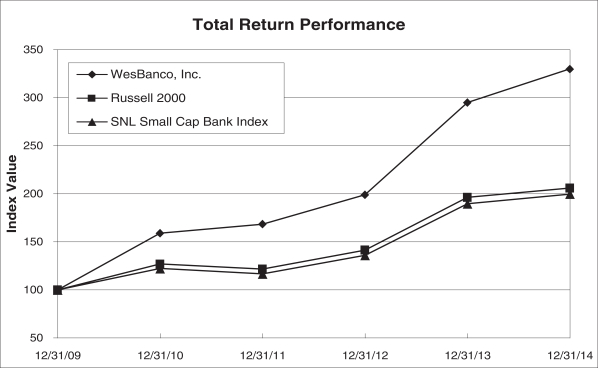
| Period Ending | ||||||||||||||||||||||||
|
Index |
12/31/09 | 12/31/10 | 12/31/11 | 12/31/12 | 12/31/13 | 12/31/14 | ||||||||||||||||||
|
WesBanco, Inc. |
100.00 | 158.89 | 168.44 | 198.98 | 294.96 | 329.84 | ||||||||||||||||||
|
Russell 2000 |
100.00 | 126.86 | 121.56 | 141.43 | 196.34 | 205.95 | ||||||||||||||||||
|
SNL Small Cap Bank Index |
100.00 | 122.16 | 116.68 | 135.91 | 189.56 | 199.80 | ||||||||||||||||||
25
Table of Contents
| ITEM 6. | SELECTED FINANCIAL DATA |
The following consolidated selected financial data is derived from WesBanco’s audited financial statements as of and for the five years ended December 31, 2014. The following consolidated financial data should be read in conjunction with Management’s Discussion and Analysis of Financial Condition and Results of Operations (“MD&A”) and the Consolidated Financial Statements and related notes included elsewhere in this report. WesBanco’s acquisitions during the five years ended December 31, 2014 include Fidelity on November 30, 2012 and include the results of operations since the date of acquisition.
| For the years ended December 31, | ||||||||||||||||||||
|
(dollars in thousands, except shares and per share amounts) |
2014 | 2013 | 2012 | 2011 | 2010 | |||||||||||||||
|
PER COMMON SHARE INFORMATION |
||||||||||||||||||||
|
Earnings per common share—basic |
$ | 2.39 | $ | 2.18 | $ | 1.84 | $ | 1.65 | $ | 1.34 | ||||||||||
|
Earnings per common share—diluted |
2.39 | 2.18 | 1.84 | 1.65 | 1.34 | |||||||||||||||
|
Dividends declared per common share |
0.88 | 0.78 | 0.70 | 0.62 | 0.56 | |||||||||||||||
|
Book value at year end |
26.90 | 25.59 | 24.45 | 23.80 | 22.83 | |||||||||||||||
|
Tangible book value at year end (1) |
16.09 | 14.68 | 13.48 | 13.29 | 12.24 | |||||||||||||||
|
Average common shares outstanding—basic |
29,249,499 | 29,270,922 | 26,867,227 | 26,614,697 | 26,579,735 | |||||||||||||||
|
Average common shares outstanding—diluted |
29,333,876 | 29,344,683 | 26,888,847 | 26,615,281 | 26,580,293 | |||||||||||||||
|
SELECTED BALANCE SHEET INFORMATION |
||||||||||||||||||||
|
Securities |
$ | 1,511,094 | $ | 1,532,906 | $ | 1,623,753 | $ | 1,609,265 | $ | 1,426,191 | ||||||||||
|
Loans held for sale |
5,865 | 5,855 | 21,903 | 6,084 | 10,800 | |||||||||||||||
|
Net portfolio loans |
4,042,112 | 3,847,549 | 3,635,063 | 3,184,558 | 3,227,625 | |||||||||||||||
|
Total assets |
6,296,565 | 6,144,773 | 6,078,717 | 5,536,030 | 5,361,458 | |||||||||||||||
|
Deposits |
5,048,983 | 5,062,530 | 4,944,284 | 4,393,866 | 4,172,423 | |||||||||||||||
|
Total FHLB and other borrowings |
303,816 | 190,044 | 254,158 | 365,073 | 440,991 | |||||||||||||||
|
Junior subordinated debt owed to unconsolidated subsidiary trusts |
106,176 | 106,137 | 113,832 | 106,066 | 106,034 | |||||||||||||||
|
Shareholders’ equity |
788,190 | 746,595 | 714,184 | 633,790 | 606,863 | |||||||||||||||
|
SELECTED RATIOS |
||||||||||||||||||||
|
Return on average assets |
1.12 | % | 1.05 | % | 0.88 | % | 0.81 | % | 0.66 | % | ||||||||||
|
Return on average tangible assets (1) |
1.20 | 1.13 | 0.96 | 0.88 | 0.73 | |||||||||||||||
|
Return on average equity |
8.97 | 8.72 | 7.54 | 7.01 | 5.88 | |||||||||||||||
|
Return on average tangible equity (1) |
15.39 | 15.79 | 13.57 | 13.18 | 11.56 | |||||||||||||||
|
Net interest margin (3) |
3.61 | 3.58 | 3.53 | 3.66 | 3.60 | |||||||||||||||
|
Efficiency ratio (1) |
59.59 | 60.99 | 60.98 | 59.50 | 60.81 | |||||||||||||||
|
Average loans to average deposits |
76.89 | 75.28 | 74.15 | 76.32 | 82.14 | |||||||||||||||
|
Allowance for loan losses to total loans |
1.09 | 1.22 | 1.43 | 1.69 | 1.86 | |||||||||||||||
|
Allowance for loan losses to total non-performing loans |
87.76 | 91.99 | 82.79 | 63.07 | 63.39 | |||||||||||||||
|
Non-performing assets to total assets |
0.89 | 0.92 | 1.15 | 1.62 | 1.95 | |||||||||||||||
|
Net loan charge-offs to average loans |
0.23 | 0.38 | 0.66 | 1.30 | 1.28 | |||||||||||||||
|
Average shareholders’ equity to average assets |
12.48 | 12.00 | 11.71 | 11.49 | 11.18 | |||||||||||||||
|
Tangible equity to tangible assets (1) |
7.88 | 7.35 | 6.84 | 6.73 | 6.40 | |||||||||||||||
|
Tier 1 leverage ratio |
9.88 | 9.27 | 9.34 | 8.71 | 8.35 | |||||||||||||||
|
Tier 1 capital to risk-weighted assets |
13.76 | 13.06 | 12.82 | 12.68 | 11.94 | |||||||||||||||
|
Total capital to risk-weighted assets |
14.81 | 14.19 | 14.07 | 13.93 | 13.20 | |||||||||||||||
|
Dividend payout ratio |
36.82 | 35.78 | 38.04 | 37.58 | 41.79 | |||||||||||||||
|
Trust assets at market value (2) |
$ | 3,840,540 | $ | 3,688,734 | $ | 3,238,556 | $ | 2,973,352 | $ | 2,943,786 | ||||||||||
| (1) | See non-GAAP Measures with this “Item 6. Selected Financial Data” for additional information relating to the calculation of this item. |
| (2) | Trust assets are held by the Bank, in fiduciary or agency capacities for its customers and therefore are not included as assets on WesBanco’s Consolidated Balance Sheets. |
| (3) | Presented on a fully taxable-equivalent (FTE) and annualized basis. The FTE basis adjusts for the tax benefit of income on certain tax-exempt loans and investments using the federal statutory tax rate of 35% for each period presented. WesBanco believes this measure to be the preferred industry measurement of net interest income and provides relevant comparison between taxable and non-taxable amounts. |
26
Table of Contents
| For the years ended December 31, | ||||||||||||||||||||
|
(dollars in thousands, except per share amounts) |
2014 | 2013 | 2012 | 2011 | 2010 | |||||||||||||||
|
SUMMARY STATEMENTS OF INCOME |
||||||||||||||||||||
|
Interest and dividend income |
$ | 215,991 | $ | 217,890 | $ | 211,686 | $ | 224,167 | $ | 236,528 | ||||||||||
|
Interest expense |
22,763 | 32,403 | 43,335 | 54,802 | 70,436 | |||||||||||||||
|
|
|
|
|
|
|
|
|
|
|
|||||||||||
|
Net interest income |
193,228 | 185,487 | 168,351 | 169,365 | 166,092 | |||||||||||||||
|
Provision for credit losses |
6,405 | 9,086 | 19,874 | 35,311 | 44,578 | |||||||||||||||
|
|
|
|
|
|
|
|
|
|
|
|||||||||||
|
Net interest income after provision for credit losses |
186,823 | 176,401 | 148,477 | 134,054 | 121,514 | |||||||||||||||
|
Non-interest income |
68,504 | 69,285 | 64,775 | 59,888 | 59,599 | |||||||||||||||
|
Non-interest expense |
161,633 | 160,998 | 150,120 | 140,295 | 141,152 | |||||||||||||||
|
|
|
|
|
|
|
|
|
|
|
|||||||||||
|
Income before provision for income taxes |
93,694 | 84,688 | 63,132 | 53,647 | 39,961 | |||||||||||||||
|
Provision for income taxes |
23,720 | 20,763 | 13,588 | 9,838 | 4,350 | |||||||||||||||
|
|
|
|
|
|
|
|
|
|
|
|||||||||||
|
Net income |
$ | 69,974 | $ | 63,925 | $ | 49,544 | $ | 43,809 | $ | 35,611 | ||||||||||
|
|
|
|
|
|
|
|
|
|
|
|||||||||||
|
Earnings per common share—basic |
$ | 2.39 | $ | 2.18 | $ | 1.84 | $ | 1.65 | $ | 1.34 | ||||||||||
|
|
|
|
|
|
|
|
|
|
|
|||||||||||
|
Earnings per common share—diluted |
$ | 2.39 | $ | 2.18 | $ | 1.84 | $ | 1.65 | $ | 1.34 | ||||||||||
|
|
|
|
|
|
|
|
|
|
|
|||||||||||
Non-GAAP Measures
The following non-GAAP financial measures used by WesBanco provide information that WesBanco believes is useful to investors in understanding WesBanco’s operating performance and trends, and facilitates comparisons with the performance of WesBanco’s peers. The following tables summarize the non-GAAP financial measures derived from amounts reported in WesBanco’s financial statements.
| For the years ended December 31, | ||||||||||||||||||||
|
(dollars in thousands) |
2014 | 2013 | 2012 | 2011 | 2010 | |||||||||||||||
|
Tangible equity to tangible assets: |
||||||||||||||||||||
|
Total shareholders’ equity |
$ | 788,190 | $ | 746,595 | $ | 714,184 | $ | 633,790 | $ | 606,863 | ||||||||||
|
Less: goodwill and other intangible assets, net of deferred tax liability |
(316,914 | ) | (318,161 | ) | (320,399 | ) | (279,967 | ) | (281,534 | ) | ||||||||||
|
|
|
|
|
|
|
|
|
|
|
|||||||||||
|
Tangible equity |
471,276 | 428,434 | 393,785 | 353,823 | 325,329 | |||||||||||||||
|
Total assets |
6,296,565 | 6,144,773 | 6,078,717 | 5,536,030 | 5,361,458 | |||||||||||||||
|
Less: goodwill and other intangible assets, net of deferred tax liability |
(316,914 | ) | (318,161 | ) | (320,399 | ) | (279,967 | ) | (281,534 | ) | ||||||||||
|
|
|
|
|
|
|
|
|
|
|
|||||||||||
|
Tangible assets |
5,979,651 | 5,826,612 | 5,758,318 | 5,256,063 | 5,079,924 | |||||||||||||||
|
|
|
|
|
|
|
|
|
|
|
|||||||||||
|
Tangible equity to tangible assets |
7.88 | % | 7.35 | % | 6.84 | % | 6.73 | % | 6.40 | % | ||||||||||
|
|
|
|
|
|
|
|
|
|
|
|||||||||||
|
Tangible book value: |
||||||||||||||||||||
|
Total shareholders’ equity |
$ | 788,190 | $ | 746,595 | $ | 714,184 | $ | 633,790 | $ | 606,863 | ||||||||||
|
Less: goodwill and other intangible assets, net of deferred tax liability |
(316,914 | ) | (318,161 | ) | (320,399 | ) | (279,967 | ) | (281,534 | ) | ||||||||||
|
|
|
|
|
|
|
|
|
|
|
|||||||||||
|
Tangible equity |
471,276 | 428,434 | 393,785 | 353,823 | 325,329 | |||||||||||||||
|
Common shares outstanding |
29,298,188 | 29,175,236 | 29,214,660 | 26,629,360 | 26,586,953 | |||||||||||||||
|
|
|
|
|
|
|
|
|
|
|
|||||||||||
|
Tangible book value at year end |
$ | 16.09 | $ | 14.68 | $ | 13.48 | $ | 13.29 | $ | 12.24 | ||||||||||
|
|
|
|
|
|
|
|
|
|
|
|||||||||||
|
Return on average tangible equity: |
||||||||||||||||||||
|
Net income |
$ | 69,974 | $ | 63,925 | $ | 49,544 | $ | 43,809 | $ | 35,611 | ||||||||||
|
Plus: amortization of intangibles, net of tax |
1,248 | 1,487 | 1,398 | 1,566 | 1,774 | |||||||||||||||
|
|
|
|
|
|
|
|
|
|
|
|||||||||||
|
Net income before amortization of intangibles |
71,222 | 65,412 | 50,942 | 45,375 | 37,385 | |||||||||||||||
|
Average total shareholders’ equity |
780,423 | 733,249 | 656,684 | 625,061 | 605,742 | |||||||||||||||
|
Less: average goodwill and other intangibles, net of deferred tax liability |
(317,523 | ) | (318,913 | ) | (281,326 | ) | (280,718 | ) | (282,389 | ) | ||||||||||
|
|
|
|
|
|
|
|
|
|
|
|||||||||||
|
Average tangible equity |
462,900 | 414,336 | 375,358 | 344,343 | 323,353 | |||||||||||||||
|
|
|
|
|
|
|
|
|
|
|
|||||||||||
|
Return on average tangible equity |
15.39 | % | 15.79 | % | 13.57 | % | 13.18 | % | 11.56 | % | ||||||||||
|
|
|
|
|
|
|
|
|
|
|
|||||||||||
27
Table of Contents
| For the years ended December 31, | ||||||||||||||||||||
|
(dollars in thousands) |
2014 | 2013 | 2012 | 2011 | 2010 | |||||||||||||||
|
Return on average tangible assets: |
||||||||||||||||||||
|
Net income |
$ | 69,974 | $ | 63,925 | $ | 49,544 | $ | 43,809 | $ | 35,611 | ||||||||||
|
Plus: amortization of intangibles, net of tax |
1,248 | 1,487 | 1,398 | 1,566 | 1,774 | |||||||||||||||
|
|
|
|
|
|
|
|
|
|
|
|||||||||||
|
Net income before amortization of intangibles |
71,222 | 65,412 | 50,942 | 45,375 | 37,385 | |||||||||||||||
|
Average total assets |
6,253,253 | 6,109,311 | 5,606,386 | 5,440,243 | 5,416,470 | |||||||||||||||
|
Less: average goodwill and other intangibles, net of deferred tax liability |
(317,523 | ) | (318,913 | ) | (281,326 | ) | (280,718 | ) | (282,389 | ) | ||||||||||
|
|
|
|
|
|
|
|
|
|
|
|||||||||||
|
Average tangible assets |
5,935,730 | 5,790,398 | 5,325,060 | 5,159,525 | 5,134,081 | |||||||||||||||
|
|
|
|
|
|
|
|
|
|
|
|||||||||||
|
Return on average tangible assets |
1.20 | % | 1.13 | % | 0.96 | % | 0.88 | % | 0.73 | % | ||||||||||
|
|
|
|
|
|
|
|
|
|
|
|||||||||||
|
Efficiency Ratio |
||||||||||||||||||||
|
Non-interest expense |
$ | 161,633 | $ | 160,998 | $ | 150,120 | $ | 140,295 | $ | 141,152 | ||||||||||
|
Less: restructuring and merger-related expense |
(1,309 | ) | (1,310 | ) | (3,888 | ) | — | (175 | ) | |||||||||||
|
|
|
|
|
|
|
|
|
|
|
|||||||||||
|
Non-interest expense excluding restructuring and merger-related expense |
160,324 | 159,688 | 146,232 | 140,295 | 140,977 | |||||||||||||||
|
Net interest income on a fully taxable equivalent basis |
200,545 | 192,556 | 175,027 | 175,885 | 172,235 | |||||||||||||||
|
Non-interest income |
68,504 | 69,285 | 64,775 | 59,888 | 59,599 | |||||||||||||||
|
|
|
|
|
|
|
|
|
|
|
|||||||||||
|
Net interest income on a fully taxable equivalent basis plus non-interest income |
269,049 | 261,841 | 239,802 | 235,773 | 231,834 | |||||||||||||||
|
|
|
|
|
|
|
|
|
|
|
|||||||||||
|
Efficiency Ratio |
59.59 | % | 60.99 | % | 60.98 | % | 59.50 | % | 60.81 | % | ||||||||||
|
|
|
|
|
|
|
|
|
|
|
|||||||||||
28
Table of Contents
| ITEM 7. | MANAGEMENT’S DISCUSSION AND ANALYSIS OF FINANCIAL CONDITION AND RESULTS OF OPERATIONS |
Management’s Discussion and Analysis represents an overview of the results of operations and financial condition of WesBanco. This discussion and analysis should be read in conjunction with the Consolidated Financial Statements and Notes thereto.
FORWARD-LOOKING STATEMENTS
Forward-looking statements in this report relating to WesBanco’s plans, strategies, objectives, expectations, intentions and adequacy of resources, are made pursuant to the safe harbor provisions of the Private Securities Litigation Reform Act of 1995. The information contained in this report should be read in conjunction with WesBanco’s Form 10-Qs for the prior quarters ended March 31, 2014, June 30, 2014 and September 30, 2014, respectively, and documents subsequently filed by WesBanco which are available at the SEC’s website, www.sec.gov or at WesBanco’s website, www.wesbanco.com. Investors are cautioned that forward-looking statements, which are not historical fact, involve risks and uncertainties, including those detailed under “Risk Factors” in Part I, Item 1A of this Annual Report on Form 10-K. Such statements are subject to important factors that could cause actual results to differ materially from those contemplated by such statements, including, without limitation, that the businesses of WesBanco and ESB may not be integrated successfully or such integration may take longer to accomplish than expected; the expected cost savings and any revenue synergies from the merger of WesBanco and ESB may not be fully realized within the expected timeframes; disruption from the merger of WesBanco and ESB may make it more difficult to maintain relationships with clients, associates, or suppliers; the effects of changing regional and national economic conditions; changes in interest rates, spreads on earning assets and interest-bearing liabilities, and associated interest rate sensitivity; sources of liquidity available to WesBanco and its related subsidiary operations; potential future credit losses and the credit risk of commercial, real estate, and consumer loan customers and their borrowing activities; actions of the Federal Reserve Board, the FDIC, the SEC, FINRA, the Municipal Securities Rulemaking Board, the Securities Investors Protection Corporation, and other regulatory bodies; potential legislative and federal and state regulatory actions and reform, including, without limitation, the impact of the implementation of the Dodd-Frank Act; adverse decisions of federal and state courts; fraud, scams and schemes of third parties; internet hacking; competitive conditions in the financial services industry; rapidly changing technology affecting financial services; marketability of debt instruments and corresponding impact on fair value adjustments; and/or other external developments materially impacting WesBanco’s operational and financial performance. WesBanco does not assume any duty to update forward-looking statements.
APPLICATION OF CRITICAL ACCOUNTING POLICIES AND ESTIMATES
WesBanco’s Consolidated Financial Statements are prepared in accordance with GAAP and follow general practices within the industries in which it operates. Application of these principles requires management to make estimates, assumptions and judgments that affect the amounts reported in the financial statements and accompanying notes. These estimates, assumptions and judgments are based on information available as of the date of the financial statements; accordingly, as this information changes, the financial statements could reflect different estimates, assumptions and judgments. Certain policies inherently have a greater reliance on the use of estimates, assumptions and judgments and as such have a greater possibility of producing results that could be materially different than originally reported.
The most significant accounting policies followed by WesBanco are included in Note 1, “Summary of Significant Accounting Policies,” of the Consolidated Financial Statements. These policies, along with other Notes to the Consolidated Financial Statements and this MD&A, provide information on how significant assets and liabilities are valued in the financial statements and how those values are determined. Management has identified the allowance for loan losses and the evaluation of goodwill and other intangible assets for impairment to be the accounting estimates that require the most subjective or complex judgments, and as such could be most subject to revision as new information becomes available.
29
Table of Contents
Allowance for Credit Losses— The allowance for credit losses represents management’s estimate of probable losses inherent in the loan portfolio and in future advances against loan commitments. Determining the amount of the allowance requires significant judgment about the collectability of loans and the factors that deserve consideration in estimating probable credit losses. The allowance is increased by a provision charged to operating expense and reduced by charge-offs, net of recoveries. Management evaluates the adequacy of the allowance at least quarterly. This evaluation is inherently subjective as it requires material estimates that may be susceptible to significant change from period to period.
The evaluation includes an assessment of quantitative factors such as actual loss experience within each category of loans and testing of certain loans for impairment. The evaluation also considers qualitative factors such as economic trends and conditions, which includes levels of unemployment, real estate values and the impact on specific industries and geographical markets, changes in lending policies and underwriting standards, delinquency and other credit quality trends, concentrations of credit risk, if any, the results of internal loan reviews and examinations by bank regulatory agencies, the volatility of historical loss rates, the velocity of changes in historical loss rates, and regulatory guidance pertaining to the allowance for credit losses. Management relies on observable data from internal and external sources to the extent it is available to evaluate each of these factors and adjusts the actual historical loss rates to reflect the impact these factors may have on probable losses in the portfolio.
Commercial real estate and commercial and industrial loans greater than $1 million that are reported as non-accrual or a troubled debt restructuring (“TDR”) are tested individually for impairment. Specific reserves are established when appropriate for such loans based on the present value of expected future cash flows of the loan or the estimated realizable value of the collateral, if any.
General reserves are established for loans that are not individually tested for impairment based on historical loss rates adjusted for the impact of the qualitative factors discussed above. Historical loss rates for commercial real estate and commercial and industrial loans are determined for each internal risk grade or group of pass grades using a migration analysis that categorizes each charged-off loan based on its risk grade twelve months prior to the charge-off. Historical loss rates for commercial real estate land and construction, residential real estate, home equity and consumer loans that are not risk graded are determined for the total of each category of loans. Historical loss rates for deposit account overdrafts are based on actual losses in relation to average overdrafts for the period.
Management has determined that the greater of the most recent twelve or thirty-six month historical loss rate is generally the most indicative of probable losses in the portfolio because the twelve month loss rate more accurately reflects the adverse impact of current conditions during periods of economic stress while the thirty-six month loss rate more accurately reflects probable losses during normal economic cycles. Historical loss rates for longer periods than thirty-six months may not be as meaningful because of changes in the risk profile and characteristics of the portfolio that can occur over longer periods of time. However, management does evaluate historical loss rates for periods longer than thirty-six months to give adequate consideration to the longer economic cycle and its impact on probable losses in the current period.
Management may also adjust its assumptions to account for differences between estimated and actual incurred losses from period to period. The variability of management’s assumptions could alter the level of the allowance for credit losses and may have a material impact on future results of operations and financial condition. The loss estimation models and methods used to determine the allowance for credit losses are continually refined and enhanced; however, there have been no material substantive changes compared to prior periods.
Goodwill and Other Intangible Assets— WesBanco accounts for business combinations using the acquisition method of accounting. Accordingly, the identifiable assets acquired, the liabilities assumed, and any non-controlling interest of an acquired business are recorded at their estimated fair values as of the date of
30
Table of Contents
acquisition with any excess of the cost of the acquisition over the fair value recorded as goodwill. At December 31, 2014, the carrying value of goodwill and other intangible assets was $312.1 million and $7.4 million, respectively, which represents approximately 39.6% and 0.9% of total shareholders’ equity, respectively. At December 31, 2014, WesBanco had one significant reporting unit with goodwill, community banking.
WesBanco evaluated goodwill for impairment by performing the two-step goodwill impairment test. WesBanco uses market capitalization, multiples of tangible book value, a discounted cash flow model, and various other market-based methods to estimate the current fair value of its reporting units. In particular, the discounted cash flow model includes various assumptions regarding an investors’ required rate of return on WesBanco common stock, future loan loss provisions, future net interest margins, along with various growth and economic recovery and stabilization assumptions of the economy as a whole. The resulting fair values of each method are then weighted based on the relevance and reliability of each respective method in light of the current economic environment to arrive at a weighted average fair value. The evaluation also considered macroeconomic conditions such as the general economic outlook, regional and national unemployment rates and recent trends in equity and credit markets. Additionally, industry and market considerations, such as market-dependent multiples and metrics relative to peers, were evaluated. WesBanco also considered recent trends in credit quality, overall financial performance, stock price appreciation, internal forecasts and various other market-based methods to estimate the current fair value of its reporting units.
WesBanco concluded that goodwill at the reporting units was not impaired as of November 30, 2014 and determined that goodwill was not impaired as of December 31, 2014 as there were no significant changes in market conditions, consolidated operating results, or forecasted future results from November 30, 2014, the date of the most recent goodwill impairment evaluation.
Intangible assets with finite useful lives (primarily core deposit and customer list intangibles) are evaluated for impairment whenever events or changes in circumstances indicate that their carrying amount may not be recoverable. An impairment loss is recognized when the carrying amount of an intangible asset with a finite useful life is not recoverable from its undiscounted cash flows and is measured as the difference between the carrying amount and the fair value of the asset. Intangible assets with finite useful lives at December 31, 2014 are comprised of $7.2 million in core deposit intangibles held at the Bank and customer list intangibles of $0.2 million held at WesBanco Securities. At December 31, 2014 there were no indicators of impairment related to intangible assets with finite useful lives.
EXECUTIVE OVERVIEW
In 2014, for the fifth consecutive year, financial performance improved as WesBanco continued to achieve loan growth, enhance efficiency through reduced costs, increase the net interest margin through better funding structures and expand our presence within the communities we serve. In addition, on February 10, 2015, WesBanco completed the acquisition of ESB Financial Corporation (“ESB”), a Pennsylvania thrift holding company based in Ellwood City, Pennsylvania with $1.9 billion in assets and 23 branches. The transaction expanded WesBanco’s franchise in the Pittsburgh and western Pennsylvania region. Post-acquisition, WesBanco operates through 143 offices and 130 ATMs with total assets of approximately $8.3 billion.
Net income increased $6.0 million or 10% to $70.0 million. Net interest income improved $7.7 million or 4.2%, primarily through higher average loan balances and lower funding costs as higher cost certificates of deposits and other borrowings were replaced with lower cost demand and money market deposits and short term FHLB borrowings. Continued improvement in credit quality reduced the provision for credit losses by $2.7 million. Growth was achieved in certain categories of non-interest income: trust fees increased $1.5 million, electronic banking fees increased $0.5 million and securities brokerage operations increased $0.7 million. However, service charges on deposits declined $1.8 million through reduced overdraft fees as customers retained higher demand account balances, and gains on sales of mortgages decreased due to a slower housing market and a greater percentage of originated loans held for investment. Net gains / losses on other assets included a third quarter charge of $1.4 million to prepay a higher-rate repurchase agreement with another bank to reduce funding
31
Table of Contents
costs. Increases in expenses of only 0.4% were due to costs related to the opening of three branches and infrastructure enhancements, primarily in the last six quarters, and other growth areas such as trust and securities brokerage offset by lower employee benefits and communication expenses. Due to the increase in net income, return on average assets increased to 1.12% from 1.05% in 2013. Strong earnings and improved total capital have enabled WesBanco to increase the quarterly dividend rate, at $0.22 per share for the fourth quarter, seven times over the last four years, cumulatively representing a 57% increase, with a 2014 increase of 10%. The dividend was increased again in February 2015 to $0.23 per share, a $0.01 per share or 5% increase to be paid April 1, 2015.
Total assets at December 31, 2014 increased 2.5% or $151.8 million from December 31, 2013, primarily due to loan growth. Portfolio loans increased $191.8 million or 4.9% in 2014, achieved through $1.4 billion in loan originations. Loan growth was driven by increased business activity, additional lending personnel, focused marketing efforts, an expanded presence in our larger urban markets, and continued improvement in loan origination processes. Deposits, excluding CDs, increased $192.8 million or 5.4% from December 31, 2013, with deposits for Marcellus and Utica shale gas contributing to the increase. All deposit types increased except certificates of deposit, which decreased $206.4 million due to lower rate offerings for maturing CDs and customers preference for other deposit types. Borrowings increased $113.8 million primarily due to increases in low-rate short-term FHLB borrowings, partially offset by reduced balances of longer-term higher-rate borrowings.
WesBanco continues to maintain strong regulatory capital ratios. At December 31, 2014, tier I leverage was 9.88%, tier I risk-based capital was 13.76%, and total risk-based capital was 14.81%, all of which improved from December 31, 2013. Both consolidated and bank-level regulatory capital ratios are well above the applicable “well-capitalized” standards promulgated by bank regulators, as well as the recently finalized fully-implemented BASEL III capital standards. Total tangible equity to tangible assets (1) was 7.88% at December 31, 2014, increasing from 7.35% at December 31, 2013.
WesBanco had numerous operating accomplishments in 2014 that supported the improved financial results for the year:
| • |
The ESB acquisition was the largest in our history. We are now the 10 th largest full service financial institution in western Pennsylvania, which is also our largest market area. We anticipate the ESB customer account and operational integrations will be completed in late April, 2015. |
| • |
Throughout 2014 WesBanco continued to expand customer relationship personnel to support further growth in loan production and improve service to our customers. |
| • |
In November, we opened a new $4.5 million banking center in Southpointe, Pennsylvania. The 4,000 square foot two story facility is located at Southpointe Town Center, a retail and commercial mixed-use development south of Pittsburgh. |
| • |
As our customers rapidly move toward mobile payments as a preferred purchase option, we announced in late-2014 that WesBanco was one of the first 30 banks in the country to integrate with Apple Pay. WesBanco debit cards can now combine with Apple’s seamlessly integrated hardware, software and services to create a unique and incredibly intuitive purchase experience. |
Enhancement of the products and processes that support customers and employees expands WesBanco’s growth opportunities.
| (1) | See non-GAAP Measures within Item 6. “Selected Financial Data” for additional information relating to the calculation of this item. |
32
Table of Contents
RESULTS OF OPERATIONS
EARNINGS SUMMARY
Net income increased 10% for the twelve months ended December 31, 2014, to $70.0 million compared to $63.9 million for 2013, while diluted earnings per share were $2.39, an increase of 10% compared to $2.18 per share for 2013. The increased net income improved the return on average assets to 1.12% in 2014 from 1.05% in 2013. Return on assets and return on tangible equity for WesBanco remain well above third quarter 2014 peer group averages, the most recent available.
Net interest income increased $7.7 million or 4.2% in 2014 compared to 2013 due to a 3.1% increase in average earning assets, primarily through a 4.8% increase in average loan balances, and improvement in the net interest margin. Growth in net interest income has been very consistent. The net interest margin improved by 3 basis points to 3.61% in 2014 compared to 3.58% in 2013. Accretion of various purchase accounting adjustments from a 2012 acquisition benefited the net interest margin throughout 2013 and 2014, but at a decreasing rate. Excluding this benefit from both years, the net interest margin increased by 8 basis points from 3.49% in 2013 to 3.57% in 2014. The improved net interest margin in the current low interest rate environment resulted partially from the aforementioned loan growth as the average rate on loans is higher than the average rate on securities. In addition, funding costs continued to decrease in 2014 as a result of a 9.4% increase in lower-cost demand, money market and savings account deposits, while higher-cost CDs decreased by 11.8%. The average rate on CDs declined by 43 basis points as higher rate CDs matured. In addition, a 29.2% reduction in higher-rate average other borrowings improved funding costs through the prepayment of a higher-rate $22.0 million repurchase agreement with another bank in the third quarter, and through maturities. Overall, average deposits increased by 2.6% in 2014 compared to 2013.
Credit quality has continued to improve over the past year. Total non-performing loans, including TDRs, decreased 1.2% from December 31, 2013 to $50.9 million, while criticized and classified loans decreased 40.2% over the last twelve months to $81.1 million at December 31, 2014. Net charge-offs for 2014 were $9.3 million or 0.23% of average portfolio loans compared to $14.2 million or 0.38% in 2013. Lower charge-offs and continued improvement in delinquent, non-performing and classified and criticized loans resulted in a provision for credit losses of $6.4 million in 2014 compared to $9.1 million in 2013. The allowance for loan losses represented 1.09% of total portfolio loans at December 31, 2014, compared to 1.22% at the end of 2013.
For 2014, non-interest income decreased $0.8 million or 1.1% compared to 2013. The third quarter of 2014 included a $1.4 million charge related to the prepayment of the repurchase agreement. Non-interest income, excluding this charge, increased $0.6 million or 0.9% for the year. Trust fees increased 7.6% for the year as assets under management continued to increase from customer development initiatives and overall market improvements. Total trust assets were $3.8 billion at December 31, 2014, representing an increase of 4.1% from $3.7 billion at December 31, 2013. Net securities brokerage revenues increased $0.7 million or 10.8%, due to significant production increases from the addition of support and sales staff in several regions, as well as an increase in referrals and production from a licensed retail banker program. Service charges on deposits decreased 10.0% compared to 2013 due to lower overdraft fees that are affected by consistent increases in deposit levels and higher average deposits per account. Mortgage loan sale gains decreased 38.6% as the weak housing market reduced mortgage demand resulting in lower mortgage activity, which was also impacted by the new 2014 Qualified Mortgage and Ability-to-Repay rules, somewhat limiting the Bank’s product offerings.
In 2014, revenue growth outpaced expense growth and as a result, the efficiency ratio improved to 59.6% for 2014 from 61.0% in 2013. Non-interest expense increased $0.6 million or only 0.4% for 2014 compared to 2013. Salaries and wages increased 3.0%, due to routine annual adjustments to compensation, increased commissions on higher brokerage revenue and incentive and stock-related compensation granted in 2014, partially offset by lower average full time employees (“FTEs”). In 2014, employee benefits expense decreased 7.5%, primarily from decreased pension and other benefits expense, partially offset by higher health insurance costs. In addition, net occupancy and equipment expense increased due to higher weather-related expenses, the opening of three branches over the last five quarters and investment in internal infrastructure in the second half of
33
Table of Contents
last year. These decreases were offset by increased other expenses of $1.0 million primarily due to customer fraud losses recognized totaling $0.6 million, increased franchise taxes and other miscellaneous fees and costs, partially offset by reduced communication expenses.
The provision for federal and state income taxes increased to $23.7 million in 2014 compared to $20.8 million in 2013. The increase in income tax expense was due to a $9.0 million increase in pre-tax income, which caused a higher effective tax rate of 25.3% compared to 24.5% for 2013.
TABLE 1. NET INTEREST INCOME
| For the years ended December 31, | ||||||||||||
|
(dollars in thousands) |
2014 | 2013 | 2012 | |||||||||
|
Net interest income |
$ | 193,228 | $ | 185,487 | $ | 168,351 | ||||||
|
Taxable-equivalent adjustments to net interest income |
7,317 | 7,069 | 6,676 | |||||||||
|
|
|
|
|
|
|
|||||||
|
Net interest income, fully taxable-equivalent |
$ | 200,545 | $ | 192,556 | $ | 175,027 | ||||||
|
|
|
|
|
|
|
|||||||
|
Net interest spread, non-taxable-equivalent |
3.37 | % | 3.32 | % | 3.23 | % | ||||||
|
Benefit of net non-interest bearing liabilities |
0.11 | % | 0.13 | % | 0.17 | % | ||||||
|
|
|
|
|
|
|
|||||||
|
Net interest margin |
3.48 | % | 3.45 | % | 3.40 | % | ||||||
|
Taxable-equivalent adjustment |
0.13 | % | 0.13 | % | 0.13 | % | ||||||
|
|
|
|
|
|
|
|||||||
|
Net interest margin, fully taxable-equivalent |
3.61 | % | 3.58 | % | 3.53 | % | ||||||
|
|
|
|
|
|
|
|||||||
Net interest income, which is WesBanco’s largest source of revenue, is the difference between interest income on earning assets, primarily loans and securities, and interest expense on liabilities (deposits and short and long-term borrowings). Net interest income is affected by the general level and changes in interest rates, the steepness and shape of the yield curve, changes in the amount and composition of interest earning assets and interest bearing liabilities, as well as the frequency of repricing of those assets and liabilities. Net interest income increased by $7.7 million or 4.2% in 2014 compared to 2013 due to a 3.1% increase in average earning assets, primarily through increased average loan balances and an improvement in the net interest margin. Growth in net interest income has been consistent, with the fourth quarter of 2014 being the sixth consecutive quarter that net interest income has increased. Average earning assets increased $168.3 million in 2014 due to growth in average portfolio loan balances of $181.7 million or 4.8%. The increase in average earning assets was funded primarily by increases in average deposits and short-term borrowings. Total average deposits increased by $131.8 million or 2.6%. These increases occurred primarily in demand deposit, savings and money market accounts, and resulted from marketing campaigns, customer incentives, wealth management and business initiatives, as well as from Marcellus and Utica shale gas bonus and royalty payments. In addition, the net interest margin increased 3 basis points to 3.61% in 2014 compared to 3.58% in 2013. Accretion of purchase accounting adjustments from a 2012 acquisition benefited the net interest margin throughout 2013 and 2014, but at a decreasing rate. Excluding this benefit from both years, the net interest margin increased by 8 basis points from 2013. The improved net interest margin in the current low interest rate environment resulted partially from the aforementioned loan growth as the average rate on loans is higher than the average rate on securities. The cost of funds improved significantly in 2014 due to lower offered rates, declining average balances on certificates of deposit, an increase in balances of lower-cost products and lower average balances of certain other borrowings. The low interest rate environment continues to result in reduced rates earned on the securities and loan portfolios, but with a larger decrease in lower average rates paid on interest bearing liabilities. The average rate on interest bearing liabilities declined by 21 basis points while the rate on earning assets decreased by 16 basis points in 2014.
Interest income decreased in 2014 by $1.9 million or 0.9% compared to 2013 due primarily to a 30 basis point decrease in loan yields which was mitigated by higher average loan balances and increases in interest income on securities and other interest income. The decrease in loan yields was from reduced rates on new and repriced assets due to the necessity of offering lower rates on quality credits in an increasingly competitive and
34
Table of Contents
low interest rate environment. Even with the decrease in loan yields, loans offer the highest rates for investment in earning assets. In 2014, average loans represented 71.2% of average earning assets compared to 70.1% in 2013. Total securities yields increased in 2014 by 4 basis points from 3.17% to 3.21% due to a greater reinvestment of funds from maturities, calls and paydowns into tax-exempt securities, which offer the highest yields within securities. Tax-exempt securities yields decreased 7 basis points in 2014 due to the aforementioned purchases of municipals at lower rates; however, because of their relative yield advantage, the average balance of tax-exempt securities increased 5.0% over last year and was 25.8% of total average securities in 2014 compared to 24.6% in 2013. Taxable securities yields increased 4 basis points in 2014, due in part to a decrease in amortization expense from lower prepayment speeds on mortgage-backed and collateralized mortgage securities. Average taxable securities decreased due to calls of taxable municipal securities and the prepayments in mortgage-backed and collateralized mortgage securities, somewhat offset by purchases of lower-premium collateralized mortgage securities and 10-15 year residential mortgage pools. Purchases of collateralized mortgage securities and shorter-term mortgage pools minimize the average life of the portfolio, particularly for the portion accounted for as available-for-sale, positioning the Bank for possible future increases in interest rates, while maintaining required levels of pledgeable securities.
Portfolio loans increased $191.8 million or 4.9% in 2014, as originations continued to outpace paydowns primarily from a 14.8% increase in C&I loans and a 15.9% increase in home equity lines of credit. Management’s objective for 2014 was to achieve net loan growth in primarily these two categories in order to reduce dependence on CRE loans and begin to better diversify the composition of the portfolio. Net loan growth was achieved through overall loan originations of $1.4 billion in 2014. Loan growth accelerated in the second half of the year to an annualized growth rate of 7.1% and was driven by increased business activity, additional lending personnel, focused marketing efforts, expanded presence in larger urban markets and continued improvement in loan origination processes.
In 2014, interest expense decreased $9.6 million or 29.8% due to decreases in rates paid, a continued shift in the liability mix towards less expensive sources of funding, and a 0.4% decrease in total average interest bearing balances. The average rate paid on interest bearing liabilities decreased 21 basis points to 0.52% from 0.73% in 2013. Rates paid on deposits were nearly unchanged in all categories except certificates of deposit, which declined by 43 basis points as a result of management reducing offered rates in the current low interest rate environment. Improvements in the deposit funding mix also lowered the cost of funds, with average certificates of deposit decreasing to 27.6% of total average deposits from 32.1% last year. Average interest bearing deposits increased by $8.3 million from 2013, and non-interest bearing demand deposits increased by $123.4 million. Average deposits increased most significantly in demand and money market product categories, even as offered rates on interest bearing accounts remained low. Total average demand deposits, including interest bearing and non-interest bearing, increased $164.7 million or 9.3% in 2014 compared to 2013. Average certificates of deposit decreased by 11.8% as WesBanco continued to focus on reducing rate offerings and growing customers with multiple banking relationships, as opposed to single service certificate of deposit customers. In addition, a 29.2% reduction in higher-rate average other borrowings improved funding costs through the $22.0 million prepayment of higher-rate repurchase agreements in the third quarter, and through maturities. Increased FHLB borrowings in 2014 were generally due to the utilization of new short-term low-rate FHLB borrowings to manage normal liquidity needs, reducing the average rate on FHLB borrowings by 66 basis points. Average total FHLB and other borrowings decreased $22.9 million or 11.1%, due to maturities and paydowns, and were 4.1% of average interest bearing liabilities in 2014 compared to 4.6% in 2013.
35
Table of Contents
TABLE 2. AVERAGE BALANCE SHEETS AND NET INTEREST MARGIN ANALYSIS
| For the years ended December 31, | ||||||||||||||||||||||||||||||||||||
| 2014 | 2013 | 2012 | ||||||||||||||||||||||||||||||||||
|
(dollars in thousands) |
Average
Balance |
Interest |
Average
Rate |
Average
Balance |
Interest |
Average
Rate |
Average
Balance |
Interest |
Average
Rate |
|||||||||||||||||||||||||||
|
ASSETS |
||||||||||||||||||||||||||||||||||||
|
Due from banks-interest bearing |
$ | 25,713 | $ | 60 | 0.23 | % | $ | 37,556 | $ | 84 | 0.22 | % | $ | 26,865 | $ | 68 | 0.25 | % | ||||||||||||||||||
|
Loans, net of unearned income (1) |
3,953,823 | 172,182 | 4.35 | % | 3,772,172 | 175,323 | 4.65 | % | 3,323,078 | 166,656 | 5.02 | % | ||||||||||||||||||||||||
|
Securities: (2) |
||||||||||||||||||||||||||||||||||||
|
Taxable |
1,158,738 | 29,233 | 2.52 | % | 1,175,865 | 29,193 | 2.48 | % | 1,270,446 | 32,461 | 2.56 | % | ||||||||||||||||||||||||
|
Tax-exempt (3) |
403,088 | 20,906 | 5.19 | % | 384,069 | 20,197 | 5.26 | % | 323,885 | 19,075 | 5.89 | % | ||||||||||||||||||||||||
|
|
|
|
|
|
|
|
|
|
|
|
|
|
|
|
|
|
|
|||||||||||||||||||
|
Total securities |
1,561,826 | 50,139 | 3.21 | % | 1,559,934 | 49,390 | 3.17 | % | 1,594,331 | 51,536 | 3.23 | % | ||||||||||||||||||||||||
|
Other earning assets (4) |
11,726 | 927 | 7.91 | % | 15,165 | 162 | 1.07 | % | 19,621 | 102 | 0.52 | % | ||||||||||||||||||||||||
|
|
|
|
|
|
|
|
|
|
|
|
|
|
|
|
|
|
|
|||||||||||||||||||
|
Total earning assets (3) |
5,553,088 | 223,308 | 4.02 | % | 5,384,827 | 224,959 | 4.18 | % | 4,963,895 | 218,362 | 4.40 | % | ||||||||||||||||||||||||
|
|
|
|
|
|
|
|
|
|
|
|
|
|
|
|
|
|
|
|||||||||||||||||||
|
Other assets |
700,165 | 724,484 | 642,491 | |||||||||||||||||||||||||||||||||
|
|
|
|
|
|
|
|||||||||||||||||||||||||||||||
|
Total Assets |
$ | 6,253,253 | $ | 6,109,311 | $ | 5,606,386 | ||||||||||||||||||||||||||||||
|
|
|
|
|
|
|
|||||||||||||||||||||||||||||||
|
LIABILITIES AND SHAREHOLDERS’ EQUITY |
||||||||||||||||||||||||||||||||||||
|
Interest bearing demand deposits |
$ | 899,887 | $ | 1,568 | 0.17 | % | $ | 858,679 | $ | 1,415 | 0.16 | % | $ | 755,908 | $ | 1,526 | 0.20 | % | ||||||||||||||||||
|
Money market accounts |
972,496 | 1,877 | 0.19 | % | 867,473 | 1,462 | 0.17 | % | 781,400 | 2,183 | 0.28 | % | ||||||||||||||||||||||||
|
Savings deposits |
822,221 | 532 | 0.06 | % | 770,687 | 525 | 0.07 | % | 645,310 | 864 | 0.13 | % | ||||||||||||||||||||||||
|
Certificates of deposit |
1,418,459 | 13,286 | 0.94 | % | 1,607,918 | 22,010 | 1.37 | % | 1,547,379 | 26,371 | 1.70 | % | ||||||||||||||||||||||||
|
|
|
|
|
|
|
|
|
|
|
|
|
|
|
|
|
|
|
|||||||||||||||||||
|
Total interest bearing deposits |
4,113,063 | 17,263 | 0.42 | % | 4,104,757 | 25,412 | 0.62 | % | 3,729,997 | 30,944 | 0.83 | % | ||||||||||||||||||||||||
|
Federal Home Loan Bank borrowings |
81,159 | 968 | 1.19 | % | 62,344 | 1,151 | 1.85 | % | 130,048 | 4,473 | 3.44 | % | ||||||||||||||||||||||||
|
Other borrowings |
101,291 | 1,333 | 1.32 | % | 142,992 | 2,525 | 1.77 | % | 191,534 | 4,480 | 2.34 | % | ||||||||||||||||||||||||
|
Junior subordinated debt |
106,156 | 3,199 | 3.01 | % | 107,665 | 3,315 | 3.08 | % | 106,727 | 3,438 | 3.22 | % | ||||||||||||||||||||||||
|
|
|
|
|
|
|
|
|
|
|
|
|
|
|
|
|
|
|
|||||||||||||||||||
|
Total interest bearing liabilities |
4,401,669 | 22,763 | 0.52 | % | 4,417,758 | 32,403 | 0.73 | % | 4,158,306 | 43,335 | 1.04 | % | ||||||||||||||||||||||||
|
Non-interest bearing demand deposits |
1,029,370 | 905,921 | 751,345 | |||||||||||||||||||||||||||||||||
|
Other liabilities |
41,791 | 52,383 | 40,051 | |||||||||||||||||||||||||||||||||
|
Shareholders’ equity |
780,423 | 733,249 | 656,684 | |||||||||||||||||||||||||||||||||
|
|
|
|
|
|
|
|||||||||||||||||||||||||||||||
|
Total Liabilities and Shareholders’ Equity |
$ | 6,253,253 | $ | 6,109,311 | $ | 5,606,386 | ||||||||||||||||||||||||||||||
|
|
|
|
|
|
|
|||||||||||||||||||||||||||||||
|
Net interest spread |
3.50 | % | 3.45 | % | 3.36 | % | ||||||||||||||||||||||||||||||
|
Taxable-equivalent net interest margin (3) |
$ | 200,545 | 3.61 | % | $ | 192,556 | 3.58 | % | $ | 175,027 | 3.53 | % | ||||||||||||||||||||||||
|
|
|
|
|
|
|
|
|
|
|
|
|
|||||||||||||||||||||||||
| (1) | Total loans are gross of the allowance for loan losses, include loans held for sale, and are adjusted for net deferred loan fees comprised of unearned income net of deferred loan costs. |
Non-accrual loans were included in the average volume for the entire period. Net loan fees included in interest income on loans totaled $3.5 million, $3.8 million and $4.0 million for the years ended December 31, 2014, 2013 and 2012, respectively. Additionally, loan accretion included in interest income on loans acquired from a 2012 acquisition was $1.4 million and $2.7 million for the years ended December 31, 2014 and 2013, respectively, while accretion on interest bearing liabilities from the 2012 acquisition was $0.7 million and $1.7 million for the years ended December 31, 2014 and 2013, respectively.
| (2) | Average yields on securities available-for-sale have been calculated based on amortized cost. |
| (3) | The yield on earning assets and the net interest margin are presented on a fully taxable-equivalent (FTE) and annualized basis. The FTE basis adjusts for the tax benefit of income on certain tax-exempt loans and investments using the federal statutory tax rate of 35% for each period presented. WesBanco believes this measure to be the preferred industry measurement of net interest income and provides relevant comparison between taxable and non-taxable amounts. |
| (4) | Interest income on other earning assets includes $0.5 million of interest on a federal income tax refund for the year ended December 31, 2014. |
36
Table of Contents
TABLE 3. RATE/VOLUME ANALYSIS OF CHANGES IN INTEREST INCOME AND INTEREST EXPENSE (1)
| 2014 Compared to 2013 | 2013 Compared to 2012 | |||||||||||||||||||||||
|
(in thousands) |
Volume | Rate |
Net Increase
(Decrease) |
Volume | Rate |
Net Increase
(Decrease) |
||||||||||||||||||
|
Increase (decrease) in interest income: |
||||||||||||||||||||||||
|
Due from banks-interest bearing |
$ | (28 | ) | $ | 4 | $ | (24 | ) | $ | 24 | $ | (8 | ) | $ | 16 | |||||||||
|
Loans, net of unearned income |
8,212 | (11,353 | ) | (3,141 | ) | 21,542 | (12,875 | ) | 8,667 | |||||||||||||||
|
Taxable securities |
(428 | ) | 468 | 40 | (2,367 | ) | (901 | ) | (3,268 | ) | ||||||||||||||
|
Tax-exempt securities (2) |
990 | (280 | ) | 710 | 3,305 | (2,183 | ) | 1,122 | ||||||||||||||||
|
Other earning assets |
(45 | ) | 810 | 765 | (26 | ) | 86 | 60 | ||||||||||||||||
|
|
|
|
|
|
|
|
|
|
|
|
|
|||||||||||||
|
Total interest income change (2) |
8,701 | (10,351 | ) | (1,650 | ) | 22,478 | (15,881 | ) | 6,597 | |||||||||||||||
|
|
|
|
|
|
|
|
|
|
|
|
|
|||||||||||||
|
Increase (decrease) in interest expense: |
||||||||||||||||||||||||
|
Interest bearing demand deposits |
70 | 83 | 153 | 194 | (305 | ) | (111 | ) | ||||||||||||||||
|
Money market |
190 | 225 | 415 | 222 | (943 | ) | (721 | ) | ||||||||||||||||
|
Savings deposits |
33 | (26 | ) | 7 | 146 | (485 | ) | (339 | ) | |||||||||||||||
|
Certificates of deposit |
(2,371 | ) | (6,353 | ) | (8,724 | ) | 981 | (5,342 | ) | (4,361 | ) | |||||||||||||
|
Federal Home Loan Bank borrowings |
291 | (474 | ) | (183 | ) | (1,758 | ) | (1,564 | ) | (3,322 | ) | |||||||||||||
|
Other borrowings |
(635 | ) | (557 | ) | (1,192 | ) | (995 | ) | (960 | ) | (1,955 | ) | ||||||||||||
|
Junior subordinated debt |
(46 | ) | (70 | ) | (116 | ) | 30 | (153 | ) | (123 | ) | |||||||||||||
|
|
|
|
|
|
|
|
|
|
|
|
|
|||||||||||||
|
Total interest expense change |
(2,468 | ) | (7,172 | ) | (9,640 | ) | (1,180 | ) | (9,752 | ) | (10,932 | ) | ||||||||||||
|
|
|
|
|
|
|
|
|
|
|
|
|
|||||||||||||
|
Net interest income increase (decrease) (2) |
$ | 11,169 | $ | (3,179 | ) | $ | 7,990 | $ | 23,658 | $ | (6,129 | ) | $ | 17,529 | ||||||||||
|
|
|
|
|
|
|
|
|
|
|
|
|
|||||||||||||
| (1) | Changes to rate/volume are allocated to both rate and volume on a proportionate dollar basis. |
| (2) | The yield on earning assets and the net interest margin are presented on a fully taxable-equivalent (FTE) and annualized basis. The FTE basis adjusts for the tax benefit of income on certain tax-exempt loans and investments using the federal statutory tax rate of 35% for each period presented. WesBanco believes this measure to be the preferred industry measurement of net interest income and provides relevant comparison between taxable and non-taxable amounts. |
PROVISION FOR CREDIT LOSSES
The provision for credit losses is the amount to be added to the allowance for credit losses after net charge-offs have been deducted to bring the allowance to a level considered appropriate to absorb probable losses in the loan portfolio. The provision for credit losses also includes the amount to be added to the reserve for loan commitments to bring that reserve to a level considered appropriate to absorb probable losses on unfunded commitments. The provision for credit losses for the year ended December 31, 2014 decreased 29.5% to $6.4 million compared to $9.1 million for the year ended December 31, 2013. This decrease is the result of a 34.5% decrease in net charge-offs, a 33.2% decrease in accruing non-restructured delinquent loans, and a 22.3% decrease in classified loans, all of which reflect an improved economic climate and WesBanco’s focus on achieving prudent loan growth and maintaining high credit quality. The provision for credit losses was lower than net charge-offs by $2.9 million in 2014 and $5.1 million in 2013 due to recognition of losses in both years that were provided for in prior years. (Please see the “Allowance for Credit Losses” section of this MD&A for additional discussion).
37
Table of Contents
TABLE 4. NON-INTEREST INCOME
|
For the Years Ended
December 31, |
$ Change | % Change | ||||||||||||||
|
(dollars in thousands) |
2014 | 2013 | ||||||||||||||
|
Trust fees |
$ | 21,069 | $ | 19,577 | $ | 1,492 | 7.6 | |||||||||
|
Service charges on deposits |
16,135 | 17,925 | (1,790 | ) | (10.0 | ) | ||||||||||
|
Electronic banking fees |
12,708 | 12,198 | 510 | 4.2 | ||||||||||||
|
Net securities brokerage revenue |
6,922 | 6,248 | 674 | 10.8 | ||||||||||||
|
Bank-owned life insurance |
4,614 | 4,664 | (50 | ) | (1.1 | ) | ||||||||||
|
Net gains on sales of mortgage loans |
1,604 | 2,614 | (1,010 | ) | (38.6 | ) | ||||||||||
|
Net securities gains |
903 | 684 | 219 | 32.0 | ||||||||||||
|
Net losses on other real estate owned and other assets |
(1,006 | ) | (81 | ) | (925 | ) | (1,142.0 | ) | ||||||||
|
Net insurance services revenue |
2,733 | 2,734 | (1 | ) | (0.0 | ) | ||||||||||
|
Other |
2,822 | 2,722 | 100 | 3.7 | ||||||||||||
|
|
|
|
|
|
|
|
|
|||||||||
|
Total non-interest income |
$ | 68,504 | $ | 69,285 | $ | (781 | ) | (1.1 | ) | |||||||
|
|
|
|
|
|
|
|
|
|||||||||
Non-interest income is a significant source of revenue and an important part of WesBanco’s results of operations. WesBanco offers its customers a wide range of retail, commercial, investment and electronic banking services, which are viewed as a vital component of WesBanco’s ability to attract and maintain customers, as well as providing additional fee income beyond normal spread-related income to WesBanco. Non-interest income decreased $0.8 million or 1.1% compared to 2013. The third quarter of 2014 included a $1.4 million charge related to the prepayment of a repurchase agreement. Excluding the prepayment charge, non-interest income increased $0.6 million, or 0.9% for the year primarily from increased trust fees, securities brokerage revenue and net security gains, while service charges on deposits and gains on sales of loans decreased.
Trust fees increased $1.5 million or 7.6% as assets under management continued to increase from customer development initiatives and overall market improvements. Total trust assets were $3.8 billion at December 31, 2014, representing an increase of 4.1% from $3.7 billion at December 31, 2013. At December 31, 2014, trust assets include managed assets of $3.1 billion and non-managed (custodial) assets of $0.7 billion. Assets managed for the WesMark Funds, a proprietary group of mutual funds that is advised by WesBanco’s trust and investment services group, were $952.1 million as of December 31, 2014 and $900.0 million at December 31, 2013 and are included in trust managed assets.
Service charges on deposits decreased 10.0% for the year compared to 2013 due to lower overdraft fees that are affected by lower customer usage patterns, implementation of certain FDIC guidelines for overdraft products, consistent increases in deposit levels and higher average deposits per account.
Electronic banking fees, which include debit card interchange fees, continued to grow, increasing 4.2% compared to 2013, due to a higher volume of debit card transactions, which have continued to grow due to marketing and process initiatives and as customers move more towards electronic transactions and a higher percentage of customers using these products.
Net securities brokerage revenue increased $0.7 million or 10.8% compared to 2013 due to improved production from existing markets, additional market coverage in the newer western Pennsylvania market, the addition of support and producing staff in several regions, as well as an increase in referrals and production from a licensed retail banker program.
Net gains on sales of mortgage loans decreased 38.6% compared to 2013 as the weak housing market reduced housing demand and lower refinancings resulting in lower mortgage activity. Total mortgage production was $283.4 million in 2014, down 27.8% from 2013. Mortgages sold into the secondary market represented
38
Table of Contents
$101.7 million or 35.9% of overall mortgage loan production in 2014 compared to $129.2 million or 32.9% in 2013. Mortgage activity was also impacted by new Qualified Mortgage and Ability-to-Repay rules, which have somewhat limited the Bank’s product offerings to certain non-qualified customers.
Net losses on other real estate owned and other assets increased $0.9 million due to a $1.4 million charge in the third quarter 2014 related to the $22.0 million prepayment of higher-rate repurchase agreements.
TABLE 5. NON-INTEREST EXPENSE
|
For the Years Ended
December 31, |
$ Change | % Change | ||||||||||||||
|
(dollars in thousands) |
2014 | 2013 | ||||||||||||||
|
Salaries and wages |
$ | 67,408 | $ | 65,431 | $ | 1,977 | 3.0 | |||||||||
|
Employee benefits |
21,518 | 23,255 | (1,737 | ) | (7.5 | ) | ||||||||||
|
Net occupancy |
12,122 | 11,809 | 313 | 2.7 | ||||||||||||
|
Equipment |
11,542 | 10,669 | 873 | 8.2 | ||||||||||||
|
Marketing |
5,242 | 5,174 | 68 | 1.3 | ||||||||||||
|
FDIC insurance |
3,376 | 3,725 | (349 | ) | (9.4 | ) | ||||||||||
|
Amortization of intangible assets |
1,920 | 2,288 | (368 | ) | (16.1 | ) | ||||||||||
|
Restructuring and merger-related expenses |
1,309 | 1,310 | (1 | ) | (0.1 | ) | ||||||||||
|
Franchise and other miscellaneous taxes |
6,748 | 5,887 | 861 | 14.6 | ||||||||||||
|
Consulting, regulatory, accounting and advisory fees |
4,405 | 4,445 | (40 | ) | (0.9 | ) | ||||||||||
|
ATM and electronic banking interchange expenses |
4,222 | 4,310 | (88 | ) | (2.0 | ) | ||||||||||
|
Postage and courier expenses |
3,373 | 3,317 | 56 | 1.7 | ||||||||||||
|
Communications |
1,555 | 2,717 | (1,162 | ) | (42.8 | ) | ||||||||||
|
Supplies |
2,425 | 2,675 | (250 | ) | (9.3 | ) | ||||||||||
|
Legal fees |
2,531 | 2,549 | (18 | ) | (0.7 | ) | ||||||||||
|
Other real estate owned and foreclosure expenses |
1,101 | 1,753 | (652 | ) | (37.2 | ) | ||||||||||
|
Other |
10,836 | 9,684 | 1,152 | 11.9 | ||||||||||||
|
|
|
|
|
|
|
|
|
|||||||||
|
Total non-interest expense |
$ | 161,633 | $ | 160,998 | $ | 635 | 0.4 | |||||||||
|
|
|
|
|
|
|
|
|
|||||||||
Non-interest expense in 2014 increased $0.6 million or 0.4% compared to 2013. Overall, employee-related costs increased $0.2 million, while all other non-interest expenses collectively increased $0.4 million.
Salaries and wages increased $2.0 million in 2014 due to routine annual adjustments to compensation, increased brokerage revenue commissions and higher incentive and stock-based compensation granted in 2014, partially offset by lower average full time employees (“FTEs”). Employee benefit expenses decreased 7.5% in 2014 primarily from decreased pension expense and other benefits expense, partially offset by higher healthcare costs.
Net occupancy and equipment expense increased $1.2 million or 5.3% in 2014 due to increased depreciation and other maintenance costs resulting from the opening of three branches over the last five quarters, significant upgrades to our data processing and communications infrastructure, including a new mainframe computer, new disaster recovery site, new mobile banking capabilities, and other internal infrastructure placed into service during the second half of 2013. In addition, new teller cash recycling machines continued to be introduced into our branches, which have improved the speed of customer service, improved cash controls and reduced full-time equivalent employees. Higher weather-related expenses also contributed to the increase in net occupancy year-over-year.
Marketing expenses, which included multiple marketing campaigns targeting non-interest bearing checking accounts and debit card usage, as well as home equity and other consumer loans, remained flat for 2014.
39
Table of Contents
FDIC insurance decreased $0.3 million or 9.4% compared to 2013 due to a lower assessment rate from improved financial ratios which are used to calculate the assessment rate.
Restructuring and merger-related expenses of $1.3 million in 2014 related to the ESB acquisition include $0.5 million in legal expenses, $0.3 million in investment banking services, $0.3 million related to systems conversion, and $0.2 million of various other merger-related expenses. Estimated pre-tax merger-related expenses of approximately $12.0 to $13.0 million are expected to be recognized in WesBanco’s Consolidated Statements of Income for the twelve months ending December 31, 2015, primarily in the first quarter.
Miscellaneous taxes increased $0.9 million or 14.6% in 2014 due to increased Pennsylvania franchise taxes.
Communications expense decreased $1.2 million or 42.8% from 2013 due to the implementation of a company-wide modernization of the internal communication and personal computer infrastructure.
Other real estate owned and foreclosure expenses decreased $0.7 million in 2014 compared to 2013 due to lower foreclosure and liquidation activity.
Other non-interest expense increased $1.2 million in 2014 compared to 2013 due to customer fraud losses recognized totaling $0.6 million, higher banking call center expenses and other miscellaneous operating expenses.
INCOME TAXES
The provision for federal and state income taxes increased to $23.7 million in 2014 compared to $20.8 million in 2013. The increase in income tax expense was due to a $9.0 million increase in pre-tax income, which caused a higher effective tax rate of 25.3% compared to 24.5% for 2013.
FINANCIAL CONDITION
Total assets, total borrowings and shareholders’ equity increased 2.5%, 38.4% and 5.6%, respectively, in 2014, while total deposits decreased 0.3% compared to December 31, 2013. The increase in total assets was primarily the result of a $191.8 million or 4.9% increase in the loan portfolio. Loan growth was achieved through $1.4 billion in loan originations in 2014, which were a result of increased business activity in markets impacted by Marcellus and Utica shale gas drilling, additional lending personnel, focused marketing efforts, an expanded presence in larger urban markets, and continued improvement in the loan origination process. Loan growth was funded primarily by growth in demand and money market deposits, short-term FHLB borrowings and maturing securities. The decrease in deposits resulted from a 13.7% decrease in certificates of deposit due to lower rate offerings on maturities, which was partially offset by a 7.0% increase in demand deposits, a 6.7% increase in savings deposits and a 1.3% increase money market deposits. The increases in these deposits were attributable to marketing, marketing incentives paid to customers, focused retail and business strategies to obtain more account relationships, and customers’ overall preference for short-term maturities. These increases were also achieved through approximately $237 million in initial deposits from bonus and royalty payments for Marcellus and Utica shale gas payments from energy companies in WesBanco’s southwestern Pennsylvania, eastern Ohio and northern West Virginia markets. Total shareholders’ equity increased by $41.6 million primarily due to net income exceeding dividends by $44.2 million for the year, which was partially offset by a $6.1 million decrease in accumulated other comprehensive income. The decrease in accumulated other comprehensive income resulted from a $14.8 million unrealized loss in the defined benefit pension plan during the year, which was partially offset by $8.7 million in unrealized gains in the securities portfolio. The tangible equity to tangible assets ratio (non-GAAP measure) increased to 7.88% at December 31, 2014 from 7.35% at December 31, 2013, primarily as a result of the increase in shareholders’ equity at a faster pace than the increase in tangible assets. See “Item 6. Selected Financial Data—Non-GAAP Measures” for additional information relating to the calculation of this item.
40
Table of Contents
SECURITIES
TABLE 6. COMPOSITION OF SECURITIES (1)
| December 31, | 2014-2013 | December 31, | ||||||||||||||||||
|
(dollars in thousands) |
2014 | 2013 | $ Change | % Change | 2012 | |||||||||||||||
|
Available-for-sale (at fair value) |
||||||||||||||||||||
|
Obligations of government agencies |
$ | 87,736 | $ | 73,232 | $ | 14,504 | 19.8 | $ | 96,612 | |||||||||||
|
Residential mortgage-backed securities and collateralized mortgage obligations of government agencies |
701,113 | 694,267 | 6,846 | 1.0 | 732,210 | |||||||||||||||
|
Obligations of states and political subdivisions |
91,433 | 116,346 | (24,913 | ) | (21.4 | ) | 148,635 | |||||||||||||
|
Corporate debt securities |
25,996 | 38,481 | (12,485 | ) | (32.4 | ) | 32,685 | |||||||||||||
|
|
|
|
|
|
|
|
|
|
|
|||||||||||
|
Total debt securities |
906,278 | 922,326 | (16,048 | ) | (1.7 | ) | 1,010,142 | |||||||||||||
|
Equity securities |
11,146 | 12,060 | (914 | ) | (7.6 | ) | 11,102 | |||||||||||||
|
|
|
|
|
|
|
|
|
|
|
|||||||||||
|
Total available-for-sale securities |
$ | 917,424 | $ | 934,386 | $ | (16,962 | ) | (1.8 | ) | $ | 1,021,244 | |||||||||
|
|
|
|
|
|
|
|
|
|
|
|||||||||||
|
Held-to-maturity (at amortized cost) |
||||||||||||||||||||
|
Residential mortgage-backed securities and collateralized mortgage obligations of government agencies |
79,004 | 99,409 | (20,405 | ) | (20.5 | ) | 152,872 | |||||||||||||
|
Other residential collateralized mortgage obligations |
— | — | — | — | 353 | |||||||||||||||
|
Obligations of states and political subdivisions |
507,927 | 496,396 | 11,531 | 2.3 | 449,284 | |||||||||||||||
|
Corporate debt securities |
6,739 | 2,715 | 4,024 | 148 | — | |||||||||||||||
|
|
|
|
|
|
|
|
|
|
|
|||||||||||
|
Total held-to-maturity securities |
593,670 | 598,520 | (4,850 | ) | (0.8 | ) | 602,509 | |||||||||||||
|
|
|
|
|
|
|
|
|
|
|
|||||||||||
|
Total securities |
$ | 1,511,094 | $ | 1,532,906 | $ | (21,812 | ) | (1.4 | ) | $ | 1,623,753 | |||||||||
|
|
|
|
|
|
|
|
|
|
|
|||||||||||
|
Available-for-sale securities: |
||||||||||||||||||||
|
Weighted average yield at the respective year end (2) |
2.34 | % | 2.36 | % | 2.36 | % | ||||||||||||||
|
As a % of total securities |
60.7 | % | 61.0 | % | 62.9 | % | ||||||||||||||
|
Weighted average life (in years) |
4.0 | 4.2 | 3.2 | |||||||||||||||||
|
|
|
|
|
|
|
|||||||||||||||
|
Held-to-maturity securities: |
||||||||||||||||||||
|
Weighted average yield at the respective year end (2) |
4.67 | % | 4.65 | % | 4.52 | % | ||||||||||||||
|
As a % of total securities |
39.3 | % | 39.0 | % | 37.1 | % | ||||||||||||||
|
Weighted average life (in years) |
5.1 | 6.7 | 5.2 | |||||||||||||||||
|
|
|
|
|
|
|
|||||||||||||||
|
Total securities: |
||||||||||||||||||||
|
Weighted average yield at the respective year end (2) |
3.27 | % | 3.26 | % | 3.16 | % | ||||||||||||||
|
As a % of total securities |
100.0 | % | 100.0 | % | 100.0 | % | ||||||||||||||
|
Weighted average life (in years) |
4.4 | 5.8 | 3.9 | |||||||||||||||||
|
|
|
|
|
|
|
|||||||||||||||
| (1) | At December 31, 2014, 2013 and 2012, there were no holdings of any one issuer, other than the U.S. government and certain federal or federally-related agencies, in an amount greater than 10% of WesBanco’s shareholders’ equity. |
| (2) | Weighted average yields have been calculated on a taxable-equivalent basis using the federal statutory tax rate of 35%. |
Total investment securities, which represent a source of liquidity for WesBanco as well as a contributor to interest income, decreased $21.8 million or 1.4% from December 31, 2013 to December 31, 2014. The overall securities decrease for the year was due to decreases in mortgage-backed securities, obligations of states and political subdivisions and corporate securities, partially offset by increases in obligations of government agencies. WesBanco does not have any investments in private mortgage-backed securities or those that are collateralized by sub-prime mortgages, nor does WesBanco have any exposure to collateralized debt obligations or government-sponsored enterprise preferred stocks.
The investment portfolio’s tax-equivalent yield at year end, including both the held-to-maturity and available-for-sale portfolios, increased from 3.26% at December 31, 2013, to 3.27% at December 31, 2014. The
41
Table of Contents
increase in the portfolio yield is attributable to increased purchases of held-to-maturity tax-exempt municipal obligations, which due to their tax-exempt status generally have a higher tax-equivalent yield than other categories of fixed income investments, higher investment rates as compared to 2013 and a slowing of prepayment speeds in mortgage-backed securities which increases their yield. Total cash flows from the portfolio of $31.8 million in 2014 decreased by $22.6 million from $54.4 million in 2013 primarily due to security sales. Cash flows from the portfolio due to calls, maturities and prepayments decreased in 2014 by 20% to $262.8 million, from $327.5 million for 2013. Reduced prepayment speeds on mortgage-backed securities in 2014 contributed to the decrease in cash flows from calls, maturities and prepayments.
Total gross unrealized securities losses decreased by $25.4 million, from $33.9 million at December 31, 2013 to $8.5 million at December 31, 2014. WesBanco had $113.7 million in investment securities in an unrealized loss position for less than twelve months at December 31, 2014, which decreased considerably from the $769.4 million for the same category at December 31, 2013. This decrease was due to a decrease in intermediate and long-term market interest rates throughout 2014. In addition, at December 31, 2014, WesBanco had $325.9 million in investment securities in an unrealized loss position for more than twelve months, which was an increase from the $92.7 million for the same category at December 31, 2013. WesBanco believes that all of the unrealized securities losses at December 31, 2014 were temporary impairment losses. Please refer to Note 3, “Securities,” of the Consolidated Financial Statements for additional information.
Net unrealized pre-tax gains (losses) on available-for-sale securities were $4.6 million at December 31, 2014, compared to ($9.7) million at December 31, 2013. These net unrealized pre-tax losses and gains represent temporary fluctuations resulting from changes in market rates in relation to fixed yields in the available-for-sale portfolio, and on an after-tax basis are accounted for as an adjustment to other comprehensive income in shareholders’ equity. Net unrealized pre-tax gains in the held-to-maturity portfolio, which are not accounted for in other comprehensive income, were $25.9 million at December 31, 2014, compared to net unrealized pre-tax losses of ($2.2) million at December 31, 2013. The unrealized gains related to the held-to-maturity portfolio at December 31, 2014 and 2013 are for similar reasons as those securities in the available-for-sale category.
42
Table of Contents
TABLE 7. MATURITY DISTRIBUTION AND YIELD ANALYSIS OF SECURITIES
The following table presents the amortized cost and tax-equivalent yields of available-for-sale and held-to-maturity securities by contractual maturity at December 31, 2014. In some instances, the issuers may have the right to call or prepay obligations without penalty prior to the contractual maturity date.
| December 31, 2014 | ||||||||||||||||||||||||||||||||||||||||||||||||
|
One Year
or less |
One to
Five Years |
Five to
Ten Years |
Over Ten
Years |
Mortgage-
backed and equity |
Total | |||||||||||||||||||||||||||||||||||||||||||
|
(dollars in thousands) |
Amount |
Yield
(1) |
Amount |
Yield
(1) |
Amount |
Yield
(1) |
Amount |
Yield
(1) |
Amount |
Yield
(1) |
Amount |
Yield
(1) |
||||||||||||||||||||||||||||||||||||
|
Available-for-sale |
||||||||||||||||||||||||||||||||||||||||||||||||
|
Obligations of government agencies |
$ | — | — | $ | 25,791 | 1.34 | % | $ | 44,199 | 2.53 | % | $ | 16,974 | 2.26 | % | $ | — | — | $ | 86,964 | 2.12 | % | ||||||||||||||||||||||||||
|
Residential mortgage-backed securities and collateralized mortgage obligations of government agencies (2) |
— | — | — | — | — | — | — | — | 703,535 | 1.96 | % | 703,535 | 1.96 | % | ||||||||||||||||||||||||||||||||||
|
Obligations of states and political subdivisions (3) |
6,211 | 6.94 | % | 31,462 | 6.22 | % | 18,093 | 5.38 | % | 30,307 | 4.98 | % | — | — | 86,073 | 5.66 | % | |||||||||||||||||||||||||||||||
|
Corporate debt securities |
10,000 | 1.17 | % | 2,028 | 2.54 | % | 8,960 | 1.40 | % | 4,986 | 3.86 | % | — | — | 25,974 | 1.87 | % | |||||||||||||||||||||||||||||||
|
Equity securities (4) |
— | — | — | — | — | — | — | — | 10,304 | 2.00 | % | 10,304 | 2.00 | % | ||||||||||||||||||||||||||||||||||
|
|
|
|
|
|
|
|
|
|
|
|
|
|
|
|
|
|
|
|
|
|
|
|
|
|||||||||||||||||||||||||
|
Total available-for-sale securities |
$ | 16,211 | 3.38 | % | $ | 59,281 | 3.97 | % | $ | 71,252 | 3.11 | % | $ | 52,267 | 3.99 | % | $ | 713,839 | 1.96 | % | $ | 912,850 | 2.34 | % | ||||||||||||||||||||||||
|
|
|
|
|
|
|
|
|
|
|
|
|
|
|
|
|
|
|
|
|
|
|
|
|
|||||||||||||||||||||||||
|
Held-to-maturity |
||||||||||||||||||||||||||||||||||||||||||||||||
|
Residential mortgage-backed securities and collateralized mortgage obligations of government agencies (2) |
$ | — | — | $ | — | — | $ | — | — | $ | — | — | $ | 79,004 | 3.39 | % | $ | 79,004 | 3.39 | % | ||||||||||||||||||||||||||||
|
Obligations of states and political subdivisions (3) |
3,354 | 3.98 | % | 13,552 | 3.02 | % | 204,283 | 4.98 | % | 286,738 | 4.86 | % | — | — | 507,927 | 4.85 | % | |||||||||||||||||||||||||||||||
|
Corporate debt securities |
— | — | — | — | 6,739 | 3.23 | % | — | — | — | — | 6,739 | 3.23 | % | ||||||||||||||||||||||||||||||||||
|
|
|
|
|
|
|
|
|
|
|
|
|
|
|
|
|
|
|
|
|
|
|
|
|
|||||||||||||||||||||||||
|
Total held-to-maturity securities |
$ | 3,354 | 3.98 | % | $ | 13,552 | 3.02 | % | $ | 211,022 | 4.92 | % | $ | 286,738 | 4.86 | % | $ | 79,004 | 3.39 | % | $ | 593,670 | 4.67 | % | ||||||||||||||||||||||||
|
|
|
|
|
|
|
|
|
|
|
|
|
|
|
|
|
|
|
|
|
|
|
|
|
|||||||||||||||||||||||||
|
Total securities |
$ | 19,565 | 3.49 | % | $ | 72,833 | 3.79 | % | $ | 282,274 | 4.46 | % | $ | 339,005 | 4.72 | % | $ | 792,843 | 2.10 | % | $ | 1,506,520 | 3.27 | % | ||||||||||||||||||||||||
|
|
|
|
|
|
|
|
|
|
|
|
|
|
|
|
|
|
|
|
|
|
|
|
|
|||||||||||||||||||||||||
| (1) | Yields are determined based on the lower of the yield-to-call or yield-to-maturity. |
| (2) | Mortgage-backed and collateralized mortgage securities, which have prepayment provisions, are not assigned to maturity categories due to fluctuations in their prepayment speeds. Projected prepayments based on current speeds within one year, between one and five years, between five and ten years and over ten years are expected to be approximately $152.6 million, $303.9 million, $264.8 million and $61.2 million, respectively. |
| (3) | Average yields on obligations of states and political subdivisions have been calculated on a taxable-equivalent basis using the federal statutory tax rate of 35%. |
| (4) | Equity securities, which have no stated maturity, are not assigned a maturity category. |
Cost-method investments consist primarily of FHLB of Pittsburgh and FHLB of Cincinnati stock totaling $11.6 million at December 31, 2014 and 2013, respectively, and are included in other assets in the Consolidated Balance Sheets.
43
Table of Contents
WesBanco’s municipal portfolio, comprised of both tax-exempt and taxable securities, totals 39.7% of the overall securities portfolio as of December 31, 2014, and it carries different risks that are not as prevalent in other security types contained in the portfolio. The following table presents the allocation of the municipal bond portfolio based on the combined S&P and Moody’s ratings of the individual bonds:
TABLE 8. MUNICIPAL BOND RATINGS
| December 31, 2014 | December 31, 2013 | |||||||||||||||
|
(dollars in thousands) |
Amount | % of Total | Amount | % of Total | ||||||||||||
|
Municipal bonds (at fair value) (1): |
||||||||||||||||
|
Moody’s: Aaa / S&P: AAA |
$ | 50,205 | 8.1 | $ | 45,898 | 7.5 | ||||||||||
|
Moody’s: Aa1 ; Aa2 ; Aa3 / S&P: AA+ ; AA ; AA- |
449,219 | 72.1 | 429,250 | 70.5 | ||||||||||||
|
Moody’s: A1 ; A2 ; A3 / S&P: A+ ; A ; A- |
117,398 | 18.9 | 118,126 | 19.4 | ||||||||||||
|
Moody’s: Baa1 ; Baa2 ; Baa3 / S&P: BBB+ ; BBB ; BBB- (2) |
1,958 | 0.3 | 9,013 | 1.5 | ||||||||||||
|
Not rated by either agency |
3,454 | 0.6 | 6,707 | 1.1 | ||||||||||||
|
|
|
|
|
|
|
|
|
|||||||||
|
Total municipal bond portfolio |
$ | 622,234 | 100.0 | $ | 608,994 | 100.0 | ||||||||||
|
|
|
|
|
|
|
|
|
|||||||||
| (1) | The highest available rating was used when placing the bond into a category in the table. |
| (2) | As of December 31, 2014 and 2013, there are no securities in the municipal portfolio rated below investment grade. |
WesBanco’s municipal bond portfolio consists of both taxable (primarily Build America Bonds) and tax-exempt general obligation and revenue bonds. The following table presents additional information regarding the municipal bond type and issuer (at fair value):
TABLE 9. COMPOSITION OF MUNICIPAL SECURITIES
| December 31, 2014 | December 31, 2013 | |||||||||||||||
|
(dollars in thousands) |
Amount | % of Total | Amount | % of Total | ||||||||||||
|
Municipal bond type: |
||||||||||||||||
|
General Obligation |
$ | 432,967 | 69.6 | $ | 428,705 | 70.4 | ||||||||||
|
Revenue |
189,267 | 30.4 | 180,289 | 29.6 | ||||||||||||
|
|
|
|
|
|
|
|
|
|||||||||
|
Total municipal bond portfolio |
$ | 622,234 | 100.0 | $ | 608,994 | 100.0 | ||||||||||
|
|
|
|
|
|
|
|
|
|||||||||
|
Municipal bond issuer: |
||||||||||||||||
|
State Issued |
$ | 53,931 | 8.7 | $ | 51,389 | 8.4 | ||||||||||
|
Local Issued |
568,303 | 91.3 | 557,605 | 91.6 | ||||||||||||
|
|
|
|
|
|
|
|
|
|||||||||
|
Total municipal bond portfolio |
$ | 622,234 | 100.0 | $ | 608,994 | 100.0 | ||||||||||
|
|
|
|
|
|
|
|
|
|||||||||
The amortized cost of the municipal bond portfolio at December 31, 2014 and December 31, 2013 was $594.0 million and $608.9 million, respectively.
44
Table of Contents
WesBanco’s municipal bond portfolio is broadly spread across the United States. The following table presents the top five states of municipal bond concentration based on total fair value at December 31, 2014:
TABLE 10. CONCENTRATION OF MUNICIPAL SECURITIES
| December 31, 2014 | ||||||||
|
(dollars in thousands) |
Fair Value | % of Total | ||||||
|
Pennsylvania |
$ | 167,566 | 26.9 | |||||
|
Ohio |
82,735 | 13.3 | ||||||
|
Texas |
76,666 | 12.3 | ||||||
|
Illinois |
33,153 | 5.3 | ||||||
|
Michigan |
23,949 | 3.8 | ||||||
|
All other states (1) |
238,165 | 38.4 | ||||||
|
|
|
|
|
|||||
|
Total municipal bond portfolio |
$ | 622,234 | 100.0 | |||||
|
|
|
|
|
|||||
| (1) | WesBanco’s municipal bond portfolio contains obligations in the State of West Virginia totaling $15.8 million or 2.5% of the total municipal portfolio. |
WesBanco uses prices from independent pricing services and, to a lesser extent, indicative (non-binding) quotes from independent brokers, to measure the fair value of its securities. WesBanco validates prices received from pricing services or brokers using a variety of methods, including, but not limited to, comparison to secondary pricing services, corroboration of pricing by reference to other independent market data such as secondary broker quotes and relevant benchmark indices, review of pricing by personnel familiar with market liquidity and other market-related conditions, review of pricing service methodologies, review of independent auditor reports received from the pricing service regarding its internal controls, and through review of inputs and assumptions used in pricing certain securities thinly traded or with limited observable data points. The procedures in place provide management with a sufficient understanding of the valuation models, assumptions, inputs and pricing to reasonably measure the fair value of WesBanco’s securities. For additional disclosure relating to fair value measurement, refer to Note 14, “Fair Value Measurement” in the Consolidated Financial Statements.
LOANS AND LOAN COMMITMENTS
Loans represent WesBanco’s largest balance sheet asset classification and the largest source of interest income. Commercial loans include commercial real estate (“CRE”), which is further differentiated between land and construction, and improved property loans; as well as other commercial and industrial (“C&I”) loans that are not secured by real estate. Retail loans include residential real estate mortgage loans, home equity lines of credit (“HELOC”), and loans for other consumer purposes.
Loan commitments, which are not reported on the balance sheet, represent available balances on commercial and consumer lines of credit, commercial letters of credit, deposit account overdraft protection limits, certain loan guarantee contracts, and approved commitments to extend credit. Approved commitments are included net of any WesBanco loan balances that are to be refinanced by the new commitment. However, typically not all approved commitments will ultimately be funded.
45
Table of Contents
Loans and loan commitments are summarized in Table 11.
TABLE 11. LOANS AND COMMITMENTS
| December 31, | ||||||||||||||||||||||||||||||||||||||||
| 2014 | 2013 | 2012 | 2011 | 2010 | ||||||||||||||||||||||||||||||||||||
|
(dollars in thousands) |
Amount |
% of
Total |
Amount |
% of
Total |
Amount |
% of
Total |
Amount |
% of
Total |
Amount |
% of
Total |
||||||||||||||||||||||||||||||
|
LOANS |
||||||||||||||||||||||||||||||||||||||||
|
Commercial real estate: |
||||||||||||||||||||||||||||||||||||||||
|
Land and construction |
$ | 262,643 | 6.4 | $ | 263,117 | 6.7 | $ | 193,004 | 5.2 | $ | 175,867 | 5.4 | $ | 154,841 | 4.7 | |||||||||||||||||||||||||
|
Improved property |
1,682,817 | 41.1 | 1,649,802 | 42.3 | 1,665,341 | 44.9 | 1,509,698 | 46.5 | 1,602,408 | 48.6 | ||||||||||||||||||||||||||||||
|
|
|
|
|
|
|
|
|
|
|
|
|
|
|
|
|
|
|
|
|
|||||||||||||||||||||
|
Total commercial real estate |
1,945,460 | 47.5 | 1,912,919 | 49.0 | 1,858,345 | 50.1 | 1,685,565 | 51.9 | 1,757,249 | 53.3 | ||||||||||||||||||||||||||||||
|
Commercial and industrial |
638,410 | 15.6 | 556,249 | 14.3 | 478,025 | 12.9 | 426,315 | 13.1 | 412,726 | 12.5 | ||||||||||||||||||||||||||||||
|
|
|
|
|
|
|
|
|
|
|
|
|
|
|
|
|
|
|
|
|
|||||||||||||||||||||
|
Total commercial loans |
2,583,870 | 63.1 | 2,469,168 | 63.3 | 2,336,370 | 63.0 | 2,111,880 | 65.0 | 2,169,975 | 65.8 | ||||||||||||||||||||||||||||||
|
|
|
|
|
|
|
|
|
|
|
|
|
|
|
|
|
|
|
|
|
|||||||||||||||||||||
|
Residential real estate: |
||||||||||||||||||||||||||||||||||||||||
|
Land and construction |
19,681 | 0.5 | 27,559 | 0.7 | 11,805 | 0.3 | 9,654 | 0.3 | 7,714 | 0.2 | ||||||||||||||||||||||||||||||
|
Other mortgages |
909,089 | 22.2 | 863,245 | 22.1 | 781,897 | 21.0 | 611,729 | 18.9 | 600,979 | 18.2 | ||||||||||||||||||||||||||||||
|
Home equity lines of credit |
330,031 | 8.1 | 284,687 | 7.3 | 277,226 | 7.5 | 251,785 | 7.8 | 249,423 | 7.6 | ||||||||||||||||||||||||||||||
|
|
|
|
|
|
|
|
|
|
|
|
|
|
|
|
|
|
|
|
|
|||||||||||||||||||||
|
Total residential real estate |
1,258,801 | 30.8 | 1,175,491 | 30.1 | 1,070,928 | 28.8 | 873,168 | 27.0 | 858,116 | 26.0 | ||||||||||||||||||||||||||||||
|
Consumer |
244,095 | 6.0 | 250,258 | 6.4 | 280,464 | 7.6 | 254,320 | 7.8 | 260,585 | 7.9 | ||||||||||||||||||||||||||||||
|
|
|
|
|
|
|
|
|
|
|
|
|
|
|
|
|
|
|
|
|
|||||||||||||||||||||
|
Total retail loans |
1,502,896 | 36.8 | 1,425,749 | 36.5 | 1,351,392 | 36.4 | 1,127,488 | 34.8 | 1,118,701 | 33.9 | ||||||||||||||||||||||||||||||
|
|
|
|
|
|
|
|
|
|
|
|
|
|
|
|
|
|
|
|
|
|||||||||||||||||||||
|
Total portfolio loans |
4,086,766 | 99.9 | 3,894,917 | 99.8 | 3,687,762 | 99.4 | 3,239,368 | 99.8 | 3,288,676 | 99.7 | ||||||||||||||||||||||||||||||
|
Loans held for sale |
5,865 | 0.1 | 5,855 | 0.2 | 21,903 | 0.6 | 6,084 | 0.2 | 10,800 | 0.3 | ||||||||||||||||||||||||||||||
|
|
|
|
|
|
|
|
|
|
|
|
|
|
|
|
|
|
|
|
|
|||||||||||||||||||||
|
Total loans |
$ | 4,092,631 | 100.0 | $ | 3,900,772 | 100.0 | $ | 3,709,665 | 100.0 | $ | 3,245,452 | 100.0 | $ | 3,299,476 | 100.0 | |||||||||||||||||||||||||
|
|
|
|
|
|
|
|
|
|
|
|
|
|
|
|
|
|
|
|
|
|||||||||||||||||||||
|
LOAN COMMITMENTS |
||||||||||||||||||||||||||||||||||||||||
|
Commercial real estate: |
||||||||||||||||||||||||||||||||||||||||
|
Land and construction |
$ | 276,075 | 22.5 | $ | 305,600 | 26.4 | $ | 188,764 | 17.0 | $ | 122,946 | 14.5 | $ | 61,014 | 8.8 | |||||||||||||||||||||||||
|
Improved property |
81,715 | 6.7 | 60,387 | 5.2 | 113,164 | 10.2 | 102,677 | 12.1 | 72,907 | 10.5 | ||||||||||||||||||||||||||||||
|
|
|
|
|
|
|
|
|
|
|
|
|
|
|
|
|
|
|
|
|
|||||||||||||||||||||
|
Total commercial real estate |
357,790 | 29.2 | 365,987 | 31.6 | 301,928 | 27.2 | 225,623 | 26.6 | 133,921 | 19.3 | ||||||||||||||||||||||||||||||
|
Commercial and industrial |
420,577 | 34.2 | 383,327 | 33.0 | 408,322 | 36.8 | 297,203 | 35.1 | 252,522 | 36.5 | ||||||||||||||||||||||||||||||
|
|
|
|
|
|
|
|
|
|
|
|
|
|
|
|
|
|
|
|
|
|||||||||||||||||||||
|
Total commercial commitments |
778,367 | 63.4 | 749,314 | 64.6 | 710,250 | 64.0 | 522,826 | 61.7 | 386,443 | 55.8 | ||||||||||||||||||||||||||||||
|
|
|
|
|
|
|
|
|
|
|
|
|
|
|
|
|
|
|
|
|
|||||||||||||||||||||
|
Residential real estate: |
||||||||||||||||||||||||||||||||||||||||
|
Land and construction |
17,402 | 1.4 | 15,661 | 1.4 | 5,817 | 0.6 | 4,299 | 0.5 | 3,109 | 0.5 | ||||||||||||||||||||||||||||||
|
Other mortgages |
9,227 | 0.8 | 5,461 | 0.5 | 10,226 | 0.9 | 6,773 | 0.8 | 3,631 | 0.5 | ||||||||||||||||||||||||||||||
|
Home equity lines of credit |
297,888 | 24.2 | 268,302 | 23.1 | 256,324 | 23.1 | 209,769 | 24.8 | 200,310 | 28.9 | ||||||||||||||||||||||||||||||
|
|
|
|
|
|
|
|
|
|
|
|
|
|
|
|
|
|
|
|
|
|||||||||||||||||||||
|
Total residential real estate |
324,517 | 26.4 | 289,424 | 25.0 | 272,367 | 24.6 | 220,841 | 26.1 | 207,050 | 29.9 | ||||||||||||||||||||||||||||||
|
Consumer |
26,115 | 2.1 | 23,256 | 2.0 | 26,283 | 2.4 | 15,358 | 1.8 | 14,894 | 2.2 | ||||||||||||||||||||||||||||||
|
|
|
|
|
|
|
|
|
|
|
|
|
|
|
|
|
|
|
|
|
|||||||||||||||||||||
|
Total retail commitments |
350,632 | 28.5 | 312,680 | 27.0 | 298,650 | 27.0 | 236,199 | 27.9 | 221,944 | 32.1 | ||||||||||||||||||||||||||||||
|
|
|
|
|
|
|
|
|
|
|
|
|
|
|
|
|
|
|
|
|
|||||||||||||||||||||
|
Total portfolio commitments |
1,128,999 | 91.9 | 1,061,994 | 91.6 | 1,008,900 | 91.0 | 759,025 | 89.6 | 608,387 | 87.9 | ||||||||||||||||||||||||||||||
|
Deposit overdraft limits |
95,965 | 7.8 | 96,291 | 8.3 | 93,654 | 8.5 | 85,981 | 10.1 | 81,142 | 11.7 | ||||||||||||||||||||||||||||||
|
Commitments held for sale |
3,784 | 0.3 | 1,733 | 0.1 | 5,902 | 0.5 | 2,415 | 0.3 | 2,945 | 0.4 | ||||||||||||||||||||||||||||||
|
|
|
|
|
|
|
|
|
|
|
|
|
|
|
|
|
|
|
|
|
|||||||||||||||||||||
|
Total loan commitments |
$ | 1,228,748 | 100.0 | $ | 1,160,018 | 100.0 | $ | 1,108,456 | 100.0 | $ | 847,421 | 100.0 | $ | 692,474 | 100.0 | |||||||||||||||||||||||||
|
|
|
|
|
|
|
|
|
|
|
|
|
|
|
|
|
|
|
|
|
|||||||||||||||||||||
|
Letters of credit included above |
$ | 23,362 | 1.9 | $ | 20,447 | 1.8 | $ | 20,078 | 1.8 | $ | 37,719 | 4.4 | $ | 35,794 | 5.2 | |||||||||||||||||||||||||
Total portfolio loans increased $192 million or 4.9% from December 31, 2013 to December 31, 2014, primarily due to a 14.8% increase in C&I loans and a 15.9% increase in HELOCs. Management’s objective for 2014 was to achieve net loan growth primarily in these two categories in order to reduce dependence on CRE loans and begin to better diversify the composition of the portfolio. Net loan growth was achieved despite a slight decrease in total new loan originations from $1.6 billion in 2013 to $1.4 billion in 2014, as large loan payoffs decreased.
46
Table of Contents
C&I loans increased $82 million or 14.8% from December 31, 2013 to December 31, 2014. C&I growth was achieved through the addition of lending personnel and increased business development efforts that resulted in obtaining new commercial customer relationships, new opportunities created by the Fidelity acquisition in November 2012 and the resulting expanded presence in the Pittsburgh, Pennsylvania market, increased business activity due to generally improved economic conditions in all markets as well as those impacted by Marcellus and Utica shale gas drilling activity.
HELOC loans increased $45 million or 15.9% from December 31, 2013 to December 31, 2014. This growth was achieved primarily through regular marketing activities and the introduction of a new more competitive HELOC product containing features that customers found desirable.
CRE continues to represent a significant component of the loan portfolio. CRE—improved property loans increased $33 million or 2.0% from December 31, 2013 to December 31, 2014 primarily from the reclassification of construction loans upon completion of new projects. CRE—improved property growth was also tempered by periodic unscheduled payoffs of loans that were refinanced in the secondary market, some of which occurred shortly after completion of construction. CRE—land and construction loan balances were virtually unchanged from December 31, 2013 to December 31, 2014 as periodic construction advances were offset by reclassification of completed projects. Management also intentionally limited new construction lending in the second half of 2014 due to concentration concerns, particularly in the hospitality segment.
Residential real estate mortgage loans increased $46 million or 5.3% from December 31, 2013 to December 31, 2014. This growth was achieved despite a difficult mortgage lending environment due to new, complex mortgage lending regulations and a decline in mortgage refinancing activity. Only 28% of mortgages originated in 2014 were refinances of existing mortgages compared to 45% in 2013. WesBanco retained approximately 64% of mortgages originated in 2014 for the portfolio compared to 67% in 2013.
Consumer loans decreased $6 million or 2.5% from December 31, 2013 to December 31, 2014. Consumer loans continue to decline due to lower demand and a shift from traditional consumer loan products to HELOC loans but at a slower pace than in previous years due to successful consumer lending sales campaigns in our branches.
Total loan commitments increased $69 million or 5.9% from December 31, 2013 to December 31, 2014. CRE—land and construction commitments decreased $30 million or 9.7% as projects originated prior to 2014 were funded during the year and management intentionally limited new construction lending. C&I and HELOC commitments increased $37 million or 9.7% and $30 million or 11.0%, respectively, as a result of growth in available balances consistent with the overall growth in these categories of loans.
Geographic Distribution —WesBanco primarily extends credit within the market areas where it has branch offices. Loans outside of market are generally only made to established customers that have other business relationships with WesBanco in its markets. Loans outside of WesBanco’s markets represented less than 2% and 3% of total loans at December 31, 2014 and 2013, respectively. These loans consist primarily of residential real estate loans for second residences or vacation homes, consumer purpose lines of credit to wealth management customers, automobile loans to family members of local customers, and recreational vehicle loans originated through broker-dealers from 2004 through 2009. Out-of-market CRE—land and construction loans increased from 3% to 6% of the category as a result of one loan to an established customer. Management has no current plans to significantly increase out-of-market loans.
47
Table of Contents
The geographic distribution of the loan portfolio excluding deposit overdraft limits and loans held for sale is summarized in Table 12.
TABLE 12. GEOGRAPHIC DISTRIBUTION OF LOANS
| December 31, 2014 | ||||||||||||||||||||||||||||
| Commercial Real Estate |
Commercial
and Industrial |
Residential
Real Estate |
Home
Equity Lines |
|||||||||||||||||||||||||
|
(percentage of exposure, rounded to nearest whole
|
Land and
Construction |
Improved
Property |
Consumer | Total | ||||||||||||||||||||||||
|
Upper Ohio Valley MSAs |
4 | % | 12 | % | 31 | % | 16 | % | 22 | % | 23 | % | 17 | % | ||||||||||||||
|
Morgantown, WV MSA |
5 | 5 | 12 | 6 | 6 | 5 | 6 | |||||||||||||||||||||
|
Parkersburg, WV-Marietta, OH MSA |
3 | 7 | 6 | 4 | 7 | 6 | 6 | |||||||||||||||||||||
|
Other West Virginia Locations |
8 | 8 | 10 | 16 | 15 | 20 | 12 | |||||||||||||||||||||
|
Pittsburgh, PA MSA & Western Pennsylvania |
12 | 18 | 17 | 15 | 12 | 19 | 16 | |||||||||||||||||||||
|
Columbus, OH MSA |
48 | 20 | 10 | 11 | 7 | 4 | 16 | |||||||||||||||||||||
|
Western Ohio MSAs |
7 | 16 | 3 | 14 | 15 | 4 | 12 | |||||||||||||||||||||
|
Other Ohio Locations |
7 | 13 | 8 | 16 | 15 | 13 | 13 | |||||||||||||||||||||
|
Adjacent States & Outside-of-Market |
6 | 1 | 3 | 2 | 1 | 6 | 2 | |||||||||||||||||||||
|
|
|
|
|
|
|
|
|
|
|
|
|
|
|
|||||||||||||||
|
Total |
100 | % | 100 | % | 100 | % | 100 | % | 100 | % | 100 | % | 100 | % | ||||||||||||||
|
|
|
|
|
|
|
|
|
|
|
|
|
|
|
|||||||||||||||
The Upper Ohio Valley Metropolitan Statistical Areas (“MSAs” or “MSA”) include the Wheeling, West Virginia and Weirton, West Virginia-Steubenville, Ohio MSAs. Other West Virginia locations include the Fairmont-Clarksburg and Charleston MSAs as well as communities that are not located within an MSA primarily in the northern, central and eastern parts of the state. The western Ohio MSAs include the Dayton-Springfield and the Cincinnati-Middletown MSAs. Other Ohio locations include communities in Ohio that are not located within an MSA, the majority of which are located in southeastern Ohio. Adjacent states include parts of Indiana, Kentucky and Maryland that are within close proximity to WesBanco’s markets. Outside-of-market loans consist of loans in all other locations not included in any of the other defined areas.
The only significant changes in the geographic distributions of loans from December 31, 2013 to December 31, 2014 were in the CRE—land and construction category. The percentage of this category decreased from 9% to 4% in the Upper Ohio Valley MSAs and from 18% to 12% in the Pittsburgh MSA and western Pennsylvania due to completion in 2014 of several Marcellus and Utica shale driven construction of hotels in both markets and pre-leased office buildings in western Pennsylvania. Conversely, the percentage of this category increased from 40% to 48% in the Columbus MSA due to new loans for construction of multi-family apartment projects in that market.
CREDIT RISK
The risk that borrowers will be unable or unwilling to repay their obligations is inherent in all lending activities. Repayment risk can be impacted by external events such as adverse economic conditions, social and political influences that impact entire industries or major employers, individual loss of employment or other personal calamities, and changes in interest rates. This inherent risk may be further exacerbated by the terms and structure of each loan as well as potential concentrations of risk. The primary goal of managing credit risk is to minimize the impact of all of these factors on the quality of the loan portfolio.
Credit risk is managed through the initial underwriting process as well as through ongoing monitoring and administration of the portfolio. Credit policies establish standard underwriting guidelines for each type of loan and require an appropriate evaluation of the credit characteristics of each borrower. This evaluation focuses on the sufficiency and sustainability of the primary source of repayment, the adequacy of collateral, if any, as a secondary source of repayment, and other factors unique to each type of loan that may increase or mitigate their risk. The manner and degree of monitoring and administration of the portfolio varies by type and size of loan.
48
Table of Contents
Credit risk is also managed by closely monitoring delinquency levels and trends, and initiating collection efforts at the earliest stage of delinquency. WesBanco also monitors general economic conditions, including unemployment, housing activity and real estate values in its markets. Underwriting standards are modified when appropriate based on market conditions, the performance of one or more loan categories, and other external factors. An independent loan review function also performs periodic reviews of the portfolio to assess the adequacy and effectiveness of underwriting, loan documentation and portfolio administration.
Each category of loans contain distinct elements of risk that impact the manner in which those loans are underwritten, structured, documented, administered and monitored. Customary terms and underwriting practices, together with specific risks associated with each category of loans and WesBanco’s processes for managing those risks are discussed in the remainder of this section.
Commercial Loans —The commercial portfolio consists of loans to a wide range of business enterprises. The average commercial loan approximates $388,000 at December 31, 2014 compared to $361,000 at December 31, 2013. However, many commercial loans are for larger amounts and often involve multiple loans to one borrower or a group of related borrowers, therefore the potential for loss on any single transaction can be significantly greater for commercial loans than for retail loans. Commercial loan risk is mitigated by limiting total credit exposure to individual borrowers or groups of borrowers, industries and geographic markets and by requiring appropriate collateral or guarantors.
Commercial loans are monitored for potential concentrations of loans to one borrower or group of related borrowers. The ten largest commercial relationships in total ranged from $450 million to $500 million throughout 2014 and 2013. These large relationships generally consist of more than one loan to a borrower or their related entities. The single largest relationship exposure approximated $75 million at December 31, 2014 and 2013 and consists of multiple loans to a CRE developer for several projects. The largest CRE loan exposure by property type and industry are set forth in tables 14 and 16. WesBanco’s legal lending limit to any single borrower or their related interests approximates $80 million at December 31, 2014.
Commercial loans, including renewals and extensions of maturity, are approved within a framework of individual lending authorities based on the total credit exposure of the borrower. Loans with credit exposure up to $500,000 are approved by underwriters that are not responsible for loan origination. Loans with credit exposure greater than $500,000 minimally require the approval of a senior commercial banking officer, and credit exposures greater than $1.5 million require approval of a credit officer that is not responsible for loan origination. Credit exposures greater than $10 million require approval of a credit committee comprised of executive management, directors, and other qualified persons that do not have individual lending authority and are not responsible for loan origination. Underwriters and credit officers do not receive incentive compensation based on loan origination volume. Senior commercial banking officers receive incentive compensation based on multiple factors that include loan origination, net growth in outstanding loan balances, credit quality, and portfolio administration requirements.
CRE—land and construction consists of loans to finance land for development, investment, use in a commercial business enterprise, agricultural or minerals extraction; construction of residential dwellings for resale, multi-family apartments and other commercial buildings that may be owner-occupied or income generating investments for the owner. Construction loans generally are made only when WesBanco also commits to the permanent financing of the project, has a takeout commitment from another lender for the permanent loan, or the loan is expected to be repaid from the sale of subdivided property. However, even if WesBanco has a takeout commitment, construction loans are underwritten as if WesBanco will retain the loan upon completion of construction. In recent years, many construction loans that did not have a takeout commitment when the loan originated have been refinanced in the secondary market immediately upon completion of construction at times, resulting in significant unscheduled payoffs of loans.
49
Table of Contents
CRE—improved property loans consist of loans to purchase or refinance owner-occupied and investment properties. Owner-occupied CRE consists of loans to borrowers in a diverse range of industries and property types. Investment properties include multi-family apartment buildings, 1-to-4 family rental units, and various types of commercial buildings that are rented or leased to unrelated parties of the owner.
C&I loans consist of revolving lines of credit to finance accounts receivable, inventory and other general business purposes; term loans to finance fixed assets other than real estate, and letters of credit to support trade, insurance or governmental requirements for a variety of businesses. Most C&I borrowers are privately-held companies with annual sales up to $50 million.
CRE—land and construction loans require payment of interest only during the construction period, with initial terms ranging from six months to up to three years for larger, multiple-phase projects such as residential housing developments and large scale commercial projects. Interest rates are often fully floating based on an appropriate index but may also be structured in the same manner as the interest rate that will apply to the permanent loan upon completion of construction. Interest during the construction period is typically included in the project costs and therefore is often funded by loan advances. Advances are monitored to ensure that the project is at the appropriate stage of completion with each advance and that interest reserves are not exhausted prior to completion of the project. In the event a project is not completed within the initial term, the loan is re-underwritten at maturity but interest beyond the initial term must be paid by the borrower and in some instances an additional interest reserve is required as a condition of extending the maturity. Upon completion of construction, the loan is converted to permanent financing and reclassified to CRE -improved property.
CRE—improved property loans generally require monthly principal and interest payments based on amortization periods ranging from ten to twenty-five years depending on the type, age and condition of the property. Loans with amortization periods exceeding twenty years typically also have a maturity date or call option of ten years or less. Interest rates are generally adjustable ranging from one to five years based on an appropriate index of comparable duration. Interest rates may also be fixed for longer than five years but the borrower may be required to enter into an interest rate derivative contract that converts WesBanco’s rate to an adjustable rate.
C&I term loans secured by equipment and other types of collateral generally require monthly principal and interest payments based on amortization periods up to ten years depending on the estimated useful life of the collateral with interest rates that may be fixed for the term of the loan or adjustable ranging from one to seven years based on an appropriate index.
Commercial lines and letters of credit are generally categorized as C&I but may also be categorized as CRE—improved property loans if they are secured primarily by real estate. Lines of credit typically require payment of interest only with principal due on demand or at maturity. Interest rates on lines of credit are generally fully adjustable based on an appropriate short-term index. Letters of credit typically require a periodic fee with principal and interest due on demand in the event the beneficiary of the letter requests an advance on the commitment. Lines of credit may also include a fee based on the amount of the line that is not advanced. Lines and letters of credit are generally renewable or may be cancelled annually by WesBanco but may also be committed for up to three years when appropriate. Letters of credit may also require WesBanco to notify the beneficiary within a specified time in the event WesBanco does not intend to renew or extend the commitment.
50
Table of Contents
Table 13 summarizes the distribution of maturities by rate type for all commercial loans.
TABLE 13. MATURITIES OF COMMERCIAL LOANS
| December 31, 2014 | ||||||||||||||||||||||||||||||||
| Fixed Rate Loans | Variable Rate Loans | |||||||||||||||||||||||||||||||
|
(in thousands) |
In One
Year or Less |
After One
Year Through Five Years |
After Five
Years |
Total |
In One
Year or Less |
After One
Year Through Five Years |
After Five
Years |
Total | ||||||||||||||||||||||||
|
Commercial real estate: |
||||||||||||||||||||||||||||||||
|
Land and construction |
$ | 5,894 | $ | 36,613 | $ | 1,220 | $ | 43,727 | $ | 45,191 | $ | 89,373 | $ | 84,352 | $ | 218,916 | ||||||||||||||||
|
Improved property |
39,692 | 183,430 | 88,675 | 311,797 | 76,950 | 221,279 | 1,072,791 | 1,371,020 | ||||||||||||||||||||||||
|
Commercial and industrial |
35,272 | 82,515 | 52,605 | 170,392 | 208,002 | 84,879 | 175,137 | 468,018 | ||||||||||||||||||||||||
|
|
|
|
|
|
|
|
|
|
|
|
|
|
|
|
|
|||||||||||||||||
|
Total commercial loans |
$ | 80,858 | $ | 302,558 | $ | 142,500 | $ | 525,916 | $ | 330,143 | $ | 395,531 | $ | 1,332,280 | $ | 2,057,954 | ||||||||||||||||
|
|
|
|
|
|
|
|
|
|
|
|
|
|
|
|
|
|||||||||||||||||
The primary factors that are considered in underwriting CRE—land and construction loans are the overall viability of each project, the experience and financial capacity of the developer or builder to successfully complete the project, market absorption rates and property values. These loans also have the unique risk that the developer or builder may not complete the project, or not complete it on time or within budget. Risk is generally mitigated by extending credit to developers and builders with established reputations who operate in WesBanco’s markets and have the liquidity or other resources to absorb unanticipated increases in the cost of a project or longer than anticipated absorption, periodically inspecting construction in progress, and disbursing the loan at specified stages of completion. Certification of completed construction by a licensed architect or engineer and performance and payment bonds may also be required for certain types of projects. Speculative projects are inherently riskier therefore WesBanco may require a specified percentage of pre-sales for land and residential development or pre-lease commitments for investment property before construction can begin.
The primary factors that are considered in underwriting investment real estate are the net rental income generated by the property, the composition of the tenants occupying the property, and the terms of leases all of which may vary depending on the specific type of property. Other factors that are considered include the overall financial capacity of the investors and their experience owning and managing investment property.
Repayment of owner-occupied loans must come from the cash flow generated by the occupant’s commercial business. Therefore, the primary factors that are considered in underwriting owner-occupied CRE and C&I loans are the historical and projected earnings, cash flow, capital resources, liquidity and leverage of the business. Other factors that are considered for their potential impact on repayment capacity include the borrower’s industry, competitive advantages and disadvantages, demand for the business’s products and services, business model viability, quality, experience and depth of management, and external influences that may impact the business such as general economic conditions and social or political changes.
The type, age, condition and location of real estate as well as any environmental risks associated with the property are considered for both owner-occupied and investment CRE. Environmental risk is mitigated by requiring assessments performed by qualified inspectors whenever the current or previous uses of the property or any adjacent properties are likely to have resulted in contamination of the property financed. Risk is further mitigated by requiring borrowers to have adequate down payments or cash equity, thereby limiting the loan amount in relation to the lower of the cost or the market value of the property, unless there are sufficient mitigating factors that would reduce the risk of a higher loan-to-value. Market values are determined by obtaining current appraisals or evaluations, whichever is appropriate or required by banking regulations based on the amount financed prior to the loan being made. New appraisals or evaluations may be obtained throughout the life of each loan to more accurately assess current market value when the initial term of a loan is being extended, market conditions indicate that the property value may have declined, and/or the primary source of repayment is no longer adequate to repay the loan under its original terms.
CRE loan-to-value (“LTV”) ratios are generally limited to the maximum percentages prescribed by WesBanco credit policy or banking regulations which range from 65% for unimproved land to 85% for improved
51
Table of Contents
commercial property. Regulatory guidelines also limit the aggregate of CRE loans that exceed prescribed LTV ratios to 30% of the Bank’s total risk-based capital. The aggregate of all CRE loans and loan commitments that exceeded the regulatory guidelines approximated $82 million or 15% of the Bank’s total risk-based capital at December 31, 2014 compared to $142 million or 26% at December 31, 2013. This decrease in the aggregate of CRE loans that exceeded regulatory guidelines is primarily the result of scheduled principal reductions that have reduced LTVs to within the guidelines, refinancing in the secondary market of certain loans that had higher LTVs, and management’s efforts to restrict the amount of high LTV loans. Regardless of credit policy or regulatory guidelines, lower LTV ratios may be required for certain types of properties or when other factors exist that increase the risk of volatility in market values such as single or special use properties that cannot be easily converted to other uses or may have limited marketability. Conversely, higher LTV ratios may be acceptable when there are other factors to adequately mitigate the risk.
The type and amount of collateral for C&I loans varies depending on the overall financial strength of the borrower, the amount and terms of the loan, and available collateral or guarantors. Loans secured by bank deposit accounts and marketable securities represent the lowest risk. Marketable securities are subject to changes in market value and are monitored regularly to ensure they remain appropriately margined. The total of C&I exposure secured by bank deposit accounts and marketable securities approximate $157 million at December 31, 2014 compared to $160 million at December 31, 2013. Conversely, unsecured C&I loans, which represent the highest risk, approximated $100 million at December 31, 2014 and December 31, 2013. Unsecured credit is only extended to those borrowers that exhibit consistently strong repayment capacity and the financial condition to withstand a temporary decline in their operating cash flows. The single largest unsecured exposure is $19 million extended to a publicly-traded company. Collateral other than real estate that fluctuates with business activity, such as accounts receivable and inventory, may also be subject to regular reporting and certification by the borrower and, in some instances, independent inspection or verification by WesBanco. Approximately $86 million or 8.8% of C&I exposure at December 31, 2014 is secured solely by accounts receivable and inventory compared to $96 million or 10.2% at December 31, 2013. Another $82 million or 8.4% of C&I exposure is secured by equipment or motorized vehicles at December 31, 2014 compared to $75 million or 7.9% at December 31, 2013. The remainder of the C&I portfolio is secured by multiple types of collateral, which at times includes real estate that is taken as collateral for reasons other than its value.
Most commercial loans are originated directly by WesBanco. Participation in loans originated by other financial institutions represent $222 million or 8.6% of total commercial loans at December 31, 2014 compared to $177 million or 3.5% at December 31, 2013. Included in this total are Shared National Credits of $73 million at December 31, 2014 and $27 million at December 31, 2013. Shared National Credits are defined as loans in excess of $20 million that are financed by three or more lending institutions. WesBanco performs its own customary credit evaluation and underwriting before purchasing loan participations. The credit risk associated with these loans is similar to that of loans originated by WesBanco, but additional risk may arise from the limited ability to control the actions of the lead, agent or servicing institution. The increase in participations from 2013 is the result of additional lending opportunities presented by other institutions primarily in the central Ohio market.
The commercial portfolio is monitored for potential concentrations of credit risk by market, type of lending, CRE property type, C&I and owner-occupied CRE by industry, investment CRE dependence on common tenants and industries or property types that are similarly impacted by external factors. Total credit exposure by real estate property type and industry sectors are summarized in Tables 14 and 16.
The recent global decline in oil and natural gas prices would typically have an overall positive impact on the commercial portfolio by lowering all borrowers’ energy costs. However, lower oil and natural gas prices may also result in a reduction in shale gas activity that may adversely impact certain industries or property types. At December 31, 2014, total commercial credit exposure that is most subject to potential adverse impact consisted of approximately $44 million to core energy industries such as drilling, extraction, pipeline construction and related support activities; approximately $91 million to ancillary industries such as distribution, transportation, engineering, and heavy equipment; and approximately $175 million to lodging properties located in the shale gas markets. Not
52
Table of Contents
all borrowers in these categories will be impacted to the same magnitude by a reduction in shale gas activity and some may not be at all dependent on or may be able to replace revenue associated with shale gas activity.
TABLE 14. CRE EXPOSURE BY PROPERTY TYPE
| December 31, 2014 | ||||||||||||||||||||||||||||||||||||
|
CRE Land and
Construction |
CRE Improved
Investment |
CRE Improved
Owner Occupied |
||||||||||||||||||||||||||||||||||
|
(dollars in thousands) |
Loan
Balance |
Loan
Commitment |
Loan
Balance |
Loan
Commitment |
Loan
Balance |
Loan
Commitment |
Total
Exposure |
Largest
Loan (1) |
% of
Capital (2) |
|||||||||||||||||||||||||||
|
Land |
$ | 65,572 | $ | 14,192 | $ | — | $ | — | $ | — | $ | — | $ | 79,764 | $ | 3,300 | 14.2 | |||||||||||||||||||
|
1-to-4 family |
10,300 | 13,862 | 124,787 | 5,375 | — | — | 154,324 | 4,800 | 27.5 | |||||||||||||||||||||||||||
|
Multi-family |
94,454 | 99,694 | 279,617 | 8,203 | — | — | 481,968 | 21,150 | 85.9 | |||||||||||||||||||||||||||
|
Retail |
7,184 | 19,845 | 218,650 | 10,178 | 44,418 | 4,380 | 304,655 | 16,480 | 54.3 | |||||||||||||||||||||||||||
|
Office |
8,810 | 48,846 | 149,146 | 5,008 | 64,289 | 1,365 | 277,464 | 12,377 | 49.4 | |||||||||||||||||||||||||||
|
Industrial |
681 | 3,489 | 31,044 | 369 | 50,941 | 2,852 | 89,376 | 4,758 | 15.9 | |||||||||||||||||||||||||||
|
Lodging |
35,147 | 51,650 | 168,714 | 1,751 | — | — | 257,262 | 20,700 | 45.8 | |||||||||||||||||||||||||||
|
Senior living |
8,054 | 6,983 | 47,586 | 2 | 36,677 | 64 | 99,366 | 19,801 | 17.7 | |||||||||||||||||||||||||||
|
Hospital |
— | — | — | — | 11,870 | 60 | 11,930 | 4,253 | 2.1 | |||||||||||||||||||||||||||
|
Self-storage |
— | 1,780 | 29,261 | 498 | — | — | 31,539 | 4,952 | 5.6 | |||||||||||||||||||||||||||
|
Eating place |
— | 4,200 | 8,981 | 13 | 33,951 | 1,755 | 48,900 | 4,200 | 8.7 | |||||||||||||||||||||||||||
|
Gas station |
— | — | 3,991 | 44 | 42,811 | 27 | 46,873 | 5,697 | 8.3 | |||||||||||||||||||||||||||
|
Recreational |
2,065 | 95 | 2,587 | — | 14,300 | 400 | 19,447 | 5,684 | 3.5 | |||||||||||||||||||||||||||
|
Dormitory |
3,185 | 1,815 | 18,088 | 501 | — | — | 23,589 | 8,123 | 4.2 | |||||||||||||||||||||||||||
|
House of worship |
— | — | — | 305 | 19,885 | 4,036 | 24,226 | 2,200 | 4.3 | |||||||||||||||||||||||||||
|
Other special use |
3,110 | 831 | 15,004 | 306 | 75,217 | 17,736 | 112,204 | 15,289 | 20.0 | |||||||||||||||||||||||||||
|
Mixed use |
19,824 | 7,076 | 88,178 | 4,382 | 51,708 | 2,177 | 173,345 | 14,160 | 30.9 | |||||||||||||||||||||||||||
|
Unclassified |
4,257 | 1,717 | 24,069 | 5,060 | 27,047 | 4,868 | 67,018 | 4,028 | 12.0 | |||||||||||||||||||||||||||
|
|
|
|
|
|
|
|
|
|
|
|
|
|
|
|
|
|
|
|||||||||||||||||||
|
Total |
$ | 262,643 | $ | 276,075 | $ | 1,209,703 | $ | 41,995 | $ | 473,114 | $ | 39,720 | $ | 2,303,250 | $ | 21,150 | 410.3 | |||||||||||||||||||
|
|
|
|
|
|
|
|
|
|
|
|
|
|
|
|
|
|
|
|||||||||||||||||||
| (1) | Largest loan represents the largest contractual obligation of WesBanco, which may not be fully funded. |
| (2) | Bank total risk-based capital. |
Multi-family apartments represent the single largest category of CRE. Including construction loans, multi-family apartment exposure decreased 3.2% from $498 million at December 31, 2013 to $482 at December 31, 2014. This decrease is the result of actively managing the amount of multi-family apartment exposure. The central Ohio market represents just over half of the total multi-family apartment exposure. Approximately 40% of the total multi-family exposure is for new construction projects that are expected to be refinanced in the secondary market over the next twenty-four months. During 2014, a number of properties were refinanced in the secondary market immediately upon completion and prior to stabilization. These early payoffs enable WesBanco to finance additional multi-family projects without unduly increasing multi-family exposure.
Retail property, which includes shopping centers, single-tenant buildings, and neighborhood retail store fronts represent the second largest category of CRE. Retail property exposure increased 2.0% from $299 million at December 31, 2013 to $305 million at December 31, 2014. There is no known concentration of loans secured by retail investment property occupied by a common tenant or group of tenants in the same industry, and retail property is not concentrated in any single market.
Office buildings represent the third largest category of CRE. Office building exposure increased 23.1% from $225 million at December 31, 2013 to $277 million at December 31, 2014. Most of the increase came from new development in the western Pennsylvania market but the total exposure is not concentrated in any single market.
Lodging represents the next largest category of CRE and experienced significant growth, increasing 18.2% from $218 million at December 31, 2013 to $257 million at December 31, 2014. Most of the increase occurred in several of WesBanco’s markets with Marcellus and Utica shale gas drilling activity as a result of increased demand for hotels and motels. Approximately 70% of the total lodging exposure consists of facilities located in the shale gas markets. More than 80% of the lodging exposure consists of facilities operated under high-quality hotel franchises by borrowers who are experienced in the lodging industry.
53
Table of Contents
Mixed use properties include various combinations of other property types such as retail and office in one facility. Approximately $44 million of mixed use properties also include multi-family apartments in addition to the multi-family exposure summarized above. Other special use properties consist of facilities that have a unique purpose other than those identified in Table 14, and includes properties such as funeral homes, which represent nearly 40% of the total; carwashes, other auto care facilities, fire stations, parking garages, other municipal service facilities and school buildings. No other type represents more than 20% of the other special use category. Unclassified properties are generally smaller, general purpose buildings and store fronts that can typically be adapted to any number of potential commercial uses.
In addition to the methods in which WesBanco monitors the CRE portfolio for possible concentrations of risk, the regulatory agencies use a two-tiered assessment to determine whether a bank has an overall concentration of CRE lending as a percentage of Bank total risk-based capital. The first tier measures loans for land, land development, residential construction and commercial construction. The second tier measures loans included in the first threshold plus multi-family apartments and other commercial investment property. Table 15 summarizes WesBanco’s CRE exposure according to the regulatory concentration guidelines.
TABLE 15. CRE RELATIONSHIP TO BANK TOTAL RISK-BASED CAPITAL
| December 31, 2014 | December 31, 2013 | |||||||||||||||||||||||
|
(dollars in thousands) |
Total
Exposure |
% of Bank
Total Risk- Based Capital |
Regulatory
Guideline |
Total
Exposure |
% of Bank
Total Risk- Based Capital |
Regulatory
Guideline |
||||||||||||||||||
|
Land and construction |
$ | 538,718 | 96.0 | 100.0 | % | $ | 568,717 | 103.5 | 100.0 | % | ||||||||||||||
|
Multi-family and commercial investment property |
1,121,536 | 199.8 | 1,059,693 | 192.8 | ||||||||||||||||||||
|
|
|
|
|
|
|
|
|
|
|
|
|
|||||||||||||
|
Total CRE regulatory concentration loans |
1,660,254 | 295.8 | 300.0 | % | 1,628,410 | 296.3 | 300.0 | % | ||||||||||||||||
|
Owner occupied and 1-to-4 family rental property |
642,996 | 114.5 | 650,496 | 118.4 | ||||||||||||||||||||
|
|
|
|
|
|
|
|
|
|
|
|
|
|||||||||||||
|
Total CRE |
$ | 2,303,250 | 410.3 | N/A | $ | 2,278,906 | 414.7 | N/A | ||||||||||||||||
|
|
|
|
|
|
|
|
|
|
|
|
|
|||||||||||||
WesBanco actively managed potential CRE concentrations throughout 2014, at times limiting new construction lending until existing projects it had financed were completed. As a result, land and construction exposure decreased $30 million or 5.3% from December 31, 2013 to December 31, 2014. Conversely, multi-family and commercial investment property loans increased $62 million or 5.8% during the same period through new loan originations for stabilized properties as well as construction loans that were reclassified upon completion of the projects. Management continually monitors both regulatory measures and adjusts its lending practices as necessary to prevent concentrations in CRE exposure.
The regulatory agencies also consider whether a bank’s CRE portfolio has increased by 50% or more within the prior thirty-six months of the assessment date. All CRE exposure, including owner-occupied and 1-to-4 family rental property that is excluded from the 300% of Bank total risk-based capital, increased $392 million or 20.5% for the thirty-six month period ended December 31, 2014. Organic growth accounts for $323 million of the increase in CRE exposure during this period, with the remainder consisting of exposure acquired from Fidelity in 2012.
54
Table of Contents
TABLE 16. C&I AND OWNER-OCCUPIED CRE EXPOSURE BY INDUSTRY
| December 31, 2014 | ||||||||||||||||||||||||||||
| C&I |
CRE Improved Owner
Occupied Property |
|||||||||||||||||||||||||||
|
(dollars in thousands) |
Loan
Balance |
Loan
Commitment |
Loan
Balance |
Loan
Commitment |
Total
Exposure |
Largest
Loan (1) |
% of
Capital (2) |
|||||||||||||||||||||
|
Agriculture and farming |
$ | 4,592 | $ | 2,037 | $ | 2,406 | $ | 130 | $ | 9,165 | $ | 2,500 | 1.6 | |||||||||||||||
|
Energy—oil and gas |
17,714 | 5,829 | 4,054 | 204 | 27,801 | 7,642 | 5.0 | |||||||||||||||||||||
|
Energy—mining and utilities |
14,280 | 2,631 | 1,023 | — | 17,934 | 6,453 | 3.2 | |||||||||||||||||||||
|
Construction—general |
36,165 | 41,269 | 6,362 | 682 | 84,478 | 15,000 | 15.0 | |||||||||||||||||||||
|
Construction—trades |
23,998 | 21,429 | 14,890 | 619 | 60,936 | 7,040 | 10.9 | |||||||||||||||||||||
|
Manufacturing—primary metals |
9,371 | 25,808 | 4,194 | — | 39,373 | 9,000 | 7.0 | |||||||||||||||||||||
|
Manufacturing—other |
58,552 | 47,238 | 17,928 | 1,855 | 125,573 | 18,745 | 22.4 | |||||||||||||||||||||
|
Wholesale and distribution |
32,291 | 27,570 | 16,503 | 895 | 77,259 | 6,000 | 13.8 | |||||||||||||||||||||
|
Retail—automobile dealers |
22,013 | 10,641 | 18,704 | 836 | 52,194 | 6,750 | 9.3 | |||||||||||||||||||||
|
Retail—other sales |
21,465 | 17,646 | 77,609 | 3,396 | 120,116 | 1,000 | 21.4 | |||||||||||||||||||||
|
Transportation and warehousing |
18,461 | 7,085 | 9,397 | 511 | 35,454 | 4,712 | 6.3 | |||||||||||||||||||||
|
Information and communications |
2,616 | 313 | 2,291 | — | 5,220 | 1,303 | 0.9 | |||||||||||||||||||||
|
Finance and insurance |
54,216 | 64,995 | 8,355 | 22 | 127,588 | 15,000 | 22.7 | |||||||||||||||||||||
|
Equipment leasing |
11,449 | 5,155 | 3,665 | 2 | 20,271 | 3,570 | 3.6 | |||||||||||||||||||||
|
Services—real estate |
33,887 | 12,597 | 34,898 | 1,703 | 83,085 | 5,000 | 14.8 | |||||||||||||||||||||
|
Services—business and professional |
30,801 | 27,446 | 18,917 | 889 | 78,053 | 3,250 | 13.9 | |||||||||||||||||||||
|
Services—personal and other |
15,195 | 4,087 | 55,437 | 16,440 | 91,159 | 15,289 | 16.2 | |||||||||||||||||||||
|
Schools and education services |
45,303 | 4,122 | 12,019 | 151 | 61,595 | 13,162 | 11.0 | |||||||||||||||||||||
|
Healthcare—medical practitioners |
9,844 | 7,361 | 24,075 | 130 | 41,410 | 3,441 | 7.4 | |||||||||||||||||||||
|
Healthcare—hospitals and other |
82,828 | 37,017 | 57,827 | 677 | 178,349 | 38,500 | 31.8 | |||||||||||||||||||||
|
Entertainment and recreation |
10,216 | 3,389 | 15,031 | 402 | 29,038 | 5,684 | 5.2 | |||||||||||||||||||||
|
Restaurants and lodging |
21,519 | 3,389 | 43,020 | 1,799 | 69,727 | 6,346 | 12.4 | |||||||||||||||||||||
|
Religious organizations |
33,791 | 15,124 | 19,796 | 4,036 | 72,747 | 15,000 | 13.0 | |||||||||||||||||||||
|
Government |
17,957 | 4,426 | 6,023 | — | 28,406 | 3,000 | 5.1 | |||||||||||||||||||||
|
Unclassified |
9,886 | 21,973 | 7,320 | 20,530 | 59,709 | 810 | 10.5 | |||||||||||||||||||||
|
|
|
|
|
|
|
|
|
|
|
|
|
|
|
|||||||||||||||
|
Total commercial real estate |
$ | 638,410 | $ | 420,577 | $ | 481,744 | $ | 55,909 | $ | 1,596,640 | $ | 38,500 | 284.4 | |||||||||||||||
|
|
|
|
|
|
|
|
|
|
|
|
|
|
|
|||||||||||||||
| (1) | Largest loan represents the largest contractual obligation of WesBanco, which may not be fully funded. |
| (2) | Bank total risk-based capital. |
All of the services sectors combined represent the largest industry exposure at 44.9% of capital; however, these sectors include a variety of service-providing businesses. Combined exposure to the services sectors increased minimally from $247 million at December 31, 2013 to $252 million at December 31, 2014. Approximately $51 million of exposure to mortuary services is the single largest industry group exposure in the services sectors and represents approximately 20% of the combined total.
The healthcare sector including medical practitioners represents the second largest industry at 39.2% of capital, increasing from 32.7% at the end of the previous year. Total exposure to healthcare increased 22.5% from $179 million at December 31, 2013 to $220 million at December 31, 2014. The increase in healthcare exposure came primarily from additional lending to general hospitals and senior living facilities.
The retail sales sectors including automobile dealers represent the third largest industry exposure at 30.7% of capital. However, total exposure to the retail sectors decreased 2.4% from $177 million at December 31, 2013 to $172 million at December 31, 2014. Excluding automobile dealers, gasoline stations and convenience stores represent approximately half of the exposure to the other retail businesses.
55
Table of Contents
The manufacturing sectors represent the fourth largest industry exposure at 29.4% of capital, increasing from 24.4% at the end of the previous year. Total exposure to manufacturing increased 22.9% from $134 million at December 31, 2013 to $165 million at December 31, 2014 as a result of successful business development efforts to expand lending to manufacturing industries. Metal fabrication, products made from other minerals, and machinery and equipment collectively represent 60% of the other manufacturing sector, down from 73% at December 31, 2013 as growth in the sector was more diverse.
The construction sectors represent the next largest industry exposure at 25.9% of capital. Total exposure to this sector increased 8.2% from $134 million at December 31, 2013 to $145 million at December 31, 2014. Approximately 38% of the general construction exposure is to commercial contractors, down from 55% at December 31, 2013 with another 25% to heavy construction companies at both year-ends. Construction trades exposure is diversified with no single trade representing more than 20% of the total of these industry groups.
Finance and insurance is the only other sector that represents more than 20% of capital. Mortgage warehousing lines of credit represent $54 million or 42% of this sector at December 31, 2014 and $48 million or 39% of the total at December 31, 2013. Mortgage warehousing lines of credit are extended to companies that originate residential mortgage loans for sale to third party investors in the secondary market. Advances on these lines are made when the borrowers originate individual mortgage loans and repaid when the loans are sold, with advances being outstanding an average of less than 20 days from the date of each advance. The remainder of this sector consists of loans to other banking institutions, insurance and investment brokerage companies.
Retail Loans —Retail loans are a homogenous group, generally consisting of standardized products that are smaller in amount and distributed over a larger number of individual borrowers. The average residential real estate loan approximates $89,000 at December 31, 2014 compared to $81,000 at December 31, 2013 while the average of all retail loans approximates $40,000 at December 31, 2014 compared to $37,000 at December 31, 2013. The higher average retail loan at December 31, 2014 is attributable to increased lending in WesBanco’s metropolitan markets that have higher home values for residential mortgage loans and higher priced new cars for other consumer loans.
Residential real estate consists of loans to purchase, construct or refinance the borrower’s primary dwelling, second residence or vacation home. Residential real estate also includes approximately $20 million of 1-to-4 family rental properties, half of which were originated primarily in western Ohio markets by acquired banks prior to their acquisition by WesBanco.
WesBanco originates residential real estate loans for its portfolio as well as for sale in the secondary market. Portfolio loans also include loans to finance vacant land upon which the owner intends to construct a dwelling at a future date. Except for construction loans that require interest-only during the construction period, portfolio loans require monthly principal and interest payments to amortize the loan within terms up to thirty years. Construction periods range from six to twelve months but may be longer for larger residences. Loans for vacant land generally begin amortizing immediately and are refinanced when the owner begins construction of a dwelling. Interest rates on portfolio loans may be fixed for up to fifteen years. Adjustable rate loans are based primarily on the Treasury Constant Maturity index and can adjust annually or in increments up to five years.
HELOC loans are secured by first or second liens on a borrower’s primary residence. HELOCs are generally limited to an amount which when combined with the first mortgage on the property, if any, does not exceed 90% of the market value. Maximum LTV ratios are also tiered based on the amount of the line and the borrower’s credit history. Most HELOCs originated prior to 2005 are available for draws by the borrower for up to fifteen years at which time the outstanding balance is converted to a term loan requiring monthly principal and interest payments sufficient to repay the loan in not more than seven years. Most HELOCs originated since 2005 through 2013 are available to the borrower for an indefinite period as long as the borrower’s credit characteristics do not materially change, but may be cancelled by WesBanco under certain circumstances. Generally, lines originated since 2013 have a 15 year draw period, a ten year repayment period and also give borrowers the option to convert
56
Table of Contents
portions of the balance of their line into an installment loan requiring monthly principal and interest payments, with availability to draw on the line restored as the installment portions are repaid. HELOCs that originated prior to 2000 will begin reaching the end of their availability period starting in 2015 and years thereafter. These lines have the additional risk that the borrower will not have the capacity to make higher payments of interest and principal or may not qualify for a new line of credit. The amount of such lines that will reach the end of their availability period in 2015 represents less than 2% of the total HELOC exposure.
Consumer loans consist of installment loans originated directly by WesBanco and indirectly through dealers to finance purchases of automobiles, trucks, motorcycles, boats, and other recreational vehicles; home equity installment loans, unsecured home improvement loans, and revolving lines of credit that can be secured or unsecured. The maximum term for installment loans is generally eighty-four months for automobiles, trucks, motorcycles and boats; one hundred eighty months for travel trailers; one hundred twenty months for home equity/improvement loans; and sixty months if the loan is unsecured. Maximum terms may be less depending on age of collateral. Revolving lines of credit are generally available for an indefinite period of time as long as the borrower’s credit characteristics do not materially change but may be cancelled by WesBanco under certain circumstances. Interest rates on installment obligations are generally fixed for the term of the loan and lines of credit are adjustable daily based on the Prime Rate.
TABLE 17. MATURITIES OF RETAIL LOANS AND COMMITMENTS
| December 31, 2014 | ||||||||||||||||||||||||||||||||
| Fixed Rate Loans | Variable Rate Loans | |||||||||||||||||||||||||||||||
|
(in thousands) |
In One
Year or Less |
After One
Year Through Five Years |
After Five
Years |
Total |
In One
Year or Less |
After One
Year Through Five Years |
After Five
Years |
Total | ||||||||||||||||||||||||
|
Residential real estate |
$ | 2,547 | $ | 23,930 | $ | 639,245 | $ | 665,722 | $ | 479 | $ | 5,620 | $ | 256,949 | $ | 263,048 | ||||||||||||||||
|
Home equity lines of credit |
249 | 4,676 | 18,896 | 23,821 | 184,041 | 13,364 | 108,805 | 306,210 | ||||||||||||||||||||||||
|
Consumer |
14,372 | 94,098 | 98,728 | 207,198 | 18,186 | 10,442 | 8,269 | 36,897 | ||||||||||||||||||||||||
|
|
|
|
|
|
|
|
|
|
|
|
|
|
|
|
|
|||||||||||||||||
|
Total retail loans |
$ | 17,168 | $ | 122,704 | $ | 756,869 | $ | 896,741 | $ | 202,706 | $ | 29,426 | $ | 374,023 | $ | 606,155 | ||||||||||||||||
|
|
|
|
|
|
|
|
|
|
|
|
|
|
|
|
|
|||||||||||||||||
The primary factors that are considered in underwriting retail loans are the borrower’s credit history and their current and reasonably anticipated ability to repay their obligations as measured by their total debt-to-income ratio. Portfolio residential real estate loans are generally underwritten to secondary market lending standards using automated underwriting systems developed for the secondary market that rely on empirical data to evaluate each loan application and assess credit risk. The amount of the borrower’s down payment is an important consideration for residential real estate, as is the borrower’s equity in the property for HELOCs. It is common practice to finance the total amount of the purchase price of motor vehicles and other consumer products plus certain allowable additions for tax, title, service contracts and credit insurance.
Effective January 10, 2014 underwriting of residential real estate loans also became subject to new regulations promulgated by the Consumer Financial Protection Bureau (“CFPB”) which among other things defined the characteristics of a “qualified mortgage” and imposed new standards for determining and documenting a borrower’s ability to repay. One impact of these regulations is the risk of liability to a borrower at a future date if the borrower claims the institution had knowledge when the loan was made that the borrower did not have the ability to repay.
Risk is further mitigated by requiring residential real estate borrowers to have adequate down payments or cash equity, thereby limiting the loan amount in relation to the lower of the cost or the market value of the property, unless there are sufficient mitigating factors that would reduce the risk of a higher loan-to-value. Market values are determined by obtaining current appraisals or evaluations, whichever is appropriate or required
57
Table of Contents
by banking regulations based on the amount financed prior to the loan being made. New appraisals or evaluations are not obtained unless the borrower requests a modification or refinance of the loan or there is increased dependence on the value of the collateral because the borrower is in default.
The credit characteristics and performance of residential real estate and home equity loans is evaluated in the aggregate by the year in which loans are originated to assess differences in their risk profile by vintage. Approximately 70% of residential real estate and home equity loans were originated in the past five years and therefore do not have the same level of risk associated with loans originated in years when property values in certain markets may have been higher. Non-performing and past due loans originated within this five year period represent 0.30% of total loans originated during that period.
WesBanco does not maintain current information about the industry in which retail borrowers are employed. While such information is obtained when each loan is underwritten, it often becomes inaccurate with the passage of time or if borrowers change employment. Instead, WesBanco estimates potential exposure based on consumer demographics, market share, and other available information when there is a significant risk of loss of employment within an industry or a significant employer in WesBanco’s markets. To management’s knowledge there are no concentrations of employment that would have a material adverse impact on the retail portfolio.
Most retail loans are originated directly by WesBanco except for indirect consumer loans originated by automobile dealers and other sellers of consumer goods, and purchased pools of residential mortgage loans. WesBanco performs its own customary credit evaluation and underwriting before purchasing indirect loans and mortgage pools. The credit risk associated with these loans is similar to that of loans originated by WesBanco, but additional risk may arise from WesBanco’s limited ability to control a dealer’s compliance with applicable consumer lending laws for indirect loans and the actions of the servicing institution for mortgage pools. Indirect consumer loans represented $129 million or 53% of consumer loans at December 31, 2014 compared to $126 million or 51% at December 31, 2013. Mortgage pools represent $7 million or 0.7% of total residential real estate loans at December 31, 2014 compared to $9 million or 1.1% at December 31, 2013. There have been no purchases of mortgage pools since 2006.
Loans Held For Sale —Loans held for sale consist of residential real estate originated for sale in the secondary market. Credit risk associated with such loans is mitigated by entering into sales commitments with third party investors to purchase the loans when they are originated. This practice has the effect of minimizing the amount of such loans that are unsold and the interest rate risk at any point in time. WesBanco generally does not service these loans after they are sold. While all loans are sold without recourse, WesBanco may be required to repurchase loans under certain circumstances. The number and principal balance of loans that WesBanco has been required to repurchase has not been material and therefore reserves established for this exposure were not material.
Banks that have been acquired by WesBanco serviced many of the residential real estate loans that were sold to the secondary market prior to being acquired. Although these loans are not carried as an asset on the balance sheet, WesBanco continues to service these loans. As of December 31, 2014 and 2013, WesBanco serviced loans for others aggregating approximately $63.1 million and $81.4 million, respectively. The unamortized balance of mortgage servicing rights related to these loans is less than $1 million.
CREDIT QUALITY
The quality of the loan portfolio is measured by various factors, including the amount of loans that are past due, required to be reported as non-performing, or are adverse graded in accordance with internal risk classifications that are consistent with regulatory adverse risk classifications. Non-performing loans consists of non-accrual loans and troubled debt restructurings (“TDRs”). Non-performing assets also include real estate owned (“REO”) and repossessed assets. Net charge-offs are also an important measure of credit quality. WesBanco seeks to develop individual strategies for all assets that have adverse risk characteristics in order to minimize potential loss. However, there is no assurance such strategies will be successful and loans may ultimately proceed to foreclosure or other course of liquidation that does not fully repay the amount of the loan.
58
Table of Contents
Past Due Loans —Loans that are past due but not reported as non-performing generally consists of loans that are between 30 and 89 days contractually past due. Certain loans that are 90 days or more past due also continue to accrue interest because they are deemed to be well-secured and in the process of collection. Earlier stage delinquency requires routine collection efforts to prevent them from becoming more seriously delinquent. Early stage delinquency represents potential future non-performing loans if routine collection efforts are unsuccessful. Table 18 summarizes loans that are contractually past due 30 days or more, excluding non-accrual and TDR loans.
TABLE 18. PAST DUE AND ACCRUING LOANS EXLUDING NON-ACCRUAL AND TDR
| December 31, | ||||||||||||||||||||||||||||||||||||||||
| 2014 | 2013 | 2012 | 2011 | 2010 | ||||||||||||||||||||||||||||||||||||
|
(dollars in thousands) |
Amount |
% of
Total |
Amount |
% of
Total |
Amount |
% of
Total |
Amount |
% of
Total |
Amount |
% of
Total |
||||||||||||||||||||||||||||||
|
90 days or more: |
||||||||||||||||||||||||||||||||||||||||
|
Commercial real estate—land and construction |
$ | 71 | 0.03 | $ | 248 | 0.09 | $ | — | — | $ | — | — | $ | 277 | 0.18 | |||||||||||||||||||||||||
|
Commercial real estate—improved property |
— | — | 318 | 0.02 | 338 | 0.02 | 18 | — | 692 | 0.04 | ||||||||||||||||||||||||||||||
|
Commercial and industrial |
22 | 0.00 | — | — | 98 | 0.02 | 939 | 0.22 | 95 | 0.02 | ||||||||||||||||||||||||||||||
|
Residential real estate |
1,306 | 0.14 | 1,289 | 0.14 | 3,199 | 0.40 | 2,881 | 0.46 | 4,535 | 0.75 | ||||||||||||||||||||||||||||||
|
Home equity lines of credit |
570 | 0.17 | 411 | 0.14 | 722 | 0.26 | 498 | 0.20 | 1,126 | 0.45 | ||||||||||||||||||||||||||||||
|
Consumer |
319 | 0.13 | 325 | 0.13 | 937 | 0.33 | 799 | 0.31 | 958 | 0.37 | ||||||||||||||||||||||||||||||
|
|
|
|
|
|
|
|
|
|
|
|
|
|
|
|
|
|
|
|
|
|||||||||||||||||||||
|
Total 90 days or more |
2,288 | 0.06 | 2,591 | 0.07 | 5,294 | 0.14 | 5,135 | 0.16 | 7,683 | 0.23 | ||||||||||||||||||||||||||||||
|
|
|
|
|
|
|
|
|
|
|
|
|
|
|
|
|
|
|
|
|
|||||||||||||||||||||
|
30 to 89 days: |
||||||||||||||||||||||||||||||||||||||||
|
Commercial real estate—land and construction |
— | — | 2 | — | 750 | 0.39 | 180 | 0.10 | 252 | 0.16 | ||||||||||||||||||||||||||||||
|
Commercial real estate—improved property |
480 | 0.03 | 2,897 | 0.18 | 6,328 | 0.38 | 4,599 | 0.30 | 4,717 | 0.29 | ||||||||||||||||||||||||||||||
|
Commercial and industrial |
216 | 0.03 | 1,310 | 0.24 | 500 | 0.10 | 1,442 | 0.34 | 4,163 | 0.94 | ||||||||||||||||||||||||||||||
|
Residential real estate |
3,105 | 0.33 | 4,894 | 0.55 | 7,972 | 1.00 | 5,902 | 0.95 | 7,367 | 1.21 | ||||||||||||||||||||||||||||||
|
Home equity lines of credit |
2,524 | 0.76 | 1,934 | 0.68 | 1,322 | 0.48 | 2,266 | 0.90 | 2,255 | 0.90 | ||||||||||||||||||||||||||||||
|
Consumer |
3,022 | 1.24 | 3,794 | 1.52 | 5,666 | 2.02 | 5,499 | 2.16 | 6,020 | 2.31 | ||||||||||||||||||||||||||||||
|
|
|
|
|
|
|
|
|
|
|
|
|
|
|
|
|
|
|
|
|
|||||||||||||||||||||
|
Total 30 to 89 days |
9,347 | 0.23 | 14,831 | 0.38 | 22,538 | 0.61 | 19,888 | 0.61 | 24,774 | 0.75 | ||||||||||||||||||||||||||||||
|
|
|
|
|
|
|
|
|
|
|
|
|
|
|
|
|
|
|
|
|
|||||||||||||||||||||
|
Total 30 days or more |
$ | 11,635 | 0.29 | $ | 17,422 | 0.45 | $ | 27,832 | 0.75 | $ | 25,023 | 0.77 | $ | 32,457 | 0.98 | |||||||||||||||||||||||||
|
|
|
|
|
|
|
|
|
|
|
|
|
|
|
|
|
|
|
|
|
|||||||||||||||||||||
Loans past due 30 days or more and accruing interest and not reported as TDRs decreased $5.8 million or 33.2% from December 31, 2013 to December 31, 2014. This reduction in delinquency is the result of management’s continued focus on sound initial underwriting, timely collection of loans at their earliest stage of delinquency, declining unemployment and generally improved economic conditions.
Non-Performing Assets —Non-performing assets consists of non-accrual loans, TDRs, REO and repossessed assets.
Loans are categorized as TDRs when WesBanco, for economic or legal reasons related to a borrower’s financial difficulties, grants a concession to the borrower that it would not otherwise consider unless the modification results in only an insignificant delay in the payments to be received. Concessions include a reduction of the interest rate, the amount of accrued interest, or the principal balance of the loan; an interest rate that is less than the market rate of interest for loans with comparable risk characteristics, as well as an extension of the maturity date or the amortization schedule. Loans reported in this category continue to accrue interest so long as the borrower is able to continue repayment in accordance with the restructured terms. TDRs that are also placed on non-accrual are reported in the non-accrual category and not included with accruing TDRs.
59
Table of Contents
Loans are generally placed on non-accrual when they become past due 90 days or more unless they are both well-secured and in the process of collection. Non-accrual loans include certain loans that are also TDRs as set forth in Note 4, “Loans and the Allowance for Credit Losses,” of the Consolidated Financial Statements. Non-accrual loans also include retail loans that were recently discharged in Chapter 7 bankruptcy but for which the borrower has continued to make payments for less than six consecutive months after the discharge.
REO consists primarily of property acquired through or in lieu of foreclosure but may also include bank premises held for sale and residences of bank employees purchased to facilitate the relocation of those employees with WesBanco. Repossessed assets primarily consist of automobiles and other types of collateral acquired to satisfy defaulted consumer loans.
Table 19 summarizes non-performing assets.
TABLE 19. NON-PERFORMING ASSETS
| December 31, | ||||||||||||||||||||
|
(dollars in thousands) |
2014 | 2013 | 2012 | 2011 | 2010 | |||||||||||||||
|
TDRs accruing interest: |
||||||||||||||||||||
|
Commercial real estate—land and construction |
$ | — | $ | — | $ | 2,537 | $ | 7,410 | $ | 10,764 | ||||||||||
|
Commercial real estate—improved property |
2,437 | 3,052 | 10,198 | 17,318 | 33,122 | |||||||||||||||
|
Commercial and industrial |
329 | 415 | 632 | 839 | 73 | |||||||||||||||
|
Residential real estate |
8,215 | 9,850 | 9,022 | 3,844 | 3,443 | |||||||||||||||
|
Home equity lines of credit |
740 | 902 | 1,022 | — | — | |||||||||||||||
|
Consumer |
345 | 642 | 870 | — | 81 | |||||||||||||||
|
|
|
|
|
|
|
|
|
|
|
|||||||||||
|
Total TDRs accruing interest |
12,066 | 14,861 | 24,281 | 29,411 | 47,483 | |||||||||||||||
|
|
|
|
|
|
|
|
|
|
|
|||||||||||
|
Non-accrual loans: |
||||||||||||||||||||
|
Commercial real estate—land and construction |
1,488 | 2,564 | 4,668 | 10,135 | 4,391 | |||||||||||||||
|
Commercial real estate—improved property |
20,227 | 17,305 | 18,239 | 25,122 | 24,833 | |||||||||||||||
|
Commercial and industrial |
4,110 | 4,380 | 3,387 | 8,238 | 7,933 | |||||||||||||||
|
Residential real estate |
10,329 | 10,240 | 11,247 | 12,377 | 10,688 | |||||||||||||||
|
Home equity lines of credit |
1,923 | 1,604 | 1,184 | 1,331 | 755 | |||||||||||||||
|
Consumer |
741 | 540 | 647 | 289 | 220 | |||||||||||||||
|
|
|
|
|
|
|
|
|
|
|
|||||||||||
|
Total non-accrual loans |
38,818 | 36,633 | 39,372 | 57,492 | 48,820 | |||||||||||||||
|
|
|
|
|
|
|
|
|
|
|
|||||||||||
|
Total non-performing loans |
50,884 | 51,494 | 63,653 | 86,903 | 96,303 | |||||||||||||||
|
Real estate owned and repossessed assets |
5,082 | 4,860 | 5,988 | 3,029 | 8,069 | |||||||||||||||
|
|
|
|
|
|
|
|
|
|
|
|||||||||||
|
Total non-performing assets |
$ | 55,966 | $ | 56,354 | $ | 69,641 | $ | 89,932 | $ | 104,372 | ||||||||||
|
|
|
|
|
|
|
|
|
|
|
|||||||||||
|
Non-performing loans as a percentage of total portfolio loans |
1.25 | % | 1.32 | % | 1.73 | % | 2.68 | % | 2.93 | % | ||||||||||
|
Non-performing assets as a percentage of total assets |
0.89 | 0.92 | 1.15 | 1.62 | 1.95 | |||||||||||||||
|
Non-performing assets as a percentage of total portfolio loans, real estate owned and repossessed assets |
1.37 | 1.45 | 1.89 | 2.77 | 3.17 | |||||||||||||||
Accruing TDRs decreased $2.8 million or 18.8% from December 31, 2013 to December 31, 2014. There were no TDRs of $1 million or more at December 31, 2014 and 2013. Accruing TDRs are not concentrated in any industry, property or type of loan, however retail loans represent 77.1% of total TDRs at December 31, 2014 compared to 76.7% at December 31, 2013. This includes loans that were discharged in Chapter 7 bankruptcy in the current or prior year but for which the borrower has continued to make payments for at least six consecutive months after the discharge. Most accruing TDRs continue to pay in accordance with their modified terms; however, total accruing TDRs with aggregate balances of $1.1 million or 6.0% of total TDRs were past due 30 days or more at December 31, 2014 compared to $1.3 million or 5.2% at December 31, 2013.
60
Table of Contents
Non-accrual loans increased $2.2 million or 6.0% from December 31, 2013 to December 31, 2014, while WesBanco successfully exited a number of non-accrual loans throughout 2014, the increase at year-end is primarily attributable to two CRE loans aggregating $7.3 million that were placed on non-accrual in the second half of the year. Approximately $5.4 million or 14.0% of total non-accrual loans at December 31, 2014 also have restructured terms that would require them to be reported as a TDR if they were accruing interest, compared to $9.3 million or 25.5% of the total at December 31, 2013. Commercial loans of $1 million or more, including two CRE loans that were placed on non-accrual in the second half of the year represent nearly 40% and the aggregate of all retail loans represent another 33% of total non-accrual loans at December 31, 2014. Non-accrual loans include loans secured by commercial and residential real estate in Ohio for which foreclosure has been initiated but the properties have not yet moved to public sale because of the protracted timeline of the foreclosure process in that state. It is not possible to estimate what portion of these loans will become REO because the decision whether to purchase the property depends on a number of factors including the property’s value, condition and the amount other purchasers are willing to pay at the public sale. WesBanco makes this determination at the time of the sale for each property.
REO and repossessed assets increased $0.2 million or 4.6% from December 31, 2013 to December 31, 2014. One commercial property acquired in the Fidelity acquisition represents $2.9 million or 56.9% of the total carrying value of REO at December 31, 2014 compared to 62.0% at December 31, 2013. Consummation of a sale of this property pursuant to a purchase agreement executed in 2013 was expected to take some time due to the complexity of the proposed purchaser’s development plans but has been further delayed by other external factors. Excluding this property, no other REO property has a carrying value of $1 million or more. WesBanco seeks to minimize the period for which it holds REO and repossessed assets while also attempting to obtain a fair value from their disposition. Therefore, the sales price of these assets is dependent on current market conditions that affect the value of real estate, used automobiles, and other collateral. The average holding period of other REO other than the property described above approximated 8 months at December 31, 2014 compared to 4 months at December 31, 2013. Repossessed assets are generally sold at auction within 60 days after repossession. Expenses associated with owning REO and repossessed assets charged to other expenses were $1.1 million for 2014 compared to $1.8 million for 2013. Net gains or losses on the disposition of REO and repossessed assets are credited or charged to non-interest income and approximated $0.4 million of net gains in 2014 compared to $0.1 million of net loss for 2013.
Classified Loans —Please refer to Note 4, “Loans and the Allowance for Credit Losses,” of the consolidated Financial Statements for a description of internally assigned risk grades for commercial loans and a summary of loans by grade. WesBanco’s classified loan grades are equivalent to the classifications used by banking regulators to identify those loans that have significant adverse characteristics. A classified loan grade is assigned to all non-accrual commercial loans and most commercial TDRs; however, TDRs may be upgraded after the borrower has repaid the loan in accordance with the restructured terms for a period of time, but such loans would continue to be reported as TDRs regardless of their grade. Classified loans decreased $13.5 million or 22.3% from December 31, 2013 to December 31, 2014.
Charge-offs and Recoveries —Total charge-offs decreased $4.4 million or 25.4% while total recoveries increased $0.5 million or 16.2%, resulting in a 34.5% reduction in net charge-offs for 2014 compared to 2013. The decrease in charge-offs is consistent with the overall reduction in delinquency and classified loans, lower unemployment, and a return of commercial and residential real estate values to pre-recession levels. Table 20 summarizes charge-offs and recoveries as well as net charge-offs as a percentage of average loans for each category of the loan portfolio.
61
Table of Contents
TABLE 20. CHARGE-OFFS AND RECOVERIES
| December 31, | ||||||||||||||||||||
|
(dollars in thousands) |
2014 | 2013 | 2012 | 2011 | 2010 | |||||||||||||||
|
Charge-offs: |
||||||||||||||||||||
|
Commercial real estate—land and construction |
$ | — | $ | 536 | $ | 3,879 | $ | 7,494 | $ | 3,630 | ||||||||||
|
Commercial real estate—improved property |
2,426 | 6,915 | 7,693 | 19,466 | 22,542 | |||||||||||||||
|
Commercial and industrial |
3,485 | 1,505 | 4,625 | 9,087 | 8,588 | |||||||||||||||
|
Residential real estate |
2,437 | 3,079 | 3,902 | 4,627 | 4,952 | |||||||||||||||
|
Home equity lines of credit |
652 | 549 | 1,144 | 798 | 780 | |||||||||||||||
|
Consumer |
3,120 | 3,819 | 3,851 | 4,037 | 4,909 | |||||||||||||||
|
|
|
|
|
|
|
|
|
|
|
|||||||||||
|
Total loan charge-offs |
12,120 | 16,403 | 25,094 | 45,509 | 45,401 | |||||||||||||||
|
Deposit account overdrafts |
779 | 880 | 871 | 936 | 966 | |||||||||||||||
|
|
|
|
|
|
|
|
|
|
|
|||||||||||
|
Total charge-offs |
12,899 | 17,283 | 25,965 | 46,445 | 46,367 | |||||||||||||||
|
|
|
|
|
|
|
|
|
|
|
|||||||||||
|
Recoveries: |
||||||||||||||||||||
|
Commercial real estate—land and construction |
— | 125 | 607 | 199 | 57 | |||||||||||||||
|
Commercial real estate—improved property |
603 | 615 | 1,107 | 993 | 780 | |||||||||||||||
|
Commercial and industrial |
1,194 | 471 | 390 | 909 | 512 | |||||||||||||||
|
Residential real estate |
454 | 401 | 407 | 375 | 111 | |||||||||||||||
|
Home equity lines of credit |
115 | 116 | 30 | 116 | 57 | |||||||||||||||
|
Consumer |
1,034 | 1,144 | 1,035 | 1,053 | 1,076 | |||||||||||||||
|
|
|
|
|
|
|
|
|
|
|
|||||||||||
|
Total loan recoveries |
3,400 | 2,872 | 3,576 | 3,645 | 2,593 | |||||||||||||||
|
Deposit account overdrafts |
233 | 255 | 277 | 312 | 296 | |||||||||||||||
|
|
|
|
|
|
|
|
|
|
|
|||||||||||
|
Total recoveries |
3,633 | 3,127 | 3,853 | 3,957 | 2,889 | |||||||||||||||
|
|
|
|
|
|
|
|
|
|
|
|||||||||||
|
Net charge-offs |
$ | 9,266 | $ | 14,156 | $ | 22,112 | $ | 42,488 | $ | 43,478 | ||||||||||
|
|
|
|
|
|
|
|
|
|
|
|||||||||||
|
Net charge-offs as a percentage of average loans: |
||||||||||||||||||||
|
Commercial real estate—land and construction |
— | % | 0.18 | % | 1.81 | % | 4.17 | % | 1.75 | % | ||||||||||
|
Commercial real estate—improved property |
0.11 | 0.38 | 0.43 | 1.19 | 1.40 | |||||||||||||||
|
Commercial and industrial |
0.39 | 0.20 | 1.00 | 1.94 | 1.83 | |||||||||||||||
|
Residential real estate |
0.22 | 0.32 | 0.52 | 0.70 | 0.73 | |||||||||||||||
|
Home equity lines of credit |
0.18 | 0.15 | 0.44 | 0.28 | 0.30 | |||||||||||||||
|
Consumer |
0.88 | 1.01 | 1.13 | 1.18 | 1.38 | |||||||||||||||
|
|
|
|
|
|
|
|
|
|
|
|||||||||||
|
Total net loan charge-offs |
0.22 | % | 0.37 | % | 0.65 | % | 1.29 | % | 1.28 | % | ||||||||||
|
|
|
|
|
|
|
|
|
|
|
|||||||||||
Total CRE charge-offs decreased 67% with no charge-offs in the land and construction category. This decrease reflects the overall improvement in credit quality in the CRE portfolios, recovering real estate values, and continued improvement in the economy. CRE loans experienced the most significant losses following the recession that began in 2007 as demand for new development came to an abrupt halt, investment CRE vacancies rose and property values plummeted in certain markets. C&I charge-offs increased 132% primarily as a result of a $1.8 million charge in 2014 on a single borrowing relationship in the construction trades industry sector. Approximately $0.4 million of this loss was subsequently recovered during the year, which contributed to the increase in C&I recoveries in 2014. Residential real estate and consumer charge-offs declined as a result of lower unemployment, recovering real estate values, and overall improvement in the economy. As a result, net charge-offs decreased to their lowest level since prior to the recession.
62
Table of Contents
ALLOWANCE FOR CREDIT LOSSES
The allowance for loan losses (“allowance”) decreased $2.7 million or 5.7% from December 31, 2013 to December 31, 2014 as the provision for credit losses decreased 29.5%, attributable to lower historical loss rates, improved credit quality, and a stronger economic environment, all of which are considered when determining the adequacy of the allowance. Table 21 summarizes the allowance together with selected relationships of the allowance and provision for credit losses to total loans and certain categories of loans.
The allowance as a percentage of total loans decreased due to improvement in most of the factors that determine the adequacy of the allowance including any allowance for the difference between estimated losses on acquired loans and the remaining unamortized credit mark associated with those loans in years following any acquisition. If the credit portion of the fair market value adjustment for acquired loans were included with the allowance, the combined total would approximate 1.17% of total loans at December 31, 2014 and 1.34% at December 31, 2013.
TABLE 21. ALLOWANCE FOR CREDIT LOSSES
| December 31, | ||||||||||||||||||||
|
(dollars in thousands) |
2014 | 2013 | 2012 | 2011 | 2010 | |||||||||||||||
|
Balance at beginning of year: |
||||||||||||||||||||
|
Allowance for loan losses |
$ | 47,368 | $ | 52,699 | $ | 54,810 | $ | 61,051 | $ | 61,160 | ||||||||||
|
Allowance for loan commitments |
602 | 341 | 468 | 1,404 | 195 | |||||||||||||||
|
|
|
|
|
|
|
|
|
|
|
|||||||||||
|
Total beginning balance |
47,970 | 53,040 | 55,278 | 62,455 | 61,355 | |||||||||||||||
|
|
|
|
|
|
|
|
|
|
|
|||||||||||
|
Provision for credit losses: |
||||||||||||||||||||
|
Provision for loan losses |
6,552 | 8,825 | 20,001 | 36,247 | 43,369 | |||||||||||||||
|
Provision for loan commitments |
(147 | ) | 261 | (127 | ) | (936 | ) | 1,209 | ||||||||||||
|
|
|
|
|
|
|
|
|
|
|
|||||||||||
|
Total provision for credit losses |
6,405 | 9,086 | 19,874 | 35,311 | 44,578 | |||||||||||||||
|
|
|
|
|
|
|
|
|
|
|
|||||||||||
|
Net charge-offs: |
||||||||||||||||||||
|
Total charge-offs |
12,899 | 17,283 | 25,965 | 46,445 | 46,367 | |||||||||||||||
|
Total recoveries |
3,633 | 3,127 | 3,853 | 3,957 | 2,889 | |||||||||||||||
|
|
|
|
|
|
|
|
|
|
|
|||||||||||
|
Net charge-offs |
9,266 | 14,156 | 22,112 | 42,488 | 43,478 | |||||||||||||||
|
|
|
|
|
|
|
|
|
|
|
|||||||||||
|
Balance at end of year: |
||||||||||||||||||||
|
Allowance for loan losses |
44,654 | 47,368 | 52,699 | 54,810 | 61,051 | |||||||||||||||
|
Allowance for loan commitments |
455 | 602 | 341 | 468 | 1,404 | |||||||||||||||
|
|
|
|
|
|
|
|
|
|
|
|||||||||||
|
Total ending balance |
$ | 45,109 | $ | 47,970 | $ | 53,040 | $ | 55,278 | $ | 62,455 | ||||||||||
|
|
|
|
|
|
|
|
|
|
|
|||||||||||
|
Allowance for loan losses as a percentage of total loans |
1.09 | % | 1.22 | % | 1.43 | % | 1.69 | % | 1.86 | % | ||||||||||
|
Allowance for loan losses to non-accrual loans |
1.15x | 1.29x | 1.34x | 0.95x | 1.25x | |||||||||||||||
|
Allowance for loan losses to total non-performing loans |
0.88x | 0.92x | 0.83x | 0.63x | 0.63x | |||||||||||||||
|
Allowance for loan losses to total non-performing loans and loans past due 90 days or more |
0.84x | 0.88x | 0.76x | 0.6x | 0.59x | |||||||||||||||
The allowance consists of specific reserves for certain impaired loans and a general reserve for all other loans. WesBanco uses the greater of the most recent twelve month or thirty-six month historical loss rate by risk grade for CRE—improved property and C&I loans and for the total of CRE—land and construction loans, retail loans and deposit overdrafts as a base loss rate for the general allowance. The base loss rate is adjusted for the impact of qualitative factors which in management’s judgment are appropriate to accurately reflect probable loss in each loan category. Qualitative factors include the impact of historical loss rates for the most recent sixty months, the volatility and velocity with which historical loss rates have changed during the economic cycle, economic conditions, delinquency levels and trends, non-performing and classified loan levels and trends, changes in credit policies and lending standards, concentrations of credit exposure if any, the results of regulatory examinations and internal loan reviews, and other external factors when appropriate. Table 22 summarizes the components of the allowance.
63
Table of Contents
TABLE 22. COMPONENTS OF THE ALLOWANCE FOR CREDIT LOSSES
| December 31, | ||||||||||||||||||||
|
(in thousands) |
2014 | 2013 | 2012 | 2011 | 2010 | |||||||||||||||
|
General allowance: |
||||||||||||||||||||
|
Based on historical loss experience |
$ | 29,359 | $ | 38,545 | $ | 39,761 | $ | 42,920 | $ | 42,133 | ||||||||||
|
Based on qualitative factors |
11,497 | 8,091 | 11,195 | 8,537 | 11,998 | |||||||||||||||
|
Specific reserves |
3,798 | 732 | 1,743 | 3,353 | 6,920 | |||||||||||||||
|
|
|
|
|
|
|
|
|
|
|
|||||||||||
|
Total allowance for loan losses |
44,654 | 47,368 | 52,699 | 54,810 | 61,051 | |||||||||||||||
|
Allowance for loan commitments |
455 | 602 | 341 | 468 | 1,404 | |||||||||||||||
|
|
|
|
|
|
|
|
|
|
|
|||||||||||
|
Total allowance for credit losses |
$ | 45,109 | $ | 47,970 | $ | 53,040 | $ | 55,278 | $ | 62,455 | ||||||||||
|
|
|
|
|
|
|
|
|
|
|
|||||||||||
The general allowance based on historical loss experience decreased $9.2 million or 23.8% from December 31, 2013 to December 31, 2014, which is directionally consistent with a decrease in net charge-offs for the past twelve and thirty-six month periods. However, net charge-offs have decreased rapidly following the recession that impacted the periods prior to the past thirty-six months. Therefore, the general allowance based on qualitative factors increased $3.4 million or 42.1% from December 31, 2013 to December 31, 2014 primarily due to consideration of higher loss rates experienced through the longer economic cycle and management’s uncertainty about the sustainability of recent improvement in general economic conditions. Specific reserves increased $3.1 million from December 31, 2013 to December 31, 2014 as a result of two CRE loans aggregating $7.3 million being placed on non-accrual in the second half of 2014. The allowance for loan commitments, which is not material to the total allowance for credit losses, decreased $0.1 million or 24.4% from December 31, 2013 to December 31, 2014.
Table 23 summarizes the allocation of the allowance for credit losses to each category of loans.
TABLE 23. ALLOCATION OF THE ALLOWANCE FOR CREDIT LOSSES
| December 31, | ||||||||||||||||||||
|
(dollars in thousands) |
2014 | 2013 | 2012 | 2011 | 2010 | |||||||||||||||
|
Allowance for loan losses: |
||||||||||||||||||||
|
Commercial real estate—land and construction |
$ | 5,654 | $ | 6,056 | $ | 3,741 | $ | 4,842 | $ | 4,701 | ||||||||||
|
Commercial real estate—improved property |
17,573 | 18,157 | 23,614 | 24,748 | 30,836 | |||||||||||||||
|
Commercial and industrial |
9,063 | 9,925 | 9,326 | 11,414 | 10,793 | |||||||||||||||
|
Residential real estate |
5,382 | 5,673 | 7,182 | 5,638 | 5,950 | |||||||||||||||
|
Home equity lines of credit |
2,329 | 2,017 | 2,458 | 1,962 | 2,073 | |||||||||||||||
|
Consumer |
4,078 | 5,020 | 5,557 | 5,410 | 5,641 | |||||||||||||||
|
Deposit account overdrafts |
575 | 520 | 821 | 796 | 1,057 | |||||||||||||||
|
|
|
|
|
|
|
|
|
|
|
|||||||||||
|
Total allowance for loan losses |
44,654 | 47,368 | 52,699 | 54,810 | 61,051 | |||||||||||||||
|
|
|
|
|
|
|
|
|
|
|
|||||||||||
|
Allowance for loan commitments: |
||||||||||||||||||||
|
Commercial real estate—land and construction |
194 | 301 | 27 | 74 | 1,037 | |||||||||||||||
|
Commercial real estate—improved property |
10 | 62 | 25 | 21 | 285 | |||||||||||||||
|
Commercial and industrial |
112 | 130 | 215 | 323 | 65 | |||||||||||||||
|
Residential real estate |
9 | 5 | 6 | 4 | 1 | |||||||||||||||
|
Home equity lines of credit |
90 | 85 | 49 | 33 | 14 | |||||||||||||||
|
Consumer |
40 | 19 | 19 | 13 | 2 | |||||||||||||||
|
|
|
|
|
|
|
|
|
|
|
|||||||||||
|
Total allowance for loan commitments |
455 | 602 | 341 | 468 | 1,404 | |||||||||||||||
|
|
|
|
|
|
|
|
|
|
|
|||||||||||
|
Total allowance for credit losses |
$ | 45,109 | $ | 47,970 | $ | 53,040 | $ | 55,278 | $ | 62,455 | ||||||||||
|
|
|
|
|
|
|
|
|
|
|
|||||||||||
64
Table of Contents
Please refer to Note 4, “Loans and the Allowance for Credit Losses,” of the consolidated Financial Statements for a summary of changes in the allowance for credit losses applicable to each category of loans. Changes in the allowance for all categories of loans also reflect the net effect of changes in historical loss rates, loan balances, and specific reserves, and management’s judgment with respect to the impact of qualitative factors on each category of loans. Decreases in the allowances for all loan categories generally reflect lower historical loss rates and reductions in classified commercial loans. However, the decrease in the allowance for CRE—improved property loans was tempered by higher specific reserves on two non-accrual loans, and the allowance for HELOCs increased due to loan growth and repayment risk associated with lines that are nearing the end of their availability period. The allowance for deposit account overdrafts increased but is not material to the total allowance. Although the allowance for credit losses is allocated as described in Table 23, the total allowance is available to absorb losses in any category of loans. However, differences between management’s estimation of probable losses and actual incurred losses in subsequent periods may necessitate future adjustments to the provision for credit losses. Management believes the allowance for credit losses is appropriate to absorb probable losses at December 31, 2014.
DEPOSITS
TABLE 24. DEPOSITS
| December 31, | ||||||||||||||||
|
(dollars in thousands) |
2014 | 2013 | $ Change | % Change | ||||||||||||
|
Deposits |
||||||||||||||||
|
Non-interest bearing demand |
$ | 1,061,075 | $ | 960,814 | $ | 100,261 | 10.4 | |||||||||
|
Interest bearing demand |
885,037 | 857,761 | 27,276 | 3.2 | ||||||||||||
|
Money market |
954,957 | 942,768 | 12,189 | 1.3 | ||||||||||||
|
Savings deposits |
842,818 | 789,709 | 53,109 | 6.7 | ||||||||||||
|
Certificates of deposit |
1,305,096 | 1,511,478 | (206,382 | ) | (13.7 | ) | ||||||||||
|
|
|
|
|
|
|
|
|
|||||||||
|
Total deposits |
$ | 5,048,983 | $ | 5,062,530 | $ | (13,547 | ) | (0.3 | ) | |||||||
|
|
|
|
|
|
|
|
|
|||||||||
Deposits, which represent WesBanco’s primary source of funds, are offered in various account forms at various rates through WesBanco’s 120 branches in West Virginia, Ohio and western Pennsylvania. The FDIC insures all deposits up to $250,000 per account.
Total deposits decreased by $13.5 million or 0.3% in 2014 due to a $206.4 million decrease in CDs, which was primarily offset by increases in all other deposit categories. Non-interest bearing demand deposits and savings deposits had increases of 10.4% and 6.7%, respectively, while interest bearing demand deposits and money market deposits had smaller increases of 3.2% and 1.3%, respectively. These increases were due to marketing, marketing incentives paid to customers, focused retail, business and treasury management strategies to obtain more account relationships, and customers’ overall preference for short-term maturities. Additionally, these increases were achieved through initial deposits from bonus and royalty payments for Marcellus and Utica shale gas payments, of approximately $237 million, from energy companies in WesBanco’s southwestern Pennsylvania, eastern Ohio and northern West Virginia markets.
Certificates of deposit decreased by 13.7% during 2014 due primarily to lower offered rates on maturing certificates of deposit and customer preferences for other non-maturity deposit types. The average rate on certificates of deposit decreased 43 basis points from 1.37% for the year ended December 31, 2013 to 0.94% in 2014. WesBanco does not generally solicit brokered or other deposits out-of-market or over the internet, but does participate in the Certificate of Deposit Account Registry Services (CDARS ® ) program and the Insured Cash Sweep (ICS ® ) money market deposit program. CDARS ® balances totaled $283.0 million in total outstanding balances at December 31, 2014, of which $172.3 million represented one-way buys, compared to $344.7 million in total outstanding balances at December 31, 2013, of which $234.1 million represented one-way buys. ICS ® balances totaled $117.1 million and $107.3 million at December 31, 2014 and 2013, respectively. Certificates of
65
Table of Contents
deposit greater than $250,000 were approximately $174.7 million at December 31, 2014 compared to $164.8 million at December 31, 2013. Certificates of deposit of $100,000 or more were approximately $706.1 million at December 31, 2014 compared to $809.7 million at December 31, 2013. Certificates of deposit totaling approximately $764.7 million at December 31, 2014 with a cost of 0.88% are scheduled to mature within the next year. The average rate on certificates of deposit decreased 43 basis points from 1.37% for the year ended December 31, 2013 to 0.94% in 2014 with a similar decrease experienced for jumbo certificates of deposit. WesBanco intends to continue to focus on its core deposit strategies and improving its overall mix of transaction accounts to total deposits. From time to time the Bank may offer special promotions on certain certificates of deposit maturities and savings products based on competition, sales strategies, liquidity needs and wholesale borrowing costs, although in the current interest rate environment, CD rate offerings are generally lower for all maturities and types compared to rates paid on existing CDs that were purchased in prior years when rates were higher.
TABLE 25. MATURITY DISTRIBUTION OF CERTIFICATES OF DEPOSIT OF $100,000 OR MORE
| December 31, | ||||||||||||||||
|
(dollars in thousands) |
2014 | 2013 | $ Change | % Change | ||||||||||||
|
Maturity: |
||||||||||||||||
|
Within three months |
$ | 182,097 | $ | 181,739 | $ | 358 | 0.2 | |||||||||
|
Three to six months |
134,180 | 94,187 | 39,993 | 42.5 | ||||||||||||
|
Seven to twelve months |
118,791 | 126,782 | (7,991 | ) | (6.3 | ) | ||||||||||
|
Over twelve months |
271,068 | 407,023 | (135,955 | ) | (33.4 | ) | ||||||||||
|
|
|
|
|
|
|
|
|
|||||||||
|
Total certificates of deposit of $100,000 or more |
$ | 706,136 | $ | 809,731 | $ | (103,595 | ) | (12.8 | ) | |||||||
|
|
|
|
|
|
|
|
|
|||||||||
Interest expense on certificates of deposit of $100,000 or more totaled approximately $7.5 million, $13.0 million and $14.9 million in 2014, 2013 and 2012, respectively.
BORROWINGS
TABLE 26. BORROWINGS
| December 31, | ||||||||||||||||
|
(dollars in thousands) |
2014 | 2013 | $ Change | % Change | ||||||||||||
|
Federal Home Loan Bank Borrowings |
$ | 223,126 | $ | 39,508 | $ | 183,618 | 464.8 | |||||||||
|
Other short-term borrowings |
80,690 | 150,536 | (69,846 | ) | (46.4 | ) | ||||||||||
|
Junior subordinated debt owed to unconsolidated subsidiary trusts |
106,176 | 106,137 | 39 | 0.0 | ||||||||||||
|
|
|
|
|
|
|
|
|
|||||||||
|
Total |
$ | 409,992 | $ | 296,181 | $ | 113,811 | 38.4 | |||||||||
|
|
|
|
|
|
|
|
|
|||||||||
Borrowings are a less significant source of funding for WesBanco compared to total deposits. During 2014, FHLB borrowings increased $183.6 million at an average cost of 0.56%, from December 31, 2013, as $16.8 million in scheduled maturities were offset by new borrowings of $200.5 million which were utilized to manage WesBanco’s normal liquidity needs, including loan and investment funding, as well as CD runoff.
WesBanco is a member of the FHLB system. The FHLB system functions as a borrowing source for regulated financial institutions that are engaged in residential and commercial real estate lending along with securities investing. WesBanco uses term FHLB borrowings as a general funding source and to more appropriately match interest maturities for certain assets. FHLB borrowings are secured by blanket liens on certain residential and other mortgage loans with a market value in excess of the outstanding borrowing balances. The terms of the security agreement with the FHLB include a specific assignment of collateral that requires the maintenance of qualifying mortgage and other types of loans as pledged collateral with unpaid principal amounts
66
Table of Contents
in excess of the FHLB advances, when discounted at certain pre-established percentages of the loans’ unpaid balances. FHLB stock, which is recorded at cost of $11.6 million at December 31, 2014, is also pledged as collateral for these advances. WesBanco’s remaining maximum borrowing capacity, subject to the collateral requirements noted, with the FHLB at December 31, 2014 and 2013 was estimated to be approximately $1.5 billion and $1.6 billion, respectively.
Other short-term borrowings which may consist of federal funds purchased, callable repurchase agreements, overnight sweep checking accounts and borrowings on a revolving line of credit at December 31, 2014 were $80.7 million compared to $150.5 million at December 31, 2013. The decrease in these borrowings has occurred primarily as a result of a $20.0 million decrease in federal funds purchased coupled with a $49.8 million decrease in securities sold under agreements to repurchase. Included in the decrease in other short-term borrowings was a prepayment of a higher rate $22.0 million repurchase agreement with another bank that resulted in a $1.4 million prepayment charge.
On September 5, 2014, WesBanco entered into a new revolving line of credit, which is a senior obligation of the parent company, with another financial institution. This revolving line of credit replaced another correspondent bank revolving line of credit that matured on July 31, 2014. The new revolving line of credit, which accrues interest at an adjusted LIBOR rate, provides for aggregate unsecured borrowings of up to $25.0 million. The new revolving line of credit also requires WesBanco to maintain at all times a consolidated four quarter average return on average assets of > 0.70%, a Texas ratio of less than 25% (broadly defined as the ratio of non-performing assets to tangible common equity and the allowance for loan losses), unencumbered cash and marketable securities of at least $12.0 million, and to maintain at all times on a consolidated basis and for the Bank a total risk-based capital ratio of > 12.0%, a Tier 1 risk-based capital ratio of > 10.0% and a Tier 1 leverage ratio of > 7.0%. WesBanco was in compliance with all terms and conditions at December 31, 2014. There were no outstanding balances on either revolving line of credit as of December 31, 2014 or December 31, 2013.
67
Table of Contents
CONTRACTUAL OBLIGATIONS
TABLE 27. CONTRACTUAL OBLIGATIONS
| December 31, 2014 (1) | ||||||||||||||||||||||||
|
(in thousands) |
Footnote
Reference |
Less than
One Year |
One to
Three Years |
Three to
Five Years |
More
Than Five Years |
Total | ||||||||||||||||||
|
Deposits without a stated maturity |
N/A | $ | 3,743,887 | $ | — | $ | — | $ | — | $ | 3,743,887 | |||||||||||||
|
Certificates of deposit |
8 | 764,694 | 350,236 | 168,592 | 21,574 | 1,305,096 | ||||||||||||||||||
|
Federal Home Loan Bank borrowings |
9 | 150,858 | 65,477 | 5,306 | 1,485 | 223,126 | ||||||||||||||||||
|
Other short term borrowings |
9 | 80,690 | — | — | — | 80,690 | ||||||||||||||||||
|
Junior subordinated debt owed to unconsolidated subsidiary trusts |
10 | — | — | — | 106,176 | 106,176 | ||||||||||||||||||
|
Future benefit payments under pension plans (2)(3) |
11 | 3,409 | 7,709 | 9,034 | 257,414 | 277,566 | ||||||||||||||||||
|
Director and executive officer retirement plans (2) |
N/A | 812 | 1,727 | 1,506 | 5,177 | 9,222 | ||||||||||||||||||
|
Consulting agreements (2) |
N/A | 109 | 50 | — | — | 159 | ||||||||||||||||||
|
Leases (2) |
5 | 2,557 | 3,715 | 2,462 | 11,238 | 19,972 | ||||||||||||||||||
|
Software licenses and maintenance agreements (2) |
N/A | 1,043 | 2,085 | 1,215 | — | 4,343 | ||||||||||||||||||
|
Naming rights |
N/A | 250 | 500 | 500 | 1,000 | 2,250 | ||||||||||||||||||
|
Limited partnership funding commitments |
7 | 313 | 100 | 27 | 55 | 495 | ||||||||||||||||||
|
|
|
|
|
|
|
|
|
|
|
|||||||||||||||
|
Total |
$ | 4,748,622 | $ | 431,599 | $ | 188,642 | $ | 404,119 | $ | 5,772,982 | ||||||||||||||
|
|
|
|
|
|
|
|
|
|
|
|||||||||||||||
| (1) | Represents maturities of principal and excludes interest payments. |
| (2) | These payments are recognized as expense in the income statement when incurred and not necessarily at the time of payment. |
| (3) | Pension plan assets of $110.0 million were available at December 31, 2014 to absorb the undiscounted future estimated payments to plan participants. |
Significant fixed and determinable contractual obligations as of December 31, 2014 are presented in the table above by due date. The amounts shown do not include future interest payments, accrued interest or other similar carrying value adjustments. Additional information related to each obligation is included in the referenced footnote to the Consolidated Financial Statements.
WesBanco’s future benefit payments under pension plans are estimated based on actuarial assumptions and do not necessarily represent the actual contractual cash flows that may be required by WesBanco in the future. Please refer to Note 11, “Employee Benefit Plans,” of the Consolidated Financial Statements for more information on employee benefit plans.
OFF-BALANCE SHEET ARRANGEMENTS
WesBanco enters into financial instruments with off-balance sheet risk in the normal course of business to meet the financing needs of its customers. These financial instruments include commitments to extend credit, letters of credit, loans approved but not closed, overdraft limits and contingent obligations to purchase loans funded by other entities. Since many of these commitments expire unused or partially used, these commitments may not reflect future cash requirements. Please refer to Note 16, “Commitments and Contingent Liabilities,” of the Consolidated Financial Statements and the “Loans and Loan Commitments” section of this MD&A for additional information.
68
Table of Contents
CAPITAL RESOURCES
Shareholders’ equity increased to $788.2 million at December 31, 2014 from $746.6 million at December 31, 2013. The increase was due primarily to net income of $70.0 million, which was partially offset by the declaration of dividends to common shareholders of $25.7 million and a $6.1 million other comprehensive loss. The other comprehensive loss was due to an unrealized loss in the defined benefit pension plan, partially offset by unrealized gains in the securities portfolio.
For 2014, common dividends increased to $0.88 per share, or 12.8% on an annualized basis, compared to $0.78 per share in 2013. The common dividend per share payout ratio increased to 36.8% in 2014 from 35.5% in 2013, which is primarily attributable to common dividends increasing more rapidly than earnings year-over-year. A board-approved policy generally targets dividends as a percent of net income in a range of 40% to 60%, subject to capital levels, earnings history and prospects, regulatory concerns, and other factors. The quarterly dividend was increased again in February 2015 to $0.23 per share, or 4.5%.
In March, 2007 WesBanco’s Board of Directors approved a share repurchase plan for up to 1,000,000 shares, after completion of a prior repurchase plan. At December 31, 2014, 378,286 shares of WesBanco common stock remained authorized to be purchased under the current repurchase plan.
As of December 31, 2014 and 2013, WesBanco had an outstanding stock warrant issued to the U.S. Department of Treasury (“UST”) to purchase 100,448 shares of WesBanco common stock at a price of $10.45 per share. This warrant was issued in 2012 at the time of the acquisition of Fidelity to convert a Fidelity warrant previously issued with the sale by Fidelity of preferred stock to the UST under the Capital Purchase Program. All preferred stock sold to the UST was repurchased by Fidelity, and the warrant converted, in conjunction with the acquisition.
WesBanco is subject to risk-based capital guidelines that measure capital relative to risk-weighted assets and off-balance sheet instruments. WesBanco and its banking subsidiary WesBanco Bank maintain Tier 1 risk-based, total risk-based and Tier 1 leverage capital ratios significantly above minimum regulatory levels. WesBanco Bank paid $59.5 million in dividends to WesBanco during 2014, or 81.7% of the Bank’s net income. There are various legal limitations under federal and state laws that limit the payment of dividends from the Bank to the parent company. As of December 31, 2014, under FDIC and State of West Virginia regulations, WesBanco could receive, without prior regulatory approval, dividends of approximately $28.5 million from the Bank.
WesBanco currently has $106.2 million in junior subordinated debt in its Consolidated Balance Sheet presented as a separate category of borrowings. For regulatory purposes, trust preferred securities totaling $103.0 million, issued by unconsolidated trust subsidiaries of WesBanco underlying such junior subordinated debt, is included in Tier 1 capital in accordance with current regulatory reporting requirements. A grandfather provision of the Dodd-Frank Act permits bank holding companies with consolidated assets of less than $15 billion, such as WesBanco, to continue counting existing trust preferred securities as Tier 1 capital until they mature. In July 2013, the U.S. federal banking agencies issued a joint final rule that implements the Basel III capital standards effective January 1, 2015 with a phase-in period ending January 1, 2019. The final capital rule establishes the minimum capital levels required under the Dodd-Frank Act, permanently grandfathers trust preferred securities issued before May 19, 2010, and increases the capital required for certain categories of assets.
WesBanco has evaluated the impact of the Basel III final capital rule, including the opting out of accumulated other comprehensive income treatment, on its regulatory capital ratios and estimates a reduction of approximately 65 to 75 basis points to the Tier 1 and total risk-based capital ratios, a reduction of approximately 15 to 20 basis points to the leverage ratio, and a new common equity Tier 1 ratio in a range of 9.75% to 10% based on the December 31, 2014 balance sheet composition, which excludes ESB. These estimates are based on management’s current understanding and expectation of the regulatory implementations of the Basel III final capital rule. Management anticipates that capital ratios, on a Basel III basis, will continue to exceed the well-capitalized minimum requirements.
69
Table of Contents
Please refer to Note 19, “Regulatory Matters,” of the Consolidated Financial Statements for more information on capital amounts, ratios and minimum regulatory requirements. Also refer to “Item 1. Business” within this Annual Report on Form 10-K for more information on the Dodd-Frank Wall Street Reform and Consumer Protection Act and Basel III Capital Standards.
LIQUIDITY RISK
Liquidity is defined as a financial institution’s capacity to meet its cash and collateral obligations at a reasonable cost. Liquidity risk is the risk that an institution’s financial condition or overall safety and soundness is adversely affected by an inability, or perceived inability, to meet its obligations. An institution’s obligations, and the funding sources to meet them, depend significantly on its business mix, balance sheet structure, and the cash flows of its on- and off-balance sheet obligations. Institutions confront various internal and external situations that can give rise to increased liquidity risk including funding mismatches, market constraints on funding sources, contingent liquidity events, changes in economic conditions, and exposure to credit, market, operation, legal and reputation risk. WesBanco actively manages liquidity risk through its ability to provide adequate funds to meet changes in loan demand, unexpected outflows in deposits and other borrowings as well as to take advantage of market opportunities and meet operating cash needs. This is accomplished by maintaining liquid assets in the form of securities, sufficient borrowing capacity and a stable core deposit base. Liquidity is centrally monitored by WesBanco’s Asset/Liability Committee (“ALCO”).
WesBanco determines the degree of required liquidity by the relationship of total holdings of liquid assets to the possible need for funds to meet unexpected deposit losses and/or loan demands. The ability to quickly convert assets to cash at a minimal loss is a primary function of WesBanco’s investment portfolio management. WesBanco believes its cash flow from the loan portfolio, the investment portfolio, and other sources, adequately meet its liquidity requirements. WesBanco’s net loans to assets ratio was 64.2% at December 31, 2014 and deposit balances funded 80.2% of assets.
The following table lists the sources of liquidity from assets at December 31, 2014 expected within the next year:
|
(in thousands) |
||||
|
Cash and cash equivalents |
$ | 94,002 | ||
|
Securities with a maturity date within the next year |
19,670 | |||
|
Projected payments and prepayments on mortgage-backed securities and collateralized mortgage obligations (1) |
152,636 | |||
|
Callable securities |
99,904 | |||
|
Loans held for sale |
5,865 | |||
|
Accruing loans scheduled to mature |
606,890 | |||
|
Normal loan repayments |
339,488 | |||
|
|
|
|||
|
Total sources of liquidity expected within the next year |
$ | 1,318,455 | ||
|
|
|
|||
| (1) | Projected prepayments are based on current prepayment speeds. |
Deposit flows are another principal factor affecting overall WesBanco liquidity. Deposits totaled $5.0 billion at December 31, 2014. Deposit flows are impacted by current interest rates, products and rates offered by WesBanco versus various forms of competition, as well as customer behavior. Certificates of deposit scheduled to mature within one year totaled $764.7 million at December 31, 2014, which includes jumbo regular certificates of deposit totaling $266.5 million with a weighted-average cost of 1.11%, and jumbo CDARS ® deposits of $168.6 million with a cost of 0.57%.
70
Table of Contents
WesBanco maintains a line of credit with the FHLB as an additional funding source. Available credit with the FHLB at December 31, 2014 approximated $1.5 billion, compared to $1.6 billion at December 31, 2013. At December 31, 2014, the Bank had unpledged available-for-sale securities with an amortized cost of $273.2 million, a portion of which is an available liquidity source, or such securities could be pledged to secure additional FHLB borrowings. The FHLB requires securities to be specifically pledged to the FHLB and maintained in a FHLB-approved custodial arrangement if the member wishes to include such securities in the maximum borrowing capacity calculation. WesBanco has elected not to specifically pledge to the FHLB otherwise unpledged securities.
WesBanco participates in the Federal Reserve Bank’s Borrower-in-Custody Program (“BIC”) whereby WesBanco pledges certain consumer loans as collateral for borrowings. At December 31, 2014, WesBanco had a BIC line of credit totaling $138.9 million, none of which was outstanding. Alternative funding sources may include the utilization of existing overnight lines of credit with third party banks totaling $155.0 million, none of which was outstanding at December 31, 2014, along with seeking other lines of credit, borrowings under repurchase agreement lines, increasing deposit rates to attract additional funds, accessing brokered deposits, or selling securities available-for-sale or certain types of loans.
Other short-term borrowings of $80.7 million at December 31, 2014 consisted of callable repurchase agreements and overnight sweep checking accounts for large commercial customers. There has not been a significant fluctuation in the average deposit balance of the overnight sweep checking accounts during 2014. The overnight sweep checking accounts require U.S. Government securities to be pledged equal to or greater than the average deposit balance in the related customer accounts.
The principal sources of parent company liquidity are dividends from the Bank, $63.9 million in cash and investments on hand, and a $25.0 million revolving line of credit with another bank, which did not have an outstanding balance at December 31, 2014. WesBanco is in compliance with all loan covenants. There are various legal limitations under federal and state laws that limit the payment of dividends from the Bank to the parent company. As of December 31, 2014, under FDIC and State of West Virginia regulations, WesBanco could receive, without prior regulatory approval, dividends of approximately $28.5 million from the Bank. Management believes these are appropriate levels of cash for WesBanco given the current environment. Management continuously monitors the adequacy of parent company cash levels and sources of liquidity through the use of metrics that relate current cash levels to historical and forecasted cash inflows and outflows.
WesBanco had outstanding commitments to extend credit in the ordinary course of business approximating $1.2 billion at December 31, 2014 and 2013. On a historical basis, only a small portion of these commitments will result in an outflow of funds. Please refer to Note 16, “Commitments and Contingent Liabilities,” of the Consolidated Financial Statements and the “Loans and Loan Commitments” section of this MD&A for additional information.
Federal financial regulatory agencies previously have issued guidance to provide for sound practices for managing funding and liquidity risk and strengthening liquidity risk management practices. WesBanco maintains a comprehensive management process for identifying, measuring, monitoring, and controlling liquidity risk which is fully integrated into its risk management process. Management believes WesBanco has sufficient current liquidity to meet current obligations to borrowers, depositors and others as of December 31, 2014 and that WesBanco’s current liquidity risk management policies and procedures adequately address this guidance.
71
Table of Contents
COMPARISON OF 2013 VERSUS 2012
Net income increased 29% for the twelve months ended December 31, 2013 to $63.9 million compared to $49.5 million for 2012, while diluted earnings per share were $2.18, an increase of 18% compared to $1.84 per share for 2012. The increased net income improved the return on average assets to 1.05% in 2013 from 0.88% in 2012. The results for 2013 include the first full year of the November 2012 acquisition of Pittsburgh-based Fidelity Bancorp, Inc. (“Fidelity”) that significantly expanded WesBanco’s presence in the southwestern Pennsylvania market.
Net interest income increased $17.1 million or 10.2% in 2013 compared to 2012, due to an 8.5% increase in average earning assets, primarily through increased average loan balances. In addition, the net interest margin increased 5 basis points to 3.58%, benefitting from the loan growth, purchase accounting-related accretion and a continued decrease in funding costs. The margin improvement in 2013 was due to lower funding costs resulting from a 36.1% average reduction in higher rate FHLB advances and other borrowings, primarily through maturities, an 11.8% increase in total average deposits, with 88.6% of the increase from lower cost demand, money market or savings accounts and the repricing at lower rates of maturing CDs. Accretion of various purchase accounting adjustments from the acquisition also improved the net interest margin by 9 basis points for the year.
Credit quality continued to improve over 2012. Net charge-offs in 2013 were $14.2 million, or 0.38% of average portfolio loans, compared to net charge-offs of $22.1 million or 0.66% for 2012. As a result of an improvement in all measures of credit quality, including delinquent and non-performing loans and classified and criticized loans, the provision for credit losses decreased to $9.1 million year-to-date compared to $19.9 million in 2012.
Non-interest income increased $4.5 million or 7.0% compared to 2012. Trust fees increased 8.5% as assets under management continued to increase from customer development initiatives and overall market improvements. Total trust assets were up 13.9% from 2012. Net securities brokerage revenues increased 35.7% due to significant production increases from existing markets, the deployment of an advisor team in the Pittsburgh market, the addition of support and producing staff in several regions, and an increase in referrals and production from a licensed retail banker program. Service charges on deposits and electronic banking fees grew 4.6% and 7.6%, respectively for 2013, and somewhat benefited from the acquisition. Securities gains were lower due to reduced portfolio restructuring compared to prior periods as interest rates increased. Mortgage loan sales gains decreased as the percentage of mortgage loans retained for the portfolio increased and loan production declined, beginning in the fourth quarter, as increasing interest rates reduced customer loan refinancings. However, WesBanco overall achieved record mortgage loan production in 2013, up 13% from 2012 to $392 million.
Non-interest expense in 2013 increased $10.9 million or 7.3% compared to 2012. Increases were partially due to recurring expenses related to operating 13 additional branches acquired in the acquisition. Substantially all of the back office and other administrative savings targeted to be obtained from the merger were accomplished by year-end. Lower merger-related costs also benefited 2013. Salaries and wages increased 11.1% for 2013 due to routine annual adjustments to compensation, increased FTEs in the Pittsburgh market partially offset by the integration efficiencies, increased commissions on higher loan originations and brokerage revenue and higher incentive compensation. Employee benefit expenses increased for the year primarily from increased pension expense and employer taxes. Marketing costs were higher compared to 2012 due to additional marketing initiatives during 2013 and marketing expenses in the new Pittsburgh market.
The provision for income taxes increased to $20.8 million in 2013 compared to $13.6 million in 2012. The increase in income tax expense was due to a $21.6 million increase in pre-tax income, which caused a higher effective tax rate of 24.5% compared to 21.5% for 2012. The increase in the effective tax rate was also affected by a higher percentage of taxable vs. tax-exempt income as pre-tax income grew.
72
Table of Contents
| ITEM 7A. | QUANTITATIVE AND QUALITATIVE DISCLOSURES ABOUT MARKET RISK |
The disclosures set forth in this item are qualified by the section captioned “Forward-Looking Statements” included in “Item 7. Management’s Discussion and Analysis of Financial Condition and Results of Operations” of this report.
MARKET RISK
The primary objective of WesBanco’s ALCO is to maximize net interest income within established policy parameters. This objective is accomplished through the management of balance sheet composition, market risk exposures arising from changing economic conditions and liquidity risk.
Market risk is defined as the risk of loss due to adverse changes in the fair value of financial instruments resulting from fluctuations in interest rates and equity prices. Management considers interest rate risk to be WesBanco’s most significant market risk. Interest rate risk is the exposure to adverse changes in net interest income due to changes in interest rates. The relative consistency of WesBanco’s net interest income is largely dependent on effective management of interest rate risk. As interest rates change in the market, rates earned on interest rate sensitive assets and rates paid on interest rate sensitive liabilities do not necessarily move concurrently. Differing rate sensitivities may arise because fixed rate assets and liabilities may not have the same maturities, or because variable rate assets and liabilities differ in the timing and/or the percentage of rate changes.
WesBanco’s ALCO, comprised of senior management from various functional areas, monitors and manages interest rate risk within Board approved policy limits. Interest rate risk is monitored primarily through the use of an earnings simulation model. The model is highly dependent on various assumptions, which change regularly as the balance sheet and market interest rates change. The key assumptions and strategies employed are analyzed bi-monthly and reviewed and documented by the ALCO.
The earnings simulation model projects changes in net interest income resulting from the effect of changes in interest rates. Forecasting changes in net interest income requires management to make certain assumptions regarding loan and security prepayment rates, bond call dates, and adjustments to non-maturing deposit rates, which may not necessarily reflect the manner in which actual yields and costs respond to changes in market interest rates. Assumptions used are based primarily on historical experience and current market rates. Security portfolio maturities and prepayments are assumed to be reinvested in similar instruments and callable bond forecasts are adjusted at varying levels of interest rates. While management believes such assumptions to be reasonable, there can be no assurance that assumed prepayment rates, callable bond forecasts and non-maturing deposit rates will approximate actual future results. Moreover, the net interest income sensitivity chart presented in Table 1, “Net Interest Income Sensitivity,” assumes the composition of interest sensitive assets and liabilities existing at the end of the period remains constant over the period being measured and also assumes that a particular change in interest rates is reflected uniformly across the yield curve, regardless of the duration of the maturity or re-pricing of specific assets and liabilities. Since the assumptions used in the model relative to changes in interest rates are uncertain, the simulation analysis may not be indicative of actual results. In addition, the analysis may not consider all actions that management could employ in response to changes in interest rates and various earning asset and costing liability balances.
Management is aware of the significant effect inflation or deflation has upon interest rates and ultimately upon financial performance. WesBanco’s ability to cope with inflation or deflation is best determined by analyzing its capability to respond to changing market interest rates, as well as its ability to manage the various elements of non-interest income and expense during periods of increasing or decreasing inflation or deflation. WesBanco monitors the level and mix of interest-rate sensitive assets and liabilities through ALCO in order to reduce the impact of inflation or deflation on net interest income. Management also controls the effects of inflation or deflation by conducting periodic reviews of the prices and terms of its various products and services, both in terms of the costs to offer the services as well as outside market influences upon such pricing, by introducing new products and services or reducing the availability of existing products and services, and by controlling overhead expenses.
73
Table of Contents
Interest rate risk policy limits are determined by measuring the anticipated change in net interest income over a twelve month period assuming an immediate and sustained 100, 200 and 300 basis point increase or decrease in market interest rates compared to a stable rate environment or base model. WesBanco’s current policy limits this exposure to a reduction of 5.0%, 12.5% and 25% or less, respectively, of net interest income from the base model over a twelve month period. The table below shows WesBanco’s interest rate sensitivity at December 31, 2014 and 2013 assuming a 100, 200 and 300 basis point interest rate increase, compared to a base model. Due to the current low interest rate environment, particularly for short-term rates, the 200 and 300 basis point decreasing change is not calculated.
TABLE 1. NET INTEREST INCOME SENSITIVITY
|
Immediate Change
in Interest
|
Percentage Change in
Net Interest Income from Base over One Year |
ALCO
Guidelines |
||||
| December 31, 2014 | December 31, 2013 | |||||
|
+300 |
0.9% | 0.2% | (25.0%) | |||
|
+200 |
2.1% | 1.7% | (12.5%) | |||
|
+100 |
1.9% | 1.6% | (5.0%) | |||
|
-100 |
(1.8%) | (2.0%) | (5.0%) | |||
As per the table above, the earnings simulation model at December 31, 2014 currently projects that net interest income for the next twelve month period would decrease by 1.8% if interest rates were to fall immediately by 100 basis points, compared to a decrease of 2.0% for the same scenario as of December 31, 2013.
For rising rate scenarios, net interest income would increase by 1.9%, 2.1%, and 0.9% if rates increased by 100, 200 and 300 basis points, respectively, as of December 31, 2014 compared to increases of 1.6%, 1.7% and 0.2% in a 100, 200 and 300 basis point increasing rate environment as of December 31, 2013.
The balance sheet is slightly asset sensitive as of December 31, 2014, similar to December 31, 2013, based upon changes in the mix of various earning assets and costing liabilities, 2014 loan and transaction deposit account growth and borrowings reduction, as well as certain changes in modeling assumptions. Should rates rise more rapidly and by a higher amount than currently anticipated in the short to intermediate term, overall asset sensitivity may be somewhat neutralized due to slower anticipated prepayment speeds and extension risk associated with residential mortgages and mortgage-backed securities. In addition, variable rate commercial loans with rate floors averaging 4.26% approximated $1.1 billion at December 31, 2014, which represented approximately 42% of commercial loans. In a 100 basis point rising rate environment, these loans would not as significantly re-price from their current floor level as compared to non-floor loans. However, not all such loans are currently priced at their floor. In the current lower spread and recently downward trending yield curve environment, WesBanco expects that the net interest margin will contract slightly in 2015 until mid-year. A short-term rate increase, anticipated by mid-year by many economists and the Federal Reserve Board, should cause the margin to slightly improve assuming no earning asset or costing liability changes. Maturities of higher-costing certificates of deposit scheduled over the next year should help to mitigate potential compression from lower loan spreads and general loan re-pricing in an increasingly more competitive loan environment, along with anticipated loan growth in most loan categories. Of note, certificates of deposit totaling approximately $796.0 million mature within the next year at an average cost of 0.87%.
The Bank has significant additional borrowing capacity with the FHLB of Pittsburgh, the Federal Reserve Bank of Cleveland, and various correspondent banks, and may utilize these funding sources as necessary to lengthen liabilities, help offset mismatches in various asset maturities, and manage short-term cash needs. CDARS ® and ICS ® deposits also continue to be used to lengthen maturities in certificates of deposit, and for customers seeking higher yielding instruments and to maintain deposit balances below insured limits.
74
Table of Contents
Current balance sheet strategies to reduce the potential for margin compression in the current rate environment include:
| • |
increasing total loans; primarily commercial and residential with fixed rate periods of between 3-15 years, or variable to a published index; |
| • |
investing available short-term liquidity; |
| • |
continuing marketing programs to increase consumer loans and transaction deposits versus certificates of deposit; |
| • |
reinvestment of securities cash flows into new loans as demand warrants, or into other investments such as short and intermediate-term CMO pay structures, lower coupon MBS, and mid-term tax-exempt municipal securities; |
| • |
paying down borrowings as they mature with available cash from deposit growth, or extending term borrowings at current lower rates to balance asset/liability mismatches; and |
| • |
extending a portion of CD maturities through the CDARS ® program and continuing to decrease offered rates on CDs and other costing deposit types. |
As an alternative to the immediate rate shock analysis, the ALCO monitors interest rate risk by ramping or increasing interest rates 200 basis points gradually over a twelve month period. WesBanco’s current policy limits this exposure to 5.0% of net interest income from the base model for a twelve month period. Management believes that the ramping analysis reflects a more realistic movement of interest rates, whereas the immediate rate shock reflects a less likely scenario. The simulation model at December 31, 2014, using the 200 basis point increasing rate ramp analysis, projects that net interest income would increase 1.9% over the next twelve months, compared to a 1.1% increase at December 31, 2013.
WesBanco also periodically measures the economic value of equity, which is defined as the market value of tangible equity in various increasing and decreasing rate scenarios. At December 31, 2014, the market value of tangible equity as a percent of base in a 200 basis point rising rate environment indicates an increase of 6.0%, compared to a decrease of 2.8% at December 31, 2013. In a 100 basis point falling rate environment, the model indicates a decrease of 11.0%, compared to a decrease of 5.3% as of December 31, 2013. WesBanco’s policy is to limit such change to minus 20% for a 200 basis point change in interest rates, as long as the Tier 1 leverage capital ratio is not forecasted to decrease below 5.0% as a result of the change. Balance sheet changes in loan and securities portfolios, continued maturities of borrowings and certificates of deposit, and adding certain transaction-type deposits, as well as certain other modeling assumptions, resulted in the change in equity market value from 2013.
75
Table of Contents
MANAGEMENT’S REPORT ON INTERNAL CONTROL OVER FINANCIAL REPORTING
The management of WesBanco is responsible for establishing and maintaining adequate internal control over financial reporting. WesBanco’s internal control over financial reporting is a process designed under the supervision of WesBanco’s chief executive officer and chief financial officer to provide reasonable assurance regarding the reliability of financial reporting and the preparation of WesBanco’s financial statements for external reporting purposes in accordance with U.S. generally accepted accounting principles.
WesBanco’s management assessed the effectiveness of WesBanco’s internal control over financial reporting as of December 31, 2014 based on criteria established in Internal Control—Integrated Framework issued by the Committee of Sponsoring Organizations of the Treadway Commission (2013 framework) (the COSO criteria). Based on the assessment, management determined that, as of December 31, 2014, WesBanco’s internal control over financial reporting is effective, based on the COSO criteria. The effectiveness of WesBanco’s internal control over financial reporting as of December 31, 2014 has been audited by Ernst & Young LLP, WesBanco’s independent registered public accounting firm, as stated in their attestation report appearing below.
|
/s/ Todd F. Clossin |
/s/ Robert H. Young |
|
| Todd F. Clossin | Robert H. Young | |
| President and Chief Executive Officer | Executive Vice President and Chief Financial Officer |
76
Table of Contents
Report of Independent Registered Public Accounting Firm
The Board of Directors and Shareholders of WesBanco, Inc.
We have audited WesBanco, Inc.’s internal control over financial reporting as of December 31, 2014, based on criteria established in Internal Control—Integrated Framework issued by the Committee of Sponsoring Organizations of the Treadway Commission (2013 framework) (the COSO criteria). WesBanco, Inc.’s management is responsible for maintaining effective internal control over financial reporting, and for its assessment of the effectiveness of internal control over financial reporting included in the accompanying Management’s Report on Internal Control Over Financial Reporting. Our responsibility is to express an opinion on the Company’s internal control over financial reporting based on our audit.
We conducted our audit in accordance with the standards of the Public Company Accounting Oversight Board (United States). Those standards require that we plan and perform the audit to obtain reasonable assurance about whether effective internal control over financial reporting was maintained in all material respects. Our audit included obtaining an understanding of internal control over financial reporting, assessing the risk that a material weakness exists, testing and evaluating the design and operating effectiveness of internal control based on the assessed risk, and performing such other procedures as we considered necessary in the circumstances. We believe that our audit provides a reasonable basis for our opinion.
A company’s internal control over financial reporting is a process designed to provide reasonable assurance regarding the reliability of financial reporting and the preparation of financial statements for external purposes in accordance with generally accepted accounting principles. A company’s internal control over financial reporting includes those policies and procedures that (1) pertain to the maintenance of records that, in reasonable detail, accurately and fairly reflect the transactions and dispositions of the assets of the company; (2) provide reasonable assurance that transactions are recorded as necessary to permit preparation of financial statements in accordance with generally accepted accounting principles, and that receipts and expenditures of the company are being made only in accordance with authorizations of management and directors of the company; and (3) provide reasonable assurance regarding prevention or timely detection of unauthorized acquisition, use, or disposition of the company’s assets that could have a material effect on the financial statements.
Because of its inherent limitations, internal control over financial reporting may not prevent or detect misstatements. Also, projections of any evaluation of effectiveness to future periods are subject to the risk that controls may become inadequate because of changes in conditions, or that the degree of compliance with the policies or procedures may deteriorate.
In our opinion, WesBanco, Inc. maintained, in all material respects, effective internal control over financial reporting as of December 31, 2014, based on the COSO criteria.
We also have audited, in accordance with the standards of the Public Company Accounting Oversight Board (United States), the consolidated balance sheets of WesBanco, Inc. as of December 31, 2014 and 2013, and the related consolidated statements of income, comprehensive income, changes in shareholders’ equity, and cash flows for each of the three years in the period ended December 31, 2014 of WesBanco, Inc. and our report dated February 27, 2015 expressed an unqualified opinion thereon.
/s/ Ernst & Young LLP
Pittsburgh, Pennsylvania
February 27, 2015
77
Table of Contents
| ITEM 8. | FINANCIAL STATEMENTS AND SUPPLEMENTARY DATA |
Report of Independent Registered Public Accounting Firm
The Board of Directors and Shareholders of WesBanco, Inc.
We have audited the accompanying consolidated balance sheets of WesBanco, Inc. as of December 31, 2014 and 2013, and the related consolidated statements of income, comprehensive income, changes in shareholders’ equity and cash flows for each of the three years in the period ended December 31, 2014. These financial statements are the responsibility of the Company’s management. Our responsibility is to express an opinion on these financial statements based on our audits.
We conducted our audits in accordance with the standards of the Public Company Accounting Oversight Board (United States). Those standards require that we plan and perform the audit to obtain reasonable assurance about whether the financial statements are free of material misstatement. An audit includes examining, on a test basis, evidence supporting the amounts and disclosures in the financial statements. An audit also includes assessing the accounting principles used and significant estimates made by management, as well as evaluating the overall financial statement presentation. We believe that our audits provide a reasonable basis for our opinion.
In our opinion, the financial statements referred to above present fairly, in all material respects, the consolidated financial position of WesBanco, Inc. at December 31, 2014 and 2013, and the consolidated results of its operations and its cash flows for each of the three years in the period ended December 31, 2014, in conformity with U.S. generally accepted accounting principles.
We also have audited, in accordance with the standards of the Public Company Accounting Oversight Board (United States), WesBanco, Inc.’s internal control over financial reporting as of December 31, 2014, based on criteria established in Internal Control—Integrated Framework issued by the Committee of Sponsoring Organizations of the Treadway Commission (2013 framework) and our report dated February 27, 2015 expressed an unqualified opinion thereon.
/s/ Ernst & Young LLP
Pittsburgh, Pennsylvania
February 27, 2015
78
Table of Contents
| December 31, | ||||||||
|
(in thousands, except shares) |
2014 | 2013 | ||||||
|
ASSETS |
||||||||
|
Cash and due from banks, including interest bearing amounts of
$8,405
and $15,550,
|
$ | 94,002 | $ | 95,551 | ||||
|
Securities: |
||||||||
|
Available-for-sale, at fair value |
917,424 | 934,386 | ||||||
|
Held-to-maturity (fair values of $619,617 and $596,308, respectively) |
593,670 | 598,520 | ||||||
|
|
|
|
|
|||||
|
Total securities |
1,511,094 | 1,532,906 | ||||||
|
|
|
|
|
|||||
|
Loans held for sale |
5,865 | 5,855 | ||||||
|
|
|
|
|
|||||
|
Portfolio loans, net of unearned income |
4,086,766 | 3,894,917 | ||||||
|
Allowance for loan losses |
(44,654 | ) | (47,368 | ) | ||||
|
|
|
|
|
|||||
|
Net portfolio loans |
4,042,112 | 3,847,549 | ||||||
|
|
|
|
|
|||||
|
Premises and equipment, net |
93,135 | 93,157 | ||||||
|
Accrued interest receivable |
18,481 | 18,960 | ||||||
|
Goodwill and other intangible assets, net |
319,506 | 321,426 | ||||||
|
Bank-owned life insurance |
123,298 | 121,390 | ||||||
|
Other assets |
89,072 | 107,979 | ||||||
|
|
|
|
|
|||||
|
Total Assets |
$ | 6,296,565 | $ | 6,144,773 | ||||
|
|
|
|
|
|||||
|
LIABILITIES |
||||||||
|
Deposits: |
||||||||
|
Non-interest bearing demand |
$ | 1,061,075 | $ | 960,814 | ||||
|
Interest bearing demand |
885,037 | 857,761 | ||||||
|
Money market |
954,957 | 942,768 | ||||||
|
Savings deposits |
842,818 | 789,709 | ||||||
|
Certificates of deposit |
1,305,096 | 1,511,478 | ||||||
|
|
|
|
|
|||||
|
Total deposits |
5,048,983 | 5,062,530 | ||||||
|
|
|
|
|
|||||
|
Federal Home Loan Bank borrowings |
223,126 | 39,508 | ||||||
|
Other short-term borrowings |
80,690 | 150,536 | ||||||
|
Junior subordinated debt owed to unconsolidated subsidiary trusts |
106,176 | 106,137 | ||||||
|
|
|
|
|
|||||
|
Total borrowings |
409,992 | 296,181 | ||||||
|
|
|
|
|
|||||
|
Accrued interest payable |
1,620 | 2,354 | ||||||
|
Other liabilities |
47,780 | 37,113 | ||||||
|
|
|
|
|
|||||
|
Total Liabilities |
5,508,375 | 5,398,178 | ||||||
|
|
|
|
|
|||||
|
SHAREHOLDERS’ EQUITY |
||||||||
|
Preferred Stock, no par value; 1,000,000 shares authorized; none outstanding |
— | — | ||||||
|
Common stock, $2.0833 par value; 50,000,000 shares authorized; issued: 29,367,511 in 2014 and 2013; outstanding: 29,298,188 shares and 29,175,236 shares in 2014 and 2013, respectively |
61,182 | 61,182 | ||||||
|
Capital surplus |
244,661 | 244,974 | ||||||
|
Retained earnings |
504,578 | 460,351 | ||||||
|
Treasury stock ( 69,323 shares and 192,275 shares in 2014 and 2013, respectively, at cost) |
(2,151 | ) | (5,969 | ) | ||||
|
Accumulated other comprehensive loss |
(18,825 | ) | (12,734 | ) | ||||
|
Deferred benefits for directors |
(1,255 | ) | (1,209 | ) | ||||
|
|
|
|
|
|||||
|
Total Shareholders’ Equity |
788,190 | 746,595 | ||||||
|
|
|
|
|
|||||
|
Total Liabilities and Shareholders’ Equity |
$ | 6,296,565 | $ | 6,144,773 | ||||
|
|
|
|
|
|||||
See Notes to Consolidated Financial Statements.
79
Table of Contents
| For the years ended December 31, | ||||||||||||
|
(in thousands, except shares and per share amounts) |
2014 | 2013 | 2012 | |||||||||
|
INTEREST AND DIVIDEND INCOME |
||||||||||||
|
Loans, including fees |
$ | 172,182 | $ | 175,323 | $ | 166,656 | ||||||
|
Interest and dividends on securities: |
||||||||||||
|
Taxable |
29,233 | 29,193 | 32,461 | |||||||||
|
Tax-exempt |
13,589 | 13,128 | 12,399 | |||||||||
|
|
|
|
|
|
|
|||||||
|
Total interest and dividends on securities |
42,822 | 42,321 | 44,860 | |||||||||
|
|
|
|
|
|
|
|||||||
|
Other interest income |
987 | 246 | 170 | |||||||||
|
|
|
|
|
|
|
|||||||
|
Total interest and dividend income |
215,991 | 217,890 | 211,686 | |||||||||
|
|
|
|
|
|
|
|||||||
|
INTEREST EXPENSE |
||||||||||||
|
Interest bearing demand deposits |
1,568 | 1,415 | 1,526 | |||||||||
|
Money market deposits |
1,877 | 1,462 | 2,183 | |||||||||
|
Savings deposits |
532 | 525 | 864 | |||||||||
|
Certificates of deposit |
13,286 | 22,010 | 26,371 | |||||||||
|
|
|
|
|
|
|
|||||||
|
Total interest expense on deposits |
17,263 | 25,412 | 30,944 | |||||||||
|
|
|
|
|
|
|
|||||||
|
Federal Home Loan Bank borrowings |
968 | 1,151 | 4,473 | |||||||||
|
Other short-term borrowings |
1,333 | 2,525 | 4,480 | |||||||||
|
Junior subordinated debt owed to unconsolidated subsidiary trusts |
3,199 | 3,315 | 3,438 | |||||||||
|
|
|
|
|
|
|
|||||||
|
Total interest expense |
22,763 | 32,403 | 43,335 | |||||||||
|
|
|
|
|
|
|
|||||||
|
NET INTEREST INCOME |
193,228 | 185,487 | 168,351 | |||||||||
|
Provision for credit losses |
6,405 | 9,086 | 19,874 | |||||||||
|
|
|
|
|
|
|
|||||||
|
Net interest income after provision for credit losses |
186,823 | 176,401 | 148,477 | |||||||||
|
|
|
|
|
|
|
|||||||
|
NON-INTEREST INCOME |
||||||||||||
|
Trust fees |
21,069 | 19,577 | 18,044 | |||||||||
|
Service charges on deposits |
16,135 | 17,925 | 17,138 | |||||||||
|
Electronic banking fees |
12,708 | 12,198 | 11,336 | |||||||||
|
Net securities brokerage revenue |
6,922 | 6,248 | 4,604 | |||||||||
|
Bank-owned life insurance |
4,614 | 4,664 | 3,516 | |||||||||
|
Net gains on sales of mortgage loans |
1,604 | 2,614 | 2,876 | |||||||||
|
Net securities gains |
903 | 684 | 2,463 | |||||||||
|
Net losses on other real estate owned and other assets |
(1,006 | ) | (81 | ) | (305 | ) | ||||||
|
Other income |
5,555 | 5,456 | 5,103 | |||||||||
|
|
|
|
|
|
|
|||||||
|
Total non-interest income |
68,504 | 69,285 | 64,775 | |||||||||
|
|
|
|
|
|
|
|||||||
|
NON-INTEREST EXPENSE |
||||||||||||
|
Salaries and wages |
67,408 | 65,431 | 58,913 | |||||||||
|
Employee benefits |
21,518 | 23,255 | 21,462 | |||||||||
|
Net occupancy |
12,122 | 11,809 | 10,905 | |||||||||
|
Equipment |
11,542 | 10,669 | 9,221 | |||||||||
|
Marketing |
5,242 | 5,174 | 4,235 | |||||||||
|
FDIC insurance |
3,376 | 3,725 | 3,899 | |||||||||
|
Amortization of intangible assets |
1,920 | 2,288 | 2,150 | |||||||||
|
Restructuring and merger-related expense |
1,309 | 1,310 | 3,888 | |||||||||
|
Other operating expenses |
37,196 | 37,337 | 35,447 | |||||||||
|
|
|
|
|
|
|
|||||||
|
Total non-interest expense |
161,633 | 160,998 | 150,120 | |||||||||
|
|
|
|
|
|
|
|||||||
|
Income before provision for income taxes |
93,694 | 84,688 | 63,132 | |||||||||
|
Provision for income taxes |
23,720 | 20,763 | 13,588 | |||||||||
|
|
|
|
|
|
|
|||||||
|
NET INCOME |
$ | 69,974 | $ | 63,925 | $ | 49,544 | ||||||
|
|
|
|
|
|
|
|||||||
|
EARNINGS PER COMMON SHARE |
||||||||||||
|
Basic |
$ | 2.39 | $ | 2.18 | $ | 1.84 | ||||||
|
Diluted |
$ | 2.39 | $ | 2.18 | $ | 1.84 | ||||||
|
|
|
|
|
|
|
|||||||
|
AVERAGE COMMON SHARES OUTSTANDING |
||||||||||||
|
Basic |
29,249,499 | 29,270,922 | 26,867,227 | |||||||||
|
Diluted |
29,333,876 | 29,344,683 | 26,888,847 | |||||||||
|
|
|
|
|
|
|
|||||||
|
DIVIDENDS DECLARED PER COMMON SHARE |
$ | 0.88 | $ | 0.78 | $ | 0.70 | ||||||
|
|
|
|
|
|
|
|||||||
See Notes to Consolidated Financial Statements.
80
Table of Contents
WESBANCO, INC. CONSOLIDATED STATEMENTS OF COMPREHENSIVE INCOME
| For the years ended December 31, | ||||||||||||
|
(in thousands) |
2014 | 2013 | 2012 | |||||||||
|
Net income |
$ | 69,974 | $ | 63,925 | $ | 49,544 | ||||||
|
Securities available-for-sale: |
||||||||||||
|
Net change in unrealized gains (losses) on securities available-for-sale |
15,242 | (30,288 | ) | 4,833 | ||||||||
|
Related income tax (expense) benefit |
(5,604 | ) | 11,186 | (1,747 | ) | |||||||
|
Net securities gains reclassified into earnings |
(981 | ) | (89 | ) | (2,142 | ) | ||||||
|
Related income tax expense |
361 | 33 | 796 | |||||||||
|
|
|
|
|
|
|
|||||||
|
Net effect on other comprehensive income for the period |
9,018 | (19,158 | ) | 1,740 | ||||||||
|
|
|
|
|
|
|
|||||||
|
Securities held-to-maturity: |
||||||||||||
|
Amortization of unrealized gain transferred from available-for-sale |
(472 | ) | (1,029 | ) | (1,534 | ) | ||||||
|
Related income tax expense |
173 | 383 | 577 | |||||||||
|
|
|
|
|
|
|
|||||||
|
Net effect on other comprehensive income for the period |
(299 | ) | (646 | ) | (957 | ) | ||||||
|
|
|
|
|
|
|
|||||||
|
Defined benefit pension plan: |
||||||||||||
|
Amortization of net loss and prior service costs |
1,516 | 3,579 | 2,332 | |||||||||
|
Related income tax benefit |
(558 | ) | (1,368 | ) | (918 | ) | ||||||
|
Recognition of unrealized (loss) gain |
(24,934 | ) | 17,751 | (12,143 | ) | |||||||
|
Related income tax benefit (expense) |
9,166 | (6,527 | ) | 4,483 | ||||||||
|
|
|
|
|
|
|
|||||||
|
Net effect on other comprehensive income for the period |
(14,810 | ) | 13,435 | (6,246 | ) | |||||||
|
|
|
|
|
|
|
|||||||
|
Total other comprehensive loss |
(6,091 | ) | (6,369 | ) | (5,463 | ) | ||||||
|
|
|
|
|
|
|
|||||||
|
Comprehensive income |
$ | 63,883 | $ | 57,556 | $ | 44,081 | ||||||
|
|
|
|
|
|
|
|||||||
See Notes to Consolidated Financial Statements.
81
Table of Contents
WESBANCO, INC. CONSOLIDATED STATEMENTS OF CHANGES IN SHAREHOLDERS’ EQUITY
| For the years ended December 31, 2014, 2013 and 2012 | ||||||||||||||||||||||||||||||||
| Common Stock |
Capital
Surplus |
Retained
Earnings |
Treasury
Stock |
Accumulated
Other Comprehensive Income (Loss) |
Deferred
Benefits for Directors |
Total | ||||||||||||||||||||||||||
|
(dollars in thousands, except
|
Shares
Outstanding |
Amount | ||||||||||||||||||||||||||||||
|
January 1, 2012 |
26,629,360 | $ | 55,487 | $ | 191,679 | $ | 388,818 | $ | (96 | ) | $ | (902 | ) | $ | (1,196 | ) | $ | 633,790 | ||||||||||||||
|
|
|
|
|
|
|
|
|
|
|
|
|
|
|
|
|
|||||||||||||||||
|
Net income |
— | — | — | 49,544 | — | — | — | 49,544 | ||||||||||||||||||||||||
|
Other comprehensive loss |
— | — | — | — | — | (5,463 | ) | — | (5,463 | ) | ||||||||||||||||||||||
|
|
|
|||||||||||||||||||||||||||||||
|
Comprehensive income |
44,081 | |||||||||||||||||||||||||||||||
|
Common dividends declared ($0.70 per share) |
— | — | — | (19,116 | ) | — | — | — | (19,116 | ) | ||||||||||||||||||||||
|
Shares issued for acquisition |
2,543,132 | 5,298 | 48,368 | — | — | — | — | 53,666 | ||||||||||||||||||||||||
|
Issuance of warrant |
— | — | 865 | — | — | — | — | 865 | ||||||||||||||||||||||||
|
Stock options exercised |
4,125 | 3 | 35 | — | 46 | — | — | 84 | ||||||||||||||||||||||||
|
Restricted stock granted |
42,809 | 75 | (217 | ) | — | 142 | — | — | — | |||||||||||||||||||||||
|
Treasury shares acquired |
(4,766 | ) | — | 22 | — | (92 | ) | — | — | (70 | ) | |||||||||||||||||||||
|
Stock compensation expense |
— | — | 884 | — | — | — | — | 884 | ||||||||||||||||||||||||
|
Deferred benefits for directors—net |
— | — | 36 | — | — | — | (36 | ) | — | |||||||||||||||||||||||
|
|
|
|
|
|
|
|
|
|
|
|
|
|
|
|
|
|||||||||||||||||
|
December 31, 2012 |
29,214,660 | $ | 60,863 | $ | 241,672 | $ | 419,246 | $ | — | $ | (6,365 | ) | $ | (1,232 | ) | $ | 714,184 | |||||||||||||||
|
|
|
|
|
|
|
|
|
|
|
|
|
|
|
|
|
|||||||||||||||||
|
Net income |
— | — | — | 63,925 | — | — | — | 63,925 | ||||||||||||||||||||||||
|
Other comprehensive loss |
— | — | — | — | — | (6,369 | ) | — | (6,369 | ) | ||||||||||||||||||||||
|
|
|
|||||||||||||||||||||||||||||||
|
Comprehensive income |
57,556 | |||||||||||||||||||||||||||||||
|
Common dividends declared ($0.78 per share) |
— | — | — | (22,820 | ) | — | — | — | (22,820 | ) | ||||||||||||||||||||||
|
Stock options exercised |
121,424 | 249 | 2,568 | — | 52 | — | — | 2,869 | ||||||||||||||||||||||||
|
Restricted stock granted |
48,750 | 79 | (348 | ) | — | 269 | — | — | — | |||||||||||||||||||||||
|
Treasury shares acquired |
(204,926 | ) | — | 80 | — | (6,290 | ) | — | — | (6,210 | ) | |||||||||||||||||||||
|
Adjustment to shares issued in acquisition |
(4,672 | ) | (9 | ) | (95 | ) | — | — | — | — | (104 | ) | ||||||||||||||||||||
|
Stock compensation expense |
— | — | 1,120 | — | — | — | — | 1,120 | ||||||||||||||||||||||||
|
Deferred benefits for directors—net |
— | — | (23 | ) | — | — | — | 23 | — | |||||||||||||||||||||||
|
|
|
|
|
|
|
|
|
|
|
|
|
|
|
|
|
|||||||||||||||||
|
December 31, 2013 |
29,175,236 | $ | 61,182 | $ | 244,974 | $ | 460,351 | $ | (5,969 | ) | $ | (12,734 | ) | $ | (1,209 | ) | $ | 746,595 | ||||||||||||||
|
|
|
|
|
|
|
|
|
|
|
|
|
|
|
|
|
|||||||||||||||||
|
Net income |
— | — | — | 69,974 | — | — | — | 69,974 | ||||||||||||||||||||||||
|
Other comprehensive loss |
— | — | — | — | — | (6,091 | ) | — | (6,091 | ) | ||||||||||||||||||||||
|
|
|
|||||||||||||||||||||||||||||||
|
Comprehensive income |
63,883 | |||||||||||||||||||||||||||||||
|
Common dividends declared ($0.88 per share) |
— | — | — | (25,747 | ) | — | — | — | (25,747 | ) | ||||||||||||||||||||||
|
Stock options exercised |
82,656 | — | (399 | ) | — | 2,566 | — | — | 2,167 | |||||||||||||||||||||||
|
Restricted stock granted |
42,554 | — | (1,321 | ) | — | 1,321 | — | — | — | |||||||||||||||||||||||
|
Treasury shares acquired |
(2,258 | ) | — | 49 | — | (69 | ) | — | — | (20 | ) | |||||||||||||||||||||
|
Stock compensation expense |
— | — | 1,312 | — | — | — | — | 1,312 | ||||||||||||||||||||||||
|
Deferred benefits for directors—net |
— | — | 46 | — | — | — | (46 | ) | — | |||||||||||||||||||||||
|
|
|
|
|
|
|
|
|
|
|
|
|
|
|
|
|
|||||||||||||||||
|
December 31, 2014 |
29,298,188 | $ | 61,182 | $ | 244,661 | $ | 504,578 | $ | (2,151 | ) | $ | (18,825 | ) | $ | (1,255 | ) | $ | 788,190 | ||||||||||||||
|
|
|
|
|
|
|
|
|
|
|
|
|
|
|
|
|
|||||||||||||||||
See Notes to Consolidated Financial Statements.
82
Table of Contents
| For the Years Ended December 31, | ||||||||||||
|
(in thousands) |
2014 | 2013 | 2012 | |||||||||
|
OPERATING ACTIVITIES |
||||||||||||
|
Net income |
$ | 69,974 | $ | 63,925 | $ | 49,544 | ||||||
|
Adjustments to reconcile net income to net cash provided by operating activities: |
||||||||||||
|
Depreciation and amortization of premises and equipment |
7,386 | 6,978 | 6,052 | |||||||||
|
Other net amortization |
1,742 | 64 | 7,609 | |||||||||
|
Provision for credit losses |
6,405 | 9,086 | 19,874 | |||||||||
|
Net securities gains |
(903 | ) | (684 | ) | (2,463 | ) | ||||||
|
Net gains on sales of mortgage loans |
(1,604 | ) | (2,614 | ) | (2,876 | ) | ||||||
|
Decrease (increase) in deferred income tax assets |
8,690 | 6,527 | (80 | ) | ||||||||
|
Increase in cash surrender value of bank-owned life insurance—net |
(4,614 | ) | (4,664 | ) | (3,516 | ) | ||||||
|
Contribution to pension plan |
(7,500 | ) | (5,000 | ) | (5,000 | ) | ||||||
|
Loans originated for sale |
(102,321 | ) | (132,039 | ) | (134,591 | ) | ||||||
|
Proceeds from the sale of loans originated for sale |
103,916 | 145,474 | 124,676 | |||||||||
|
Net change in: other assets and accrued interest receivable |
10,205 | 26,371 | 5,212 | |||||||||
|
Net change in: other liabilities and accrued interest payable |
(1,896 | ) | (4,195 | ) | 9,711 | |||||||
|
Other—net |
5,328 | 2,251 | 2,663 | |||||||||
|
|
|
|
|
|
|
|||||||
|
Net cash provided by operating activities |
94,808 | 111,480 | 76,815 | |||||||||
|
|
|
|
|
|
|
|||||||
|
INVESTING ACTIVITIES |
||||||||||||
|
Net increase in loans |
(199,760 | ) | (220,562 | ) | (169,215 | ) | ||||||
|
Securities available-for-sale: |
||||||||||||
|
Proceeds from sales |
16,249 | 9,265 | 202,810 | |||||||||
|
Proceeds from maturities, prepayments and calls |
214,934 | 241,023 | 401,589 | |||||||||
|
Purchases of securities |
(201,272 | ) | (196,514 | ) | (420,289 | ) | ||||||
|
Securities held-to-maturity: |
||||||||||||
|
Proceeds from maturities, prepayments and calls |
47,820 | 86,512 | 113,284 | |||||||||
|
Purchases of securities |
(45,955 | ) | (85,838 | ) | (93,051 | ) | ||||||
|
Net cash received from acquisitions |
— | — | 10,945 | |||||||||
|
Proceeds from bank-owned life insurance |
2,352 | 2,954 | — | |||||||||
|
Purchases of premises and equipment—net |
(7,374 | ) | (8,845 | ) | (5,970 | ) | ||||||
|
Sale of portfolio loans—net |
— | 7,506 | 15,332 | |||||||||
|
|
|
|
|
|
|
|||||||
|
Net cash (used in) provided by investing activities |
(173,006 | ) | (164,499 | ) | 55,435 | |||||||
|
|
|
|
|
|
|
|||||||
|
FINANCING ACTIVITIES |
||||||||||||
|
(Decrease) increase in deposits |
(12,869 | ) | 119,359 | 95,001 | ||||||||
|
Proceeds from Federal Home Loan Bank borrowings |
200,532 | — | — | |||||||||
|
Repayment of Federal Home Loan Bank borrowings |
(16,775 | ) | (70,850 | ) | (115,611 | ) | ||||||
|
Decrease in other short-term borrowings |
(51,021 | ) | (11,938 | ) | (108,255 | ) | ||||||
|
(Decrease) increase in federal funds purchased |
(20,000 | ) | 20,000 | — | ||||||||
|
Repayment of junior subordinated debt |
— | (7,732 | ) | — | ||||||||
|
Dividends paid to common shareholders |
(25,136 | ) | (22,243 | ) | (18,119 | ) | ||||||
|
Issuance of common stock |
— | 2,539 | 38 | |||||||||
|
Treasury shares sold (purchased)—net |
1,918 | (6,170 | ) | (24 | ) | |||||||
|
|
|
|
|
|
|
|||||||
|
Net cash provided by (used in) financing activities |
76,649 | 22,965 | (146,970 | ) | ||||||||
|
|
|
|
|
|
|
|||||||
|
Net decrease in cash and cash equivalents |
(1,549 | ) | (30,054 | ) | (14,720 | ) | ||||||
|
Cash and cash equivalents at beginning of the year |
95,551 | 125,605 | 140,325 | |||||||||
|
|
|
|
|
|
|
|||||||
|
Cash and cash equivalents at end of the year |
$ | 94,002 | $ | 95,551 | $ | 125,605 | ||||||
|
|
|
|
|
|
|
|||||||
|
SUPPLEMENTAL DISCLOSURES |
||||||||||||
|
Interest paid on deposits and other borrowings |
$ | 24,521 | $ | 36,309 | $ | 44,454 | ||||||
|
Income taxes paid |
11,706 | 18,050 | 11,920 | |||||||||
|
Transfers of loans to other real estate owned |
2,464 | 2,251 | 3,735 | |||||||||
|
Transfers of portfolio loans to loans held for sale |
— | 11,245 | 22,146 | |||||||||
|
Summary of Business Acquisition |
||||||||||||
|
Fair value of tangible assets acquired (including $26.4 million in cash) |
$ | — | $ | — | $ | 611,400 | ||||||
|
Fair value of other intangibles acquired |
— | — | 4,674 | |||||||||
|
Fair value of liabilities assumed |
— | — | (584,885 | ) | ||||||||
|
Stock issued for the purchase of acquired company’s common stock |
— | — | (53,667 | ) | ||||||||
|
Warrant issued for the purchase of acquired company’s warrant |
— | — | (865 | ) | ||||||||
|
Cash paid for the acquisition |
— | — | (15,448 | ) | ||||||||
|
|
|
|
|
|
|
|||||||
|
Goodwill and other intangibles recognized |
$ | — | $ | — | $ | (38,791 | ) | |||||
|
|
|
|
|
|
|
|||||||
See Notes to Consolidated Financial Statements.
83
Table of Contents
Nature of Operations— WesBanco, Inc. (“WesBanco”) is a bank holding company offering a full range of financial services, including trust and investment services, mortgage banking, insurance and brokerage services. WesBanco’s defined business segments are community banking and trust and investment services. WesBanco’s banking subsidiary, WesBanco Bank, Inc. (“WesBanco Bank” or the “Bank”), headquartered in Wheeling, West Virginia, operates through 120 banking offices, one loan production office and 107 ATM machines in West Virginia, Ohio and western Pennsylvania. In addition, WesBanco operates an insurance brokerage company, WesBanco Insurance Services, Inc., and a full service broker/dealer, WesBanco Securities, Inc.
Use of Estimates— The preparation of financial statements in conformity with U.S. generally accepted accounting principles requires management to make estimates and assumptions that affect the reported amounts of assets and liabilities and disclosure of contingent assets and liabilities at the date of the financial statements and the reported amounts of revenues and expenses during the reporting period. Actual results could differ from those estimates.
Principles of Consolidation— The Consolidated Financial Statements include the accounts of WesBanco and those entities in which WesBanco has a controlling financial interest. All material intercompany balances and transactions have been eliminated in consolidation.
WesBanco determines whether it has a controlling financial interest in an entity by first evaluating whether the entity is a voting interest entity or a variable interest entity. A voting interest entity is an entity in which the total equity investment at risk is sufficient to enable the entity to finance itself independently and provides the equity holders with the obligation to absorb losses, the right to receive residual returns and the right to make financial and operating decisions. WesBanco consolidates voting interest entities in which it owns all, or at least a majority (generally, greater than 50%) of the voting interest.
Variable Interest Entities —Variable interest entities (“VIE”) are entities that in general either do not have equity investors with voting rights or that have equity investors that do not provide sufficient financial resources for the entity to support its activities. WesBanco uses VIEs in various legal forms to conduct normal business activities. WesBanco reviews the structure and activities of VIEs for possible consolidation.
A controlling financial interest in a VIE is present when an enterprise has both the power to direct the activities of the VIE that most significantly impact the VIE’s economic performance and the obligation to absorb losses of the VIE that could potentially be significant to the VIE or the right to receive benefits of the VIE that could potentially be significant to the VIE. A VIE often holds financial assets, including loans or receivables, real estate or other property. The company with a controlling financial interest, known as the primary beneficiary, is required to consolidate the VIE. WesBanco has eight wholly-owned trust subsidiaries (collectively, the “Trusts”), for which it does not absorb a majority of expected losses or receive a majority of the expected residual returns. Accordingly, the Trusts and their net assets are not included in the Consolidated Financial Statements. However, the junior subordinated deferrable interest debentures issued by WesBanco to the Trusts (refer to Note 10, “Junior Subordinated Debt Owed to Unconsolidated Subsidiary Trusts”) and the minority interest in the common stock issued by the Trusts is included in the Consolidated Balance Sheets. WesBanco also owns non-controlling variable interests in certain limited partnerships for which it does not absorb a majority of expected losses or receive a majority of expected residual returns which are not included in the Consolidated Financial Statements. Refer to Note 7, “Investments in Limited Partnerships” for further detail.
Revenue Recognition —Interest and dividend income, loan fees, trust fees, fees and charges on deposit accounts, insurance commissions and other ancillary income related to the Bank’s deposits and lending activities, as well as income at WesBanco’s other subsidiary companies, are accrued as earned.
Cash and Cash Equivalents— Cash and cash equivalents include cash and due from banks, due from banks —interest bearing and federal funds sold. Generally, federal funds are sold for one-day periods.
84
Table of Contents
Securities— Available-for-sale securities: Debt securities not classified as trading or held-to-maturity are classified as available-for-sale. These securities may be sold at any time based upon management’s assessment of changes in economic or financial market conditions, interest rate or prepayment risks, liquidity considerations and other factors. These securities are stated at fair value, with the fair value adjustment, net of tax, reported as a separate component of accumulated other comprehensive income.
Held-to-maturity securities: Securities that are purchased with the positive intent and ability to be held until their maturity are stated at cost and adjusted for amortization of premiums and accretion of discounts. Transfers of debt securities into the held-to-maturity category from the available-for-sale category are made at fair value at the date of transfer. The unrealized gain or loss at the date of transfer is retained in other comprehensive income and in the carrying value of the held-to-maturity securities. Such amounts are amortized over the remaining life of the security.
Cost method investments: Securities that do not have readily determinable fair values and for which WesBanco does not exercise significant influence are carried at cost. Cost method investments consist primarily of Federal Home Loan Bank (“FHLB”) stock and are included in other assets in the Consolidated Balance Sheets. Cost method investments are evaluated for impairment whenever events or circumstances suggest that their carrying value may not be recoverable.
Securities acquired in acquisitions are recorded at fair value with the premium or discount derived from the fair market value adjustment recognized into interest income on a level yield basis over the remaining life of the security.
Gains and losses: Net realized gains and losses on sales of securities are included in non-interest income. The cost of securities sold is based on the specific identification method. The gain or loss is determined as of the trade date. Prior unrealized gains and losses are recorded through other comprehensive income and reversed when gains or losses are realized or if an impairment charge is recorded.
Amortization and accretion: Generally, premiums are amortized to call date and discounts are accreted to maturity, on a level yield basis.
Other-than-temporary impairment losses: An investment security is considered impaired if its fair value is less than its cost or amortized cost basis. If WesBanco intends to sell or will be required to sell the investment prior to recovery of cost, the entire impairment will be recognized in the Consolidated Statements of Income. If WesBanco does not intend to sell, nor is it more likely than not that it will be required to sell, impaired securities prior to the recovery of their cost, a review is conducted each quarter to determine if the impairment is other-than-temporary due to credit impairment. In estimating other-than-temporary impairment losses, WesBanco considers the financial condition and near-term prospects of the issuer, evaluating any credit downgrades or other indicators of a potential credit problem, the extent and duration of the decline in fair value, the type of security, either fixed or equity, and the receipt of principal and interest according to the contractual terms. If the impairment is to be considered temporary, the impairment for available-for-sale securities is recognized in other comprehensive income in the Consolidated Balance Sheet. If the impairment is to be considered other-than-temporary based on management’s review of the various factors that indicate credit impairment, the impairment must be separated into credit and non-credit portions. The credit portion is recognized in the Consolidated Statements of Income. For available-for-sale securities, the non-credit portion is calculated as the difference between the present value of the future cash flows and the fair value of the security and is recognized in other comprehensive income.
Loans and Loans Held for Sale— Loans originated by WesBanco are reported at the principal amount outstanding, net of unearned income, credit valuation adjustments, and unamortized deferred loan fee income and loan origination costs. Interest is accrued as earned on loans except where doubt exists as to collectability, in which case accrual of income is discontinued. Loans originated and intended for sale are carried, in aggregate, at the lower of cost or estimated market value. Portfolio loans specifically identified as held for sale are recorded at the contractual sales price or third party valuation less selling costs.
85
Table of Contents
Loans acquired in acquisitions are recorded at fair value with no carryover of related allowance for credit losses. The premium or discount derived from the fair market value adjustment is recognized into interest income using a level yield method over the remaining expected life of the loan.
Loan origination fees and direct costs are deferred and accreted or amortized into interest income or expense, as an adjustment to the yield, over the life of the loan using the level yield method. When a loan is paid off, the remaining unaccreted or unamortized net origination fees or costs are immediately recognized into income or expense.
Loans are generally placed on non-accrual when they are 90 days past due unless the loan is well-secured and in the process of collection. Loans may be returned to accrual status when a borrower has resumed paying principal and interest for a sustained period of at least six months and the Bank is reasonably assured of collecting the remaining contractual principal and interest. Loans are returned to accrual status at an amount equal to the principal balance of the loan at the time of non-accrual status less any payments applied to principal during the non-accrual period. Loans are reported as a troubled debt restructuring (“TDR”) when WesBanco for economic or legal reasons related to a borrower’s financial difficulties grants a concession to the borrower that it would not otherwise consider. Refer to the “TDR” policy below for additional detail.
A loan is considered impaired, based on current information and events, if it is probable that WesBanco will be unable to collect the payments of principal and interest when due according to the contractual terms of the loan agreement. Impaired loans include all non-accrual loans and TDRs. WesBanco recognizes interest income on non-accrual loans on the cash basis only if recovery of principal is reasonably assured.
Consumer loans are charged down to the net realizable value at 120 days past due for closed-end loans and 180 days past due for open-end revolving lines of credit. Residential real estate loans are charged down to the net realizable value of the collateral at 180 days past due. Commercial loans are charged down to the net realizable value when it is determined that WesBanco will be unable to collect the principal amount in full. Loans are reclassified to other assets at the net realizable value when foreclosure or repossession of the collateral occurs. Refer to the “Other Real Estate Owned and Repossessed Assets” policy below for additional detail.
Allowance for Credit Losses— The allowance for credit losses represents management’s estimate of probable losses inherent in the loan portfolio and in future advances against loan commitments. Determining the amount of the allowance requires significant judgment about the collectability of loans and the factors that deserve consideration in estimating probable credit losses. The allowance is increased by a provision charged to operating expense and reduced by charge-offs, net of recoveries. Management evaluates the adequacy of the allowance at least quarterly. This evaluation is inherently subjective as it requires material estimates that may be susceptible to significant change from period to period.
The evaluation includes an assessment of quantitative factors such as actual loss experience within each category of loans and testing of certain loans for impairment. The evaluation also considers qualitative factors such as economic trends and conditions, which includes levels of unemployment, real estate values and the impact on specific industries and geographical markets, changes in lending policies and underwriting standards, delinquency and other credit quality trends, concentrations of credit risk, if any, the results of internal loan reviews and examinations by bank regulatory agencies, the volatility of historical loss rates, the velocity of changes in historical loss rates, and regulatory guidance pertaining to the allowance for credit losses. Management relies on observable data from internal and external sources to the extent it is available to evaluate each of these factors and adjusts the actual historical loss rates to reflect the impact these factors may have on probable losses in the portfolio.
Commercial real estate and commercial and industrial loans greater than $1 million that are reported as non-accrual or a TDR are tested individually for impairment. Specific reserves are established when appropriate for such loans based on the present value of expected future cash flows of the loan or the estimated realizable value of the collateral, if any.
86
Table of Contents
General reserves are established for loans that are not individually tested for impairment based on historical loss rates adjusted for the impact of the qualitative factors discussed above. Historical loss rates for commercial real estate and commercial and industrial loans are determined for each internal risk grade or groups of pass grades using a migration analysis that categorizes each charged-off loan based on its risk grade twelve months prior to the charge-off. Historical loss rates for commercial real estate land and construction, residential real estate, home equity and consumer loans are determined for the total of each category of loans. Historical loss rates for deposit account overdrafts are based on actual losses in relation to average overdrafts for the period.
Management has determined that the greater of the most recent twelve or thirty-six month historical loss rate is generally the most indicative of probable losses in the portfolio because the twelve month loss rate more accurately reflects the adverse impact of current conditions during periods of economic stress while the thirty-six month loss rate more accurately reflects probable losses during normal economic cycles. Historical loss rates for longer periods than thirty-six months may not be as meaningful because of changes in the risk profile and characteristics of the portfolio that can occur over longer periods of time. However, management does evaluate historical loss rates for periods longer than thirty-six months to give adequate consideration to the longer economic cycle and its impact on probable losses in the current period.
Management may also adjust its assumptions to account for differences between estimated and actual incurred losses from period to period. The variability of management’s assumptions could alter the level of the allowance for credit losses and may have a material impact on future results of operations and financial condition. The loss estimation models and methods used to determine the allowance for credit losses is continually refined and enhanced; however there have been no material substantive changes compared to prior periods.
TDRs —A restructuring of a debt constitutes a TDR if the creditor for economic or legal reasons related to the debtor’s financial difficulties grants a concession to the debtor that it would not otherwise consider. The determination of whether a concession has been granted includes an evaluation of the debtor’s ability to access funds at a market rate for debt with similar risk characteristics and among other things, the significance of the modification relative to unpaid principal or collateral value of the debt, and/or the significance of a delay in the timing of payments relative to the frequency of payments, original maturity date, or the expected duration of the loan. The most common concessions granted generally include one or more modifications to the terms of the debt such as a reduction in the interest rate for the remaining life of the debt, an extension of the maturity date at an interest rate lower than the current market rate for new debt with similar risk, or reduction of the unpaid principal or interest. Additionally, all consumer bankruptcies are considered TDR. All TDRs are considered impaired loans.
When determining whether a debtor is experiencing financial difficulties, consideration is given to any known default on any of its debt or whether it is probable that the debtor would be in payment default in the foreseeable future without the modification. Other indicators of financial difficulty include whether the debtor has declared or is in the process of declaring bankruptcy, the debtor’s ability to continue as a going concern, or the debtor’s projected cash flow to service its debt (including principal & interest) in accordance with the contractual terms for the foreseeable future, without a modification. If the payment of principal at original maturity is primarily dependent on the value of collateral, the current value of that collateral is considered in determining whether the principal will be paid.
The restructuring of a loan does not have a material effect on the allowance or provision for credit losses as the internal risk grade of a loan has more influence on the allowance than the classification of a loan as a TDR. The internal risk rating is the primary factor for establishing the allowance for commercial loans, including commercial real estate except for loans that are individually evaluated for impairment, in which case a specific reserve is established pursuant to GAAP. Portfolio segment loss history is the primary factor for establishing the allowance for residential real estate, home equity and consumer loans.
87
Table of Contents
Non-accrual loans that are restructured remain on non-accrual, but may move to accrual status after they have performed according to the restructured terms for a period of time. TDRs on accrual status generally remain on accrual status as long as they continue to perform in accordance with their modified terms. TDRs may also be placed on non-accrual if they do not perform in accordance with the restructured terms. Loans may be removed from TDR status after they have performed according to the renegotiated terms for a period of time if the interest rate under the modified terms is at or above market, or if the loan returns to its original terms.
Mortgage Servicing Rights— Mortgage servicing rights (“MSRs”) represent the right to service loans for third party investors. MSRs are recognized as a separate asset for the rights to service mortgage loans for others, regardless of how those servicing rights are acquired. MSRs are recognized upon the sale of mortgage loans to a third party investor with the servicing rights retained by WesBanco. Servicing loans for others generally consists of collecting mortgage payments from borrowers, maintaining escrow accounts, remitting payments to third party investors and when necessary, foreclosure processing. Serviced loans are not included in the Consolidated Balance Sheets. Loan servicing income includes servicing fees received from the third party investors and certain charges collected from the borrowers. Originated MSRs are recorded at allocated fair value at the time of the sale of the loans to the third party investor. MSRs are amortized in proportion to and over the estimated period of net servicing income. MSRs are carried at amortized cost, less a valuation allowance for impairment, if any. Impairment exists if the carrying value of MSRs exceeds the estimated fair value of the MSRs.
Premises and Equipment— Premises and equipment are stated at cost less accumulated depreciation and amortization. Depreciation is computed using the straight-line method over the estimated useful lives of the assets. Leasehold improvements are amortized over the shorter of the estimated economic useful lives of the leased assets or the remaining terms of the underlying leases. Useful lives range from three to ten years for furniture and equipment, 15 to 39 years for buildings and building improvements, and 15 years for land improvements. Maintenance and repairs are expensed as incurred while major improvements that extend the useful life of an asset are capitalized and depreciated over the estimated remaining useful life of the asset.
Other Real Estate Owned and Repossessed Assets— Other real estate owned and repossessed assets, which are considered available-for-sale and are reported in other assets, are carried at the lower of cost or their estimated current fair value, less estimated costs to sell. Other real estate owned consists primarily of properties acquired through, or in lieu of, foreclosures. Repossessed collateral primarily consists of automobiles and other types of collateral acquired to satisfy defaulted consumer loans. Subsequent declines in fair value, if any, income and expense associated with the management of the collateral, and gains or losses on the disposition of these assets are recognized in the Consolidated Statements of Income.
Goodwill and Other Intangible Assets— WesBanco accounts for business combinations using the acquisition method of accounting. Accordingly, the identifiable assets acquired, the liabilities assumed, and any non-controlling interest of an acquired business are recorded at their estimated fair values as of the date of acquisition with any excess of the cost of the acquisition over the fair value recorded as goodwill. Other intangible assets represent purchased assets that lack physical substance but can be distinguished from goodwill because of contractual or other legal rights or because the asset is capable of being sold or exchanged either on its own or in combination with a related contract, asset, or liability.
Goodwill is not amortized but is evaluated for impairment annually, or more often if events or circumstances indicate it may be impaired. Finite-lived intangible assets, which consist primarily of core deposit and customer list intangibles (long-term customer-relationship intangible assets) are amortized using straight-line and accelerated methods over their weighted-average estimated useful lives, ranging from ten to sixteen years in total, and are tested for impairment whenever events or circumstances indicate that their carrying amount may not be recoverable.
Goodwill is evaluated for impairment by either assessing qualitative factors to determine whether it is necessary to perform the two-step goodwill impairment test, or WesBanco may elect to perform the two-step
88
Table of Contents
goodwill impairment test. Under the qualitative assessment, WesBanco assesses qualitative factors to determine whether it is more likely than not that the fair value of its reporting units are less than their carrying amounts, including goodwill. If it is more likely than not, the two-step goodwill impairment test is used to identify potential goodwill impairment and measure the amount of a goodwill impairment loss to be recognized, if any. In the first step, the estimated fair value of each reporting unit is compared to its carrying value, including goodwill. If the estimated fair value of a reporting unit exceeds its carrying amount, the goodwill of that reporting unit is not considered impaired, and no impairment loss is recognized. However, if the carrying amount of the reporting unit exceeds its fair value, step two, which involves comparing the implied fair value of goodwill to its carrying value, is completed and to the extent that the carrying value of goodwill exceeds its implied fair value, an impairment loss is recognized.
Intangible assets with finite useful lives (primarily core deposit and customer list intangibles) are evaluated for impairment whenever events or changes in circumstances indicate that their carrying amount may not be recoverable. An impairment loss is recognized when the carrying amount of an intangible asset with a finite useful life is not recoverable from its undiscounted cash flows and is measured as the difference between the carrying amount and the fair value of the asset. WesBanco does not have any indefinite-lived intangible assets.
Bank-Owned Life Insurance— WesBanco has purchased life insurance policies on certain executive officers and employees. WesBanco receives the cash surrender value of each policy upon its termination or benefits are payable upon the death of the insured. These policies are recorded in the Consolidated Balance Sheets at their net cash surrender value. Changes in net cash surrender value are recognized in non-interest income in the Consolidated Statements of Income.
Interest Rate Lock Commitments— In order to attract potential home borrowers, WesBanco offers interest rate lock commitments (“IRLC”) to such potential borrowers. IRLC are generally for sixty days and guarantee a specified interest rate for a loan if underwriting standards are met, but the commitment does not obligate the potential borrower to close on the loan. Accordingly, some IRLC expire prior to the funding of the related loan. For all IRLC issued in connection with potential loans intended for sale, which consist primarily of originated longer-term fixed rate residential home mortgage loans that qualify for secondary market sale, the Bank enters into one-to-one forward sales contracts on a best efforts basis (if the loan does not close for whatever reason, there is no obligation on WesBanco’s part to sell the loan to the investor). WesBanco enters into such contracts in order to control interest rate risk during the period between the IRLC and loan funding. The IRLC is executed between the mortgagee and WesBanco, and in turn a forward sales contract is executed between WesBanco and an investor. Both the IRLC and the corresponding forward sales contract for each customer are considered a derivative. As such, changes in the fair value of the derivatives during the commitment period are recorded in current earnings and included in other income in the Consolidated Statements of Income. The fair value of IRLC is the gain or loss that would be realized on the underlying loans assuming exercise of the commitments under current market rates versus the rate incorporated in the commitments, taking into consideration fallout. The fair value of forward sales contracts is based on quoted market prices. Since loans typically close before receipt of funding from an investor, they are accounted for at the lower of cost or market as “Loans Held for Sale” in the Consolidated Balance Sheets.
Income Taxes— The provision for income taxes included in the Consolidated Statements of Income includes both federal and state income taxes and is based on income in the financial statements, rather than amounts reported on WesBanco’s income tax returns. Deferred tax assets and liabilities are recognized for the future tax consequences attributable to differences between the financial statement carrying amounts of existing assets and liabilities and their respective tax bases. A test of the anticipated realizeability of deferred tax assets is performed at least annually.
Fair Value —The Accounting Standards Codification defines fair value as an exit price, representing the amount that would be received to sell an asset or paid to transfer a liability in an orderly transaction between market participants. Fair value measurements are not adjusted for transaction costs. The Codification also
89
Table of Contents
establishes a fair value hierarchy that prioritizes the inputs to valuation techniques used to measure fair value. The hierarchy gives the highest priority to unadjusted quoted prices in active markets for identical assets or liabilities (Level 1 measurement) and the lowest priority to unobservable inputs (Level 3 measurement). The three levels of the fair value hierarchy are described below:
Level 1—Unadjusted quoted prices in active markets that are accessible at the measurement date for identical, unrestricted assets or liabilities;
Level 2—Quoted prices for similar instruments in active markets, quoted prices for identical or similar instruments in markets that are not active, or model-based valuation techniques where all significant assumptions are observable, either directly or indirectly, in the market;
Level 3—Valuation is generated from model-based techniques where all significant assumptions are not observable, either directly or indirectly, in the market. These unobservable assumptions reflect our own estimates of assumptions that market participants would use in pricing the asset or liability. Valuation techniques may include use of discounted cash flow models and similar techniques.
A financial instrument’s level within the fair value hierarchy is based on the lowest level of input that is significant to the fair value measurement.
Earnings Per Common Share— Basic earnings per common share (“EPS”) are calculated by dividing net income available to common shareholders, by the weighted-average number of shares of common stock outstanding during the period. For diluted EPS, the weighted-average number of shares for the period is increased by the number of shares which would be issued assuming the exercise of in-the-money common stock options and any outstanding warrants. Restricted stock shares are recorded as issued and outstanding upon their grant, rather than upon vesting, and therefore are included in the weighted-average shares outstanding due to voting rights granted at the time restricted stock is granted.
Trust Assets— Assets held by the Bank in fiduciary or agency capacities for its customers are not included as assets in the Consolidated Balance Sheets. Certain money market trust assets are held on deposit at the Bank and are accounted for as such.
Stock-Based Compensation —Stock-based compensation awards granted, comprised of stock options and restricted stock, are valued at fair value and compensation cost is recognized on a straight-line basis, net of estimated forfeitures, over the requisite service period of each award. For service-based awards with graded vesting schedules, compensation expense is divided equally among the vesting periods with each separately vested portion of the award recognized in compensation expense on a straight-line basis over the requisite service period.
Defined Benefit Pension Plan —WesBanco recognizes in the statement of financial position an asset for the plan’s overfunded status or a liability for the plan’s underfunded status. WesBanco recognizes fluctuations in the funded status in the year in which the changes occur through other comprehensive income. Plan assets are determined based on fair value generally representing observable market prices. The projected benefit obligation is determined based on the present value of projected benefit distributions at an assumed discount rate. The discount rate utilized is based on a fitted yield curve approach whereby the yield curve compares the expected stream of future benefit payments for the plan to high quality corporate bonds available in the marketplace to determine an equivalent discount rate. Periodic pension expense includes service costs, interest costs based on an assumed discount rate, an expected return on plan assets based on an actuarially-derived market-related value, an assumed rate of annual compensation increase, and amortization or accretion of actuarial gains and losses as well as other actuarial assumptions. The plan has been closed to new entrants since August, 2007.
Recent Accounting Pronouncements —In November 2014, the Financial Accounting Standards Board (the “FASB”) issued an Accounting Standards Update (“ASU”) (ASU 2014-17) related to pushdown accounting. The amendments in this Update provide an acquired entity with an option to apply pushdown accounting in its
90
Table of Contents
separate financial statements upon occurrence of an event in which an acquirer obtains control of the acquired entity. An acquired entity may elect the option to apply pushdown accounting in the reporting period in which the change-in-control event occurs. An acquired entity should determine whether to elect to apply pushdown accounting for each individual change-in-control event in which an acquirer obtains control of the acquired entity. If pushdown accounting is not applied in the reporting period in which the change-in-control event occurs, an acquired entity will have the option to elect to apply pushdown accounting in a subsequent reporting period to the acquired entity’s most recent change-in-control event. An election to apply pushdown accounting in a reporting period after the reporting period in which the change-in-control event occurred should be considered a change in accounting principle in accordance with Topic 250, Accounting Changes and Error Corrections. If pushdown accounting is applied to an individual change-in-control event, that election is irrevocable. If an acquired entity elects the option to apply pushdown accounting in its separate financial statements, it should disclose information in the current reporting period that enables users of financial statements to evaluate the effect of pushdown accounting. The pronouncement is effective on November 18, 2014, after this date, an acquired entity can make an election to apply the guidance to future change-in-control events or to its most recent change-in-control event. However, if the financial statements for the period in which the most recent change-in-control event occurred already have been issued or made available to be issued, the application of this guidance would be a change in accounting principle. WesBanco will make an election to apply push down accounting guidance to future change-in-control events either in the reporting period in with they occur or in subsequent periods. The adoption of this pronouncement did not impact WesBanco’s Consolidated Financial Statements.
In August 2014, the FASB issued an accounting pronouncement (ASU 2014-14) related to the classification of certain government-guaranteed mortgage loans upon foreclosure. The amendments in this update require that a mortgage loan be derecognized and that a separate other receivable be recognized upon foreclosure if the following conditions are met: (1) The loan has a government guarantee that is not separable from the loan before foreclosure, (2) at the time of foreclosure, the creditor has the intent to convey the real estate property to the guarantor and make a claim on the guarantee, and the creditor has the ability to recover under that claim, (3) at the time of foreclosure, any amount of the claim that is determined on the basis of the fair value of the real estate is fixed. Upon foreclosure, the separate other receivable should be measured based upon the amount of the loan balance (principal and interest) expected to be recovered from the guarantor. The pronouncement is effective for annual periods, and interim periods within those annual periods, beginning after December 15, 2014 and may be adopted under either a modified retrospective transition method or a prospective transition method. However, the same method of transition as elected under ASU 2014-04 must be applied. Early adoption is permitted. The adoption of this pronouncement is not expected to have a material impact on WesBanco’s Consolidated Financial Statements.
In June 2014, the FASB issued an accounting pronouncement (ASU 2014-11) related to repurchase-to-maturity transactions, repurchase financing and disclosures. The pronouncement changes the accounting for repurchase-to-maturity transactions and linked repurchase financings to secured borrowing accounting, which is consistent with the accounting for other repurchase agreements. The pronouncement also requires two new disclosures. The first disclosure requires an entity to disclose information on transfers accounted for as sales in transactions that are economically similar to repurchase agreements. The second disclosure provides increased transparency about the types of collateral pledged in repurchase agreements and similar transactions accounted for as secured borrowings. The pronouncement is effective for annual periods, and interim periods within those annual periods, beginning after December 15, 2014. Early adoption is not permitted. The adoption of this pronouncement is not expected to have a material impact on WesBanco’s Consolidated Financial Statements.
In May 2014, the FASB issued an accounting pronouncement (ASU 2014-09) related to the recognition of revenue from contracts with customers. The new revenue pronouncement creates a single source of revenue guidance for all companies in all industries and is more principles-based than current revenue guidance. The pronouncement provides a five-step model for a company to recognize revenue when it transfers control of goods or services to customers at an amount that reflects the consideration to which it expects to be entitled in exchange for those goods or services. The five steps are (1) identify the contract with the customer, (2) identify the separate
91
Table of Contents
performance obligations in the contract, (3) determine the transaction price, (4) allocate the transaction price to the separate performance obligations and (5) recognize revenue when each performance obligation is satisfied. The pronouncement is effective for annual periods, and interim periods within those annual periods, beginning after December 15, 2016 using either a full retrospective approach for all periods presented in the period of adoption or a modified retrospective approach. Early adoption is not permitted. WesBanco is currently evaluating the impact of the adoption of this pronouncement on its Consolidated Financial Statements.
In January 2014, the FASB issued an accounting pronouncement (ASU 2014-04) related to in-substance repossessions and foreclosures. The pronouncement clarifies when an in-substance repossession or foreclosure occurs. A creditor is considered to have received physical possession of residential real estate property collateralizing a consumer mortgage loan, upon either (1) the creditor obtaining legal title to the residential real estate property upon completion of a foreclosure or (2) the borrower conveying all interest in the residential real estate property to the creditor to satisfy that loan through completion of a deed in lieu of foreclosure or through a similar legal agreement. Additionally, the amendments require interim and annual disclosure of both (1) the amount of foreclosed residential real estate property held by the creditor and (2) the recorded investment in consumer mortgage loans collateralized by residential real estate property that are in the process of foreclosure according to local requirements of the applicable jurisdiction. The pronouncement is effective for annual periods, and interim periods within those annual periods, beginning after December 15, 2014 and may be adopted under either a modified retrospective transition method or a prospective transition method. Early adoption is permitted. The adoption of this pronouncement did not have a material impact on WesBanco’s Consolidated Financial Statements.
In January 2014, the FASB issued an accounting pronouncement (ASU 2014-01) which applies to all reporting entities that invest in qualified affordable housing projects through limited liability entities. The pronouncement permits reporting entities to make an accounting policy election to account for these investments using the proportional amortization method if certain conditions exist. The pronouncement also requires disclosure that enables users of its financial statements to understand the nature of these investments. Under the proportional amortization method, an entity amortizes the initial cost of the investment in proportion to the tax credits and other tax benefits received and recognizes the net investment performance in the income statement as a component of income tax expense (benefit). The pronouncement should be applied retrospectively for all periods presented, effective for annual periods and interim reporting periods within those annual periods, beginning after December 15, 2014. Early adoption is permitted. The adoption of this pronouncement is not expected to have a material impact on WesBanco’s Consolidated Financial Statements.
Earnings per common share are calculated as follows:
| For the years ended December 31, | ||||||||||||
|
(in thousands, except shares and per share amounts) |
2014 | 2013 | 2012 | |||||||||
|
Numerator for both basic and diluted earnings per common share: |
||||||||||||
|
Net income |
$ | 69,974 | $ | 63,925 | $ | 49,544 | ||||||
|
|
|
|
|
|
|
|||||||
|
Denominator: |
||||||||||||
|
Total average basic common shares outstanding |
29,249,499 | 29,270,922 | 26,867,227 | |||||||||
|
Effect of dilutive stock options and warrant |
84,377 | 73,761 | 21,620 | |||||||||
|
|
|
|
|
|
|
|||||||
|
Total diluted average common shares outstanding |
29,333,876 | 29,344,683 | 26,888,847 | |||||||||
|
|
|
|
|
|
|
|||||||
|
Earnings per common share—basic |
$ | 2.39 | $ | 2.18 | $ | 1.84 | ||||||
|
Earnings per common share—diluted |
$ | 2.39 | $ | 2.18 | $ | 1.84 | ||||||
|
|
|
|
|
|
|
|||||||
Stock options representing shares of 0, 42,701 and 159,569 were not included in the computation of diluted earnings per share for the years ended December 31, 2014, 2013 and 2012, respectively, because to do so would have been anti-dilutive.
92
Table of Contents
On February 10, 2015, WesBanco issued approximately 9.2 million shares to complete its acquisition of ESB Financial Corporation (“ESB”). For additional information relating to the acquisition, refer to Note 23, “Subsequent Events.”
The following table shows the amortized cost and fair values of available-for-sale and held-to-maturity securities:
| December 31, 2014 | December 31, 2013 | |||||||||||||||||||||||||||||||
|
(in thousands) |
Amortized
Cost |
Gross
Unrealized Gains |
Gross
Unrealized Losses |
Estimated
Fair Value |
Amortized
Cost |
Gross
Unrealized Gains |
Gross
Unrealized Losses |
Estimated
Fair Value |
||||||||||||||||||||||||
|
Available-for-sale |
||||||||||||||||||||||||||||||||
|
Obligations of government agencies |
$ | 86,964 | $ | 1,087 | $ | (315 | ) | $ | 87,736 | $ | 75,164 | $ | 6 | $ | (1,938 | ) | $ | 73,232 | ||||||||||||||
|
Residential mortgage-backed securities and collateralized mortgage obligations of government agencies |
703,535 | 4,336 | (6,758 | ) | 701,113 | 707,000 | 3,191 | (15,924 | ) | 694,267 | ||||||||||||||||||||||
|
Obligations of states and political subdivisions |
86,073 | 5,365 | (5 | ) | 91,433 | 112,536 | 4,165 | (355 | ) | 116,346 | ||||||||||||||||||||||
|
Corporate debt securities |
25,974 | 141 | (119 | ) | 25,996 | 38,777 | 174 | (470 | ) | 38,481 | ||||||||||||||||||||||
|
|
|
|
|
|
|
|
|
|
|
|
|
|
|
|
|
|||||||||||||||||
|
Total debt securities |
$ | 902,546 | $ | 10,929 | $ | (7,197 | ) | $ | 906,278 | $ | 933,477 | $ | 7,536 | $ | (18,687 | ) | $ | 922,326 | ||||||||||||||
|
Equity securities |
10,304 | 842 | — | 11,146 | 10,597 | 1,463 | — | 12,060 | ||||||||||||||||||||||||
|
|
|
|
|
|
|
|
|
|
|
|
|
|
|
|
|
|||||||||||||||||
|
Total available-for-sale securities |
$ | 912,850 | $ | 11,771 | $ | (7,197 | ) | $ | 917,424 | $ | 944,074 | $ | 8,999 | $ | (18,687 | ) | $ | 934,386 | ||||||||||||||
|
|
|
|
|
|
|
|
|
|
|
|
|
|
|
|
|
|||||||||||||||||
|
Held-to-maturity |
||||||||||||||||||||||||||||||||
|
Residential mortgage-backed securities and collateralized mortgage obligations of government agencies |
$ | 79,004 | $ | 3,262 | $ | (246 | ) | $ | 82,020 | $ | 99,409 | $ | 2,804 | $ | (1,023 | ) | $ | 101,190 | ||||||||||||||
|
Obligations of states and political subdivisions |
507,927 | 23,917 | (1,043 | ) | 530,801 | 496,396 | 10,158 | (13,906 | ) | 492,648 | ||||||||||||||||||||||
|
Corporate debt securities |
6,739 | 106 | (49 | ) | 6,796 | 2,715 | — | (245 | ) | 2,470 | ||||||||||||||||||||||
|
|
|
|
|
|
|
|
|
|
|
|
|
|
|
|
|
|||||||||||||||||
|
Total held-to-maturity securities |
$ | 593,670 | $ | 27,285 | $ | (1,338 | ) | $ | 619,617 | $ | 598,520 | $ | 12,962 | $ | (15,174 | ) | $ | 596,308 | ||||||||||||||
|
|
|
|
|
|
|
|
|
|
|
|
|
|
|
|
|
|||||||||||||||||
|
Total securities |
$ | 1,506,520 | $ | 39,056 | $ | (8,535 | ) | $ | 1,537,041 | $ | 1,542,594 | $ | 21,961 | $ | (33,861 | ) | $ | 1,530,694 | ||||||||||||||
|
|
|
|
|
|
|
|
|
|
|
|
|
|
|
|
|
|||||||||||||||||
At December 31, 2014 and 2013, there were no holdings of any one issuer, other than the U.S. government and its agencies, in an amount greater than 10% of WesBanco’s shareholders’ equity.
93
Table of Contents
The following table presents the fair value of available-for-sale and held-to-maturity securities by contractual maturity at December 31, 2014. In many instances, the issuers may have the right to call or prepay obligations without penalty prior to the contractual maturity date.
| December 31, 2014 | ||||||||||||||||||||||||
|
(in thousands) |
One Year
or less |
One to
Five Years |
Five to
Ten Years |
After
Ten Years |
Mortgage-backed
and Equity |
Total | ||||||||||||||||||
|
Available-for-sale |
||||||||||||||||||||||||
|
Obligations of government agencies |
$ | — | $ | 25,645 | $ | 44,952 | $ | 17,139 | $ | — | $ | 87,736 | ||||||||||||
|
Residential mortgage-backed securities and collateralized mortgage obligations of government agencies (1) |
— | — | — | — | 701,113 | 701,113 | ||||||||||||||||||
|
Obligations of states and political subdivisions |
6,312 | 33,242 | 19,089 | 32,790 | — | 91,433 | ||||||||||||||||||
|
Corporate debt securities |
10,034 | 2,080 | 9,015 | 4,867 | — | 25,996 | ||||||||||||||||||
|
Equity securities (2) |
— | — | — | — | 11,146 | 11,146 | ||||||||||||||||||
|
|
|
|
|
|
|
|
|
|
|
|
|
|||||||||||||
|
Total available-for-sale securities |
$ | 16,346 | $ | 60,967 | $ | 73,056 | $ | 54,796 | $ | 712,259 | $ | 917,424 | ||||||||||||
|
|
|
|
|
|
|
|
|
|
|
|
|
|||||||||||||
|
Held-to-maturity (3) |
||||||||||||||||||||||||
|
Residential mortgage-backed securities and collateralized mortgage obligations of government agencies (1) |
$ | — | $ | — | $ | — | $ | — | $ | 82,020 | $ | 82,020 | ||||||||||||
|
Obligations of states and political subdivisions |
3,377 | 13,876 | 216,427 | 297,121 | — | 530,801 | ||||||||||||||||||
|
Corporate debt securities |
— | — | 6,796 | — | — | 6,796 | ||||||||||||||||||
|
|
|
|
|
|
|
|
|
|
|
|
|
|||||||||||||
|
Total held-to-maturity securities |
$ | 3,377 | $ | 13,876 | $ | 223,223 | $ | 297,121 | $ | 82,020 | $ | 619,617 | ||||||||||||
|
|
|
|
|
|
|
|
|
|
|
|
|
|||||||||||||
|
Total securities |
$ | 19,723 | $ | 74,843 | $ | 296,279 | $ | 351,917 | $ | 794,279 | $ | 1,537,041 | ||||||||||||
|
|
|
|
|
|
|
|
|
|
|
|
|
|||||||||||||
| (1) | Mortgage-backed and collateralized mortgage securities, which have prepayment provisions, are not assigned to maturity categories due to fluctuations in their prepayment speeds. |
| (2) | Equity securities, which have no stated maturity, are not assigned a maturity category. |
| (3) | The held-to-maturity portfolio is carried at an amortized cost of $593.7 million. |
Securities with aggregate fair values of $706.5 million and $701.7 million at December 31, 2014 and 2013, respectively, were pledged as security for public and trust funds, and securities sold under agreements to repurchase. Proceeds from the sale of available-for-sale securities were $16.2 million, $9.3 million and $202.8 million for the years ended December 31, 2014, 2013 and 2012, respectively. Net unrealized gains (losses) on available-for-sale securities included in accumulated other comprehensive income net of tax, as of December 31, 2014, 2013 and 2012 were $2.9 million, ($6.1) million and $13.0 million, respectively.
The following table presents the gross realized gains and losses on sales and calls of securities for the years ended December 31, 2014, 2013 and 2012, respectively.
|
For the Years Ended
December 31, |
||||||||||||
|
(in thousands) |
2014 | 2013 | 2012 | |||||||||
|
Gross realized gains |
$ | 1,131 | $ | 922 | $ | 2,680 | ||||||
|
Gross realized losses |
(228 | ) | (238 | ) | (217 | ) | ||||||
|
|
|
|
|
|
|
|||||||
|
Net realized gains (losses) |
$ | 903 | $ | 684 | $ | 2,463 | ||||||
|
|
|
|
|
|
|
|||||||
94
Table of Contents
The following tables provide information on unrealized losses on investment securities that have been in an unrealized loss position for less than twelve months and twelve months or more as of December 31, 2014 and 2013:
| December 31, 2014 | ||||||||||||||||||||||||||||||||||||
| Less than 12 months | 12 months or more | Total | ||||||||||||||||||||||||||||||||||
|
(dollars in thousands) |
Fair
Value |
Unrealized
Losses |
# of
Securities |
Fair
Value |
Unrealized
Losses |
# of
Securities |
Fair
Value |
Unrealized
Losses |
# of
Securities |
|||||||||||||||||||||||||||
|
Obligations of government agencies |
$ | 19,362 | $ | (77 | ) | 5 | $ | 19,757 | $ | (238 | ) | 4 | $ | 39,119 | $ | (315 | ) | 9 | ||||||||||||||||||
|
Residential mortgage-backed securities and collateralized mortgage obligations of government agencies |
78,786 | (386 | ) | 19 | 240,055 | (6,618 | ) | 43 | 318,841 | (7,004 | ) | 62 | ||||||||||||||||||||||||
|
Obligations of states and political subdivisions |
12,615 | (96 | ) | 15 | 61,548 | (952 | ) | 93 | 74,163 | (1,048 | ) | 108 | ||||||||||||||||||||||||
|
Corporate debt securities |
2,969 | (31 | ) | 1 | 4,573 | (137 | ) | 2 | 7,542 | (168 | ) | 3 | ||||||||||||||||||||||||
|
|
|
|
|
|
|
|
|
|
|
|
|
|
|
|
|
|
|
|||||||||||||||||||
|
Total temporarily impaired securities |
$ | 113,732 | $ | (590 | ) | 40 | $ | 325,933 | $ | (7,945 | ) | 142 | $ | 439,665 | $ | (8,535 | ) | 182 | ||||||||||||||||||
|
|
|
|
|
|
|
|
|
|
|
|
|
|
|
|
|
|
|
|||||||||||||||||||
| December 31, 2013 | ||||||||||||||||||||||||||||||||||||
| Less than 12 months | 12 months or more | Total | ||||||||||||||||||||||||||||||||||
|
(dollars in thousands) |
Fair
Value |
Unrealized
Losses |
# of
Securities |
Fair
Value |
Unrealized
Losses |
# of
Securities |
Fair
Value |
Unrealized
Losses |
# of
Securities |
|||||||||||||||||||||||||||
|
Obligations of government agencies |
$ | 54,356 | $ | (1,911) | 15 | $ | 5,083 | $ | (27 | ) | 2 | $ | 59,439 | $ | (1,938) | 17 | ||||||||||||||||||||
|
Residential mortgage-backed securities and collateralized mortgage obligations of government agencies |
513,495 | (14,639 | ) | 89 | 37,002 | (2,308 | ) | 11 | 550,497 | (16,947 | ) | 100 | ||||||||||||||||||||||||
|
Obligations of states and political subdivisions |
181,667 | (10,830 | ) | 277 | 47,793 | (3,431 | ) | 76 | 229,460 | (14,261 | ) | 353 | ||||||||||||||||||||||||
|
Corporate debt securities |
19,837 | (560 | ) | 7 | 2,845 | (155 | ) | 1 | 22,682 | (715 | ) | 8 | ||||||||||||||||||||||||
|
|
|
|
|
|
|
|
|
|
|
|
|
|
|
|
|
|
|
|||||||||||||||||||
|
Total temporarily impaired securities |
$ | 769,355 | $ | (27,940 | ) | 388 | $ | 92,723 | $ | (5,921 | ) | 90 | $ | 862,078 | $ | (33,861 | ) | 478 | ||||||||||||||||||
|
|
|
|
|
|
|
|
|
|
|
|
|
|
|
|
|
|
|
|||||||||||||||||||
Unrealized losses on debt securities in the tables represent temporary fluctuations resulting from changes in market rates in relation to fixed yields. Unrealized losses in the available-for-sale portfolio are accounted for as an adjustment, net of taxes, to other comprehensive income in shareholders’ equity.
WesBanco does not believe the securities presented above are impaired due to reasons of credit quality, as there are no debt securities rated below investment grade and all are paying principal and interest according to their contractual terms. WesBanco does not intend to sell, nor is it more likely than not that it will be required to sell, loss position securities prior to recovery of their cost, and therefore, management believes the unrealized losses detailed above are temporary and no impairment loss relating to these securities has been recognized.
Securities that do not have readily determinable fair values and for which WesBanco does not exercise significant influence are carried at cost. Cost method investments consist primarily of FHLB of Pittsburgh and FHLB of Cincinnati stock totaling $11.6 million at December 31, 2014 and 2013, respectively, and are included in other assets in the Consolidated Balance Sheets. Cost method investments are evaluated for impairment whenever events or circumstances suggest that their carrying value may not be recoverable.
95
Table of Contents
The recorded investment in loans is presented in the Consolidated Balance Sheets net of deferred loan fees and costs of $2.4 million and $2.7 million at December 31, 2014 and 2013, respectively.
| December 31, | December 31, | |||||||
|
(in thousands) |
2014 | 2013 | ||||||
|
Commercial real estate: |
||||||||
|
Land and construction |
$ | 262,643 | $ | 263,117 | ||||
|
Improved property |
1,682,817 | 1,649,802 | ||||||
|
|
|
|
|
|||||
|
Total commercial real estate |
1,945,460 | 1,912,919 | ||||||
|
|
|
|
|
|||||
|
Commercial and industrial |
638,410 | 556,249 | ||||||
|
Residential real estate |
928,770 | 890,804 | ||||||
|
Home equity |
330,031 | 284,687 | ||||||
|
Consumer |
244,095 | 250,258 | ||||||
|
|
|
|
|
|||||
|
Total portfolio loans |
4,086,766 | 3,894,917 | ||||||
|
|
|
|
|
|||||
|
Loans held for sale |
5,865 | 5,855 | ||||||
|
|
|
|
|
|||||
|
Total loans |
$ | 4,092,631 | $ | 3,900,772 | ||||
|
|
|
|
|
|||||
The following tables summarize changes in the allowance for credit losses applicable to each category of the loan portfolio:
| For the Year Ended December 31, | ||||||||||||||||||||||||||||||||
| 2014 | ||||||||||||||||||||||||||||||||
|
(in thousands) |
Commercial
Real Estate- Land and Construction |
Commercial
Real Estate- Improved Property |
Commercial
& Industrial |
Residential
Real Estate |
Home
Equity |
Consumer |
Deposit
Overdraft |
Total | ||||||||||||||||||||||||
|
Balance at beginning of year: |
||||||||||||||||||||||||||||||||
|
Allowance for loan losses |
$ | 6,056 | $ | 18,157 | $ | 9,925 | $ | 5,673 | $ | 2,017 | $ | 5,020 | $ | 520 | $ | 47,368 | ||||||||||||||||
|
Allowance for loan commitments |
301 | 62 | 130 | 5 | 85 | 19 | — | 602 | ||||||||||||||||||||||||
|
|
|
|
|
|
|
|
|
|
|
|
|
|
|
|
|
|||||||||||||||||
|
Total beginning allowance for credit losses |
6,357 | 18,219 | 10,055 | 5,678 | 2,102 | 5,039 | 520 | 47,970 | ||||||||||||||||||||||||
|
|
|
|
|
|
|
|
|
|
|
|
|
|
|
|
|
|||||||||||||||||
|
Provision for credit losses: |
||||||||||||||||||||||||||||||||
|
Provision for loan losses |
(402 | ) | 1,239 | 1,429 | 1,692 | 849 | 1,144 | 601 | 6,552 | |||||||||||||||||||||||
|
Provision for loan commitments |
(107 | ) | (52 | ) | (18 | ) | 4 | 5 | 21 | — | (147 | ) | ||||||||||||||||||||
|
|
|
|
|
|
|
|
|
|
|
|
|
|
|
|
|
|||||||||||||||||
|
Total provision for credit losses |
(509 | ) | 1,187 | 1,411 | 1,696 | 854 | 1,165 | 601 | 6,405 | |||||||||||||||||||||||
|
|
|
|
|
|
|
|
|
|
|
|
|
|
|
|
|
|||||||||||||||||
|
Charge-offs |
— | (2,426 | ) | (3,485 | ) | (2,437 | ) | (652 | ) | (3,120 | ) | (779 | ) | (12,899 | ) | |||||||||||||||||
|
Recoveries |
— | 603 | 1,194 | 454 | 115 | 1,034 | 233 | 3,633 | ||||||||||||||||||||||||
|
|
|
|
|
|
|
|
|
|
|
|
|
|
|
|
|
|||||||||||||||||
|
Net charge-offs |
— | (1,823 | ) | (2,291 | ) | (1,983 | ) | (537 | ) | (2,086 | ) | (546 | ) | (9,266 | ) | |||||||||||||||||
|
|
|
|
|
|
|
|
|
|
|
|
|
|
|
|
|
|||||||||||||||||
|
Balance at end of period: |
||||||||||||||||||||||||||||||||
|
Allowance for loan losses |
5,654 | 17,573 | 9,063 | 5,382 | 2,329 | 4,078 | 575 | 44,654 | ||||||||||||||||||||||||
|
Allowance for loan commitments |
194 | 10 | 112 | 9 | 90 | 40 | — | 455 | ||||||||||||||||||||||||
|
|
|
|
|
|
|
|
|
|
|
|
|
|
|
|
|
|||||||||||||||||
|
Total ending allowance for credit losses |
$ | 5,848 | $ | 17,583 | $ | 9,175 | $ | 5,391 | $ | 2,419 | $ | 4,118 | $ | 575 | $ | 45,109 | ||||||||||||||||
|
|
|
|
|
|
|
|
|
|
|
|
|
|
|
|
|
|||||||||||||||||
96
Table of Contents
| For the Year Ended December 31, | ||||||||||||||||||||||||||||||||
| 2013 | ||||||||||||||||||||||||||||||||
|
(in thousands) |
Commercial
Real Estate- Land and Construction |
Commercial
Real Estate- Improved Property |
Commercial
& Industrial |
Residential
Real Estate |
Home
Equity |
Consumer |
Deposit
Overdraft |
Total | ||||||||||||||||||||||||
|
Balance at beginning of year: |
||||||||||||||||||||||||||||||||
|
Allowance for loan losses |
$ | 3,741 | $ | 23,614 | $ | 9,326 | $ | 7,182 | $ | 2,458 | $ | 5,557 | $ | 821 | $ | 52,699 | ||||||||||||||||
|
Allowance for loan commitments |
27 | 25 | 215 | 6 | 49 | 19 | — | 341 | ||||||||||||||||||||||||
|
|
|
|
|
|
|
|
|
|
|
|
|
|
|
|
|
|||||||||||||||||
|
Total beginning allowance for credit losses |
3,768 | 23,639 | 9,541 | 7,188 | 2,507 | 5,576 | 821 | 53,040 | ||||||||||||||||||||||||
|
|
|
|
|
|
|
|
|
|
|
|
|
|
|
|
|
|||||||||||||||||
|
Provision for credit losses: |
||||||||||||||||||||||||||||||||
|
Provision for loan losses |
2,726 | 843 | 1,633 | 1,169 | (8 | ) | 2,138 | 324 | 8,825 | |||||||||||||||||||||||
|
Provision for loan commitments |
274 | 37 | (85 | ) | (1 | ) | 36 | — | — | 261 | ||||||||||||||||||||||
|
|
|
|
|
|
|
|
|
|
|
|
|
|
|
|
|
|||||||||||||||||
|
Total provision for credit losses |
3,000 | 880 | 1,548 | 1,168 | 28 | 2,138 | 324 | 9,086 | ||||||||||||||||||||||||
|
|
|
|
|
|
|
|
|
|
|
|
|
|
|
|
|
|||||||||||||||||
|
Charge-offs |
(536 | ) | (6,915 | ) | (1,505 | ) | (3,079 | ) | (549 | ) | (3,819 | ) | (880 | ) | (17,283 | ) | ||||||||||||||||
|
Recoveries |
125 | 615 | 471 | 401 | 116 | 1,144 | 255 | 3,127 | ||||||||||||||||||||||||
|
|
|
|
|
|
|
|
|
|
|
|
|
|
|
|
|
|||||||||||||||||
|
Net charge-offs |
(411 | ) | (6,300 | ) | (1,034 | ) | (2,678 | ) | (433 | ) | (2,675 | ) | (625 | ) | (14,156 | ) | ||||||||||||||||
|
|
|
|
|
|
|
|
|
|
|
|
|
|
|
|
|
|||||||||||||||||
|
Balance at end of period: |
||||||||||||||||||||||||||||||||
|
Allowance for loan losses |
6,056 | 18,157 | 9,925 | 5,673 | 2,017 | 5,020 | 520 | 47,368 | ||||||||||||||||||||||||
|
Allowance for loan commitments |
301 | 62 | 130 | 5 | 85 | 19 | — | 602 | ||||||||||||||||||||||||
|
|
|
|
|
|
|
|
|
|
|
|
|
|
|
|
|
|||||||||||||||||
|
Total ending allowance for credit losses |
$ | 6,357 | $ | 18,219 | $ | 10,055 | $ | 5,678 | $ | 2,102 | $ | 5,039 | $ | 520 | $ | 47,970 | ||||||||||||||||
|
|
|
|
|
|
|
|
|
|
|
|
|
|
|
|
|
|||||||||||||||||
| For the Year Ended December 31, | ||||||||||||||||||||||||||||||||
| 2012 | ||||||||||||||||||||||||||||||||
|
(in thousands) |
Commercial
Real Estate- Land and Construction |
Commercial
Real Estate- Improved Property |
Commercial
& Industrial |
Residential
Real Estate |
Home
Equity |
Consumer |
Deposit
Overdraft |
Total | ||||||||||||||||||||||||
|
Balance at beginning of year: |
||||||||||||||||||||||||||||||||
|
Allowance for loan losses |
$ | 4,842 | $ | 24,748 | $ | 11,414 | $ | 5,638 | $ | 1,962 | $ | 5,410 | $ | 796 | $ | 54,810 | ||||||||||||||||
|
Allowance for loan commitments |
74 | 21 | 323 | 4 | 33 | 13 | — | 468 | ||||||||||||||||||||||||
|
|
|
|
|
|
|
|
|
|
|
|
|
|
|
|
|
|||||||||||||||||
|
Total beginning allowance for credit losses |
4,916 | 24,769 | 11,737 | 5,642 | 1,995 | 5,423 | 796 | 55,278 | ||||||||||||||||||||||||
|
|
|
|
|
|
|
|
|
|
|
|
|
|
|
|
|
|||||||||||||||||
|
Provision for credit losses: |
||||||||||||||||||||||||||||||||
|
Provision for loan losses |
2,171 | 5,452 | 2,147 | 5,039 | 1,610 | 2,963 | 619 | 20,001 | ||||||||||||||||||||||||
|
Provision for loan commitments |
(47 | ) | 4 | (108 | ) | 2 | 16 | 6 | — | (127 | ) | |||||||||||||||||||||
|
|
|
|
|
|
|
|
|
|
|
|
|
|
|
|
|
|||||||||||||||||
|
Total provision for credit losses |
2,124 | 5,456 | 2,039 | 5,041 | 1,626 | 2,969 | 619 | 19,874 | ||||||||||||||||||||||||
|
|
|
|
|
|
|
|
|
|
|
|
|
|
|
|
|
|||||||||||||||||
|
Charge-offs |
(3,879 | ) | (7,693 | ) | (4,625 | ) | (3,902 | ) | (1,144 | ) | (3,851 | ) | (871 | ) | (25,965 | ) | ||||||||||||||||
|
Recoveries |
607 | 1,107 | 390 | 407 | 30 | 1,035 | 277 | 3,853 | ||||||||||||||||||||||||
|
|
|
|
|
|
|
|
|
|
|
|
|
|
|
|
|
|||||||||||||||||
|
Net charge-offs |
(3,272 | ) | (6,586 | ) | (4,235 | ) | (3,495 | ) | (1,114 | ) | (2,816 | ) | (594 | ) | (22,112 | ) | ||||||||||||||||
|
|
|
|
|
|
|
|
|
|
|
|
|
|
|
|
|
|||||||||||||||||
|
Balance at end of period: |
||||||||||||||||||||||||||||||||
|
Allowance for loan losses |
3,741 | 23,614 | 9,326 | 7,182 | 2,458 | 5,557 | 821 | 52,699 | ||||||||||||||||||||||||
|
Allowance for loan commitments |
27 | 25 | 215 | 6 | 49 | 19 | — | 341 | ||||||||||||||||||||||||
|
|
|
|
|
|
|
|
|
|
|
|
|
|
|
|
|
|||||||||||||||||
|
Total ending allowance for credit losses |
$ | 3,768 | $ | 23,639 | $ | 9,541 | $ | 7,188 | $ | 2,507 | $ | 5,576 | $ | 821 | $ | 53,040 | ||||||||||||||||
|
|
|
|
|
|
|
|
|
|
|
|
|
|
|
|
|
|||||||||||||||||
97
Table of Contents
The following tables present the allowance for credit losses and recorded investments in loans by category:
| Allowance for Credit Losses and Recorded Investment in Loans | ||||||||||||||||||||||||||||||||
| Commercial | Commercial | |||||||||||||||||||||||||||||||
| Real Estate- | Real Estate- | Commercial | Residential | |||||||||||||||||||||||||||||
| Land and | Improved | and | Real | Home | Over- | |||||||||||||||||||||||||||
|
(in thousands) |
Construction | Property | Industrial | Estate | Equity | Consumer | draft | Total | ||||||||||||||||||||||||
|
December 31, 2014 |
||||||||||||||||||||||||||||||||
|
Allowance for credit losses: |
||||||||||||||||||||||||||||||||
|
Allowance for loans individually evaluated for impairment |
$ | — | $ | 2,765 | $ | 1,033 | $ | — | $ | — | $ | — | $ | — | $ | 3,798 | ||||||||||||||||
|
Allowance for loans collectively evaluated for impairment |
5,654 | 14,808 | 8,030 | 5,382 | 2,329 | 4,078 | 575 | 40,856 | ||||||||||||||||||||||||
|
Allowance for loan commitments |
194 | 10 | 112 | 9 | 90 | 40 | — | 455 | ||||||||||||||||||||||||
|
|
|
|
|
|
|
|
|
|
|
|
|
|
|
|
|
|||||||||||||||||
|
Total allowance for credit losses |
$ | 5,848 | $ | 17,583 | $ | 9,175 | $ | 5,391 | $ | 2,419 | $ | 4,118 | $ | 575 | $ | 45,109 | ||||||||||||||||
|
|
|
|
|
|
|
|
|
|
|
|
|
|
|
|
|
|||||||||||||||||
|
Portfolio loans: |
||||||||||||||||||||||||||||||||
|
Individually evaluated for impairment (1) |
$ | — | $ | 11,469 | $ | 2,844 | $ | — | $ | — | $ | — | $ | — | $ | 14,313 | ||||||||||||||||
|
Collectively evaluated for impairment |
262,643 | 1,671,348 | 635,566 | 928,770 | 330,031 | 244,095 | — | 4,072,453 | ||||||||||||||||||||||||
|
|
|
|
|
|
|
|
|
|
|
|
|
|
|
|
|
|||||||||||||||||
|
Total portfolio loans |
$ | 262,643 | $ | 1,682,817 | $ | 638,410 | $ | 928,770 | $ | 330,031 | $ | 244,095 | $ | — | $ | 4,086,766 | ||||||||||||||||
|
|
|
|
|
|
|
|
|
|
|
|
|
|
|
|
|
|||||||||||||||||
|
December 31, 2013 |
||||||||||||||||||||||||||||||||
|
Allowance for credit losses: |
||||||||||||||||||||||||||||||||
|
Allowance for loans individually evaluated for impairment |
$ | — | $ | 51 | $ | 681 | $ | — | $ | — | $ | — | $ | — | $ | 732 | ||||||||||||||||
|
Allowance for loans collectively evaluated for impairment |
6,056 | 18,106 | 9,244 | 5,673 | 2,017 | 5,020 | 520 | 46,636 | ||||||||||||||||||||||||
|
Allowance for loan commitments |
301 | 62 | 130 | 5 | 85 | 19 | — | 602 | ||||||||||||||||||||||||
|
|
|
|
|
|
|
|
|
|
|
|
|
|
|
|
|
|||||||||||||||||
|
Total allowance for credit losses |
$ | 6,357 | $ | 18,219 | $ | 10,055 | $ | 5,678 | $ | 2,102 | $ | 5,039 | $ | 520 | $ | 47,970 | ||||||||||||||||
|
|
|
|
|
|
|
|
|
|
|
|
|
|
|
|
|
|||||||||||||||||
|
Portfolio loans: |
||||||||||||||||||||||||||||||||
|
Individually evaluated for impairment (1) |
$ | — | $ | 4,321 | $ | 1,754 | $ | — | $ | — | $ | — | $ | — | $ | 6,075 | ||||||||||||||||
|
Collectively evaluated for impairment |
263,117 | 1,645,481 | 554,495 | 890,804 | 284,687 | 250,258 | — | 3,888,842 | ||||||||||||||||||||||||
|
|
|
|
|
|
|
|
|
|
|
|
|
|
|
|
|
|||||||||||||||||
|
Total portfolio loans |
$ | 263,117 | $ | 1,649,802 | $ | 556,249 | $ | 890,804 | $ | 284,687 | $ | 250,258 | $ | — | $ | 3,894,917 | ||||||||||||||||
|
|
|
|
|
|
|
|
|
|
|
|
|
|
|
|
|
|||||||||||||||||
| (1) | Commercial loans greater than $1 million that are reported as non-accrual or as a TDR are individually evaluated for impairment. |
WesBanco maintains an internal loan grading system to reflect the credit quality of commercial loans. Commercial loan risk grades are determined based on an evaluation of the relevant characteristics of each loan, assigned at the inception of each loan and adjusted thereafter at any time to reflect changes in the risk profile throughout the life of each loan. The primary factors used to determine the risk grade are the reliability and sustainability of the primary source of repayment and overall financial strength of the borrower. This includes an analysis of cash flow available to repay debt, profitability, liquidity, leverage, and overall financial trends. Other factors include management, industry or property type risks, an assessment of secondary sources of repayment such as collateral or guarantees, other terms and conditions of the loan that may increase or reduce its risk, and economic conditions and other external factors that may influence repayment capacity and financial condition.
Commercial real estate—land and construction consists of loans to finance investments in vacant land, land development, construction of residential housing, and construction of commercial buildings. Commercial real estate—improved property consists of loans for the purchase or refinance of all types of improved owner-occupied and investment properties. Factors that are considered in assigning the risk grade vary depending on the type of property financed. The risk grade assigned to construction and development loans is based on the overall viability of the project, the experience and financial capacity of the developer or builder to successfully complete the project, project specific and market absorption rates and comparable property values, and the amount of pre-sales for residential housing construction or pre-leases for commercial investment property. The risk grade assigned to commercial investment property loans is based primarily on the adequacy of net rental income generated by the property to service the debt, the type, quality, industry and mix of tenants, and the terms of leases, but also considers
98
Table of Contents
the overall financial capacity of the investors and their experience in owning and managing investment property. The risk grade assigned to owner-occupied commercial real estate and commercial and industrial loans is based primarily on historical and projected earnings, the adequacy of operating cash flow to service all of the business’ debt, and the capital resources, liquidity and leverage of the business, but also considers the industry in which the business operates, the business’ specific competitive advantages or disadvantages, the quality and experience of management, and external influences on the business such as economic conditions. Other factors that are considered for commercial and industrial loans include the type, quality and marketability of non-real estate collateral and whether the structure of the loan increases or reduces its risk. The type, age, condition, location and any environmental risks associated with a property are also considered for all types of commercial real estate. The overall financial condition and repayment capacity of any guarantors is also evaluated to determine the extent to which they mitigate other risks of the loan. The following descriptions of risk grades apply to commercial real estate and commercial and industrial loans:
Pass loans are those that exhibit a history of positive financial results that are at least comparable to the average for their industry or type of real estate. The primary source of repayment is acceptable and these loans are expected to perform satisfactorily during most economic cycles. Pass loans typically have no significant external factors that are expected to adversely affect these borrowers more than others in the same industry or property type. Any minor unfavorable characteristics of these loans are outweighed or mitigated by other positive factors including but not limited to adequate secondary or tertiary sources of repayment.
Criticized or compromised loans are currently protected but have weaknesses, which, if not corrected, may inadequately protect WesBanco Bank, Inc. (the “Bank”) at some future date. These loans represent an unwarranted credit risk and would generally not be extended in the normal course of lending. Specific issues which may warrant this grade include declining financial results, increased reliance on secondary sources of repayment or guarantor support and adverse external influences that may negatively impact the business or property.
Substandard and doubtful loans are equivalent to the classifications used by banking regulators. Substandard loans are inadequately protected by the current repayment capacity and equity of the borrower or collateral pledged, if any. Substandard loans have one or more well-defined weaknesses that jeopardize their repayment or collection in full. These loans may or may not be reported as non-accrual. Doubtful loans have all the weaknesses inherent to a substandard loan with the added characteristic that full repayment is highly questionable or improbable on the basis of currently existing facts, conditions and collateral values. However, recognition of loss may be deferred if there are reasonably specific pending factors that will reduce the risk if they occur.
99
Table of Contents
The following tables summarize commercial loans by their assigned risk grade:
| Commercial Loans by Internally Assigned Risk Grade | ||||||||||||||||
|
(in thousands) |
Commercial
Real Estate- Land and Construction |
Commercial
Real Estate- Improved Property |
Commercial
& Industrial |
Total
Commercial Loans |
||||||||||||
|
As of December 31, 2014 |
||||||||||||||||
|
Pass |
$ | 257,218 | $ | 1,627,771 | $ | 617,742 | $ | 2,502,731 | ||||||||
|
Criticized—compromised |
3,645 | 17,873 | 12,770 | 34,288 | ||||||||||||
|
Classified—substandard |
1,780 | 37,173 | 7,898 | 46,851 | ||||||||||||
|
Classified—doubtful |
— | — | — | — | ||||||||||||
|
|
|
|
|
|
|
|
|
|||||||||
|
Total |
$ | 262,643 | $ | 1,682,817 | $ | 638,410 | $ | 2,583,870 | ||||||||
|
|
|
|
|
|
|
|
|
|||||||||
|
As of December 31, 2013 |
||||||||||||||||
|
Pass |
$ | 253,231 | $ | 1,548,780 | $ | 531,573 | $ | 2,333,584 | ||||||||
|
Criticized—compromised |
6,498 | 57,983 | 10,768 | 75,249 | ||||||||||||
|
Classified—substandard |
3,388 | 43,039 | 13,908 | 60,335 | ||||||||||||
|
Classified—doubtful |
— | — | — | — | ||||||||||||
|
|
|
|
|
|
|
|
|
|||||||||
|
Total |
$ | 263,117 | $ | 1,649,802 | $ | 556,249 | $ | 2,469,168 | ||||||||
|
|
|
|
|
|
|
|
|
|||||||||
Residential real estate, home equity and consumer loans are not assigned internal risk grades other than as required by regulatory guidelines that are based primarily on the age of past due loans. WesBanco primarily evaluates the credit quality of residential real estate, home equity and consumer loans based on repayment performance and historical loss rates. The aggregate amount of residential real estate, home equity and consumer loans classified as substandard in accordance with regulatory guidelines were $15.2 million at December 31, 2014 and $14.4 million at December 31, 2013, of which $2.2 and $2.0 million were accruing, for each period, respectively. The aggregate amount of residential real estate, home equity and consumer loans classified as substandard are not included in the tables above.
100
Table of Contents
The following tables summarize the age analysis of all categories of loans.
| Age Analysis of Loans | ||||||||||||||||||||||||||||
|
(in thousands) |
Current |
30-59 Days
Past Due |
60-89 Days
Past Due |
90 Days
or More Past Due |
Total
Past Due |
Total
Loans |
90 Days
or More Past Due and Accruing (1) |
|||||||||||||||||||||
|
As of December 31, 2014 |
||||||||||||||||||||||||||||
|
Commercial real estate: |
||||||||||||||||||||||||||||
|
Land and construction |
$ | 261,356 | $ | 20 | $ | — | $ | 1,267 | $ | 1,287 | $ | 262,643 | $ | 71 | ||||||||||||||
|
Improved property |
1,665,363 | 961 | 4,772 | 11,721 | 17,454 | 1,682,817 | — | |||||||||||||||||||||
|
|
|
|
|
|
|
|
|
|
|
|
|
|
|
|||||||||||||||
|
Total commercial real estate |
1,926,719 | 981 | 4,772 | 12,988 | 18,741 | 1,945,460 | 71 | |||||||||||||||||||||
|
Commercial and industrial |
634,482 | 1,834 | 240 | 1,854 | 3,928 | 638,410 | 22 | |||||||||||||||||||||
|
Residential real estate |
915,968 | 1,237 | 3,384 | 8,181 | 12,802 | 928,770 | 1,306 | |||||||||||||||||||||
|
Home equity |
325,291 | 1,877 | 895 | 1,968 | 4,740 | 330,031 | 570 | |||||||||||||||||||||
|
Consumer |
240,365 | 2,571 | 685 | 474 | 3,730 | 244,095 | 319 | |||||||||||||||||||||
|
|
|
|
|
|
|
|
|
|
|
|
|
|
|
|||||||||||||||
|
Total portfolio loans |
4,042,825 | 8,500 | 9,976 | 25,465 | 43,941 | 4,086,766 | 2,288 | |||||||||||||||||||||
|
Loans held for sale |
5,865 | — | — | — | — | 5,865 | — | |||||||||||||||||||||
|
|
|
|
|
|
|
|
|
|
|
|
|
|
|
|||||||||||||||
|
Total loans |
$ | 4,048,690 | $ | 8,500 | $ | 9,976 | $ | 25,465 | $ | 43,941 | $ | 4,092,631 | $ | 2,288 | ||||||||||||||
|
|
|
|
|
|
|
|
|
|
|
|
|
|
|
|||||||||||||||
|
Impaired loans included above are as follows: |
||||||||||||||||||||||||||||
|
Non-accrual loans |
$ | 7,562 | $ | 2,884 | $ | 5,552 | $ | 22,820 | $ | 31,256 | $ | 38,818 | ||||||||||||||||
|
TDRs accruing interest (1) |
11,016 | 151 | 542 | 357 | 1,050 | 12,066 | ||||||||||||||||||||||
|
|
|
|
|
|
|
|
|
|
|
|
|
|||||||||||||||||
|
Total impaired |
$ | 18,578 | $ | 3,035 | $ | 6,094 | $ | 23,177 | $ | 32,306 | $ | 50,884 | ||||||||||||||||
|
|
|
|
|
|
|
|
|
|
|
|
|
|||||||||||||||||
|
As of December 31, 2013 |
||||||||||||||||||||||||||||
|
Commercial real estate: |
||||||||||||||||||||||||||||
|
Land and construction |
$ | 261,165 | $ | 2 | $ | — | $ | 1,950 | $ | 1,952 | $ | 263,117 | $ | 248 | ||||||||||||||
|
Improved property |
1,632,973 | 2,482 | 2,346 | 12,001 | 16,829 | 1,649,802 | 318 | |||||||||||||||||||||
|
|
|
|
|
|
|
|
|
|
|
|
|
|
|
|||||||||||||||
|
Total commercial real estate |
1,894,138 | 2,484 | 2,346 | 13,951 | 18,781 | 1,912,919 | 566 | |||||||||||||||||||||
|
Commercial and industrial |
552,414 | 1,112 | 977 | 1,746 | 3,835 | 556,249 | — | |||||||||||||||||||||
|
Residential real estate |
875,192 | 1,641 | 4,710 | 9,261 | 15,612 | 890,804 | 1,289 | |||||||||||||||||||||
|
Home equity |
281,004 | 1,581 | 470 | 1,632 | 3,683 | 284,687 | 411 | |||||||||||||||||||||
|
Consumer |
245,876 | 3,223 | 649 | 510 | 4,382 | 250,258 | 325 | |||||||||||||||||||||
|
|
|
|
|
|
|
|
|
|
|
|
|
|
|
|||||||||||||||
|
Total portfolio loans |
3,848,624 | 10,041 | 9,152 | 27,100 | 46,293 | 3,894,917 | 2,591 | |||||||||||||||||||||
|
Loans held for sale |
5,855 | — | — | — | — | 5,855 | — | |||||||||||||||||||||
|
|
|
|
|
|
|
|
|
|
|
|
|
|
|
|||||||||||||||
|
Total loans |
$ | 3,854,479 | $ | 10,041 | $ | 9,152 | $ | 27,100 | $ | 46,293 | $ | 3,900,772 | $ | 2,591 | ||||||||||||||
|
|
|
|
|
|
|
|
|
|
|
|
|
|
|
|||||||||||||||
|
Impaired loans included above are as follows: |
||||||||||||||||||||||||||||
|
Non-accrual loans |
$ | 9,028 | $ | 588 | $ | 2,722 | $ | 24,295 | $ | 27,605 | $ | 36,633 | ||||||||||||||||
|
TDRs accruing interest (1) |
13,595 | 171 | 881 | 214 | 1,266 | 14,861 | ||||||||||||||||||||||
|
|
|
|
|
|
|
|
|
|
|
|
|
|||||||||||||||||
|
Total impaired |
$ | 22,623 | $ | 759 | $ | 3,603 | $ | 24,509 | $ | 28,871 | $ | 51,494 | ||||||||||||||||
|
|
|
|
|
|
|
|
|
|
|
|
|
|||||||||||||||||
| (1) | Loans 90 days or more past due and accruing interest exclude TDRs 90 days or more past due and accruing interest. |
Impaired Loans— A loan is considered impaired, based on current information and events, if it is probable that WesBanco will be unable to collect the payments of principal and interest when due according to the contractual terms of the loan agreement. Impaired loans generally included all non-accrual loans and TDRs.
Loans are generally placed on non-accrual when they are 90 days past due unless the loan is well-secured and in the process of collection. Loans may also be placed on non-accrual when full collection of principal is in doubt even if payments on such loans remain current, or may remain on non-accrual if they were past due but subsequently brought current.
101
Table of Contents
Loans are categorized as TDRs when the Bank, for economic or legal reasons related to a borrower’s financial difficulties, grants a concession to the borrower that it would not otherwise consider.
The following tables summarize impaired loans:
| Impaired Loans | ||||||||||||||||||||||||
| December 31, 2014 | December 31, 2013 | |||||||||||||||||||||||
|
(in thousands) |
Unpaid
Principal Balance (1) |
Recorded
Investment |
Related
Allowance |
Unpaid
Principal Balance (1) |
Recorded
Investment |
Related
Allowance |
||||||||||||||||||
|
With no related specific allowance recorded: |
||||||||||||||||||||||||
|
Commercial real estate: |
||||||||||||||||||||||||
|
Land and construction |
$ | 1,588 | $ | 1,488 | $ | — | $ | 2,663 | $ | 2,564 | $ | — | ||||||||||||
|
Improved property |
16,480 | 14,684 | — | 21,421 | 19,628 | — | ||||||||||||||||||
|
Commercial and industrial |
3,152 | 2,597 | — | 3,773 | 3,249 | — | ||||||||||||||||||
|
Residential real estate |
20,077 | 18,544 | — | 22,006 | 20,090 | — | ||||||||||||||||||
|
Home equity |
2,890 | 2,663 | — | 2,675 | 2,506 | — | ||||||||||||||||||
|
Consumer |
1,287 | 1,086 | — | 1,402 | 1,182 | — | ||||||||||||||||||
|
|
|
|
|
|
|
|
|
|
|
|
|
|||||||||||||
|
Total impaired loans without a specific allowance |
45,474 | 41,062 | — | 53,940 | 49,219 | — | ||||||||||||||||||
|
|
|
|
|
|
|
|
|
|
|
|
|
|||||||||||||
|
With a specific allowance recorded: |
||||||||||||||||||||||||
|
Commercial real estate: |
||||||||||||||||||||||||
|
Land and construction |
— | — | — | — | — | — | ||||||||||||||||||
|
Improved property |
7,980 | 7,980 | 2,765 | 729 | 729 | 51 | ||||||||||||||||||
|
Commercial and industrial |
1,842 | 1,842 | 1,033 | 1,546 | 1,546 | 681 | ||||||||||||||||||
|
|
|
|
|
|
|
|
|
|
|
|
|
|||||||||||||
|
Total impaired loans with a specific allowance |
9,822 | 9,822 | 3,798 | 2,275 | 2,275 | 732 | ||||||||||||||||||
|
|
|
|
|
|
|
|
|
|
|
|
|
|||||||||||||
|
Total impaired loans |
$ | 55,296 | $ | 50,884 | $ | 3,798 | $ | 56,215 | $ | 51,494 | $ | 732 | ||||||||||||
|
|
|
|
|
|
|
|
|
|
|
|
|
|||||||||||||
| (1) | The difference between the unpaid principal balance and the recorded investment generally reflects amounts that have been previously charged-off. |
| Impaired Loans | ||||||||||||||||||||||||
|
For the Year Ended
December 31, 2014 |
For the Year Ended
December 31, 2013 |
For the Year Ended
December 31, 2012 |
||||||||||||||||||||||
|
(in thousands) |
Average
Recorded Investment |
Interest
Income Recognized |
Average
Recorded Investment |
Interest
Income Recognized |
Average
Recorded Investment |
Interest
Income Recognized |
||||||||||||||||||
|
With no related specific allowance recorded: |
||||||||||||||||||||||||
|
Commercial real estate: |
||||||||||||||||||||||||
|
Land and construction |
$ | 1,977 | $ | 35 | $ | 4,552 | $ | 87 | $ | 9,054 | $ | 157 | ||||||||||||
|
Improved property |
17,669 | 441 | 22,702 | 610 | 28,493 | 632 | ||||||||||||||||||
|
Commercial and industrial |
3,561 | 103 | 3,757 | 112 | 6,408 | 123 | ||||||||||||||||||
|
Residential real estate |
18,829 | 855 | 19,915 | 803 | 15,724 | 639 | ||||||||||||||||||
|
Home equity |
2,356 | 75 | 2,262 | 68 | 1,324 | 64 | ||||||||||||||||||
|
Consumer |
1,122 | 97 | 1,377 | 89 | 480 | 95 | ||||||||||||||||||
|
|
|
|
|
|
|
|
|
|
|
|
|
|||||||||||||
|
Total impaired loans without a specific allowance |
45,514 | 1,606 | 54,565 | 1,769 | 61,483 | 1,710 | ||||||||||||||||||
|
|
|
|
|
|
|
|
|
|
|
|
|
|||||||||||||
|
With a specific allowance recorded: |
||||||||||||||||||||||||
|
Commercial real estate: |
||||||||||||||||||||||||
|
Land and construction |
— | — | 1,234 | — | 2,888 | 54 | ||||||||||||||||||
|
Improved property |
2,795 | 348 | 2,746 | 22 | 7,388 | 196 | ||||||||||||||||||
|
Commercial and industrial |
2,075 | 95 | 309 | 89 | — | — | ||||||||||||||||||
|
|
|
|
|
|
|
|
|
|
|
|
|
|||||||||||||
|
Total impaired loans with a specific allowance |
4,870 | 443 | 4,289 | 111 | 10,276 | 250 | ||||||||||||||||||
|
|
|
|
|
|
|
|
|
|
|
|
|
|||||||||||||
|
Total impaired loans |
$ | 50,384 | $ | 2,049 | $ | 58,854 | $ | 1,880 | $ | 71,759 | $ | 1,960 | ||||||||||||
|
|
|
|
|
|
|
|
|
|
|
|
|
|||||||||||||
102
Table of Contents
The following tables present the recorded investment in non-accrual loans and TDRs:
| Non-accrual Loans (1) | ||||||||
|
(in thousands) |
December 31,
2014 |
December 31,
2013 |
||||||
|
Commercial real estate: |
||||||||
|
Land and construction |
$ | 1,488 | $ | 2,564 | ||||
|
Improved property |
20,227 | 17,305 | ||||||
|
|
|
|
|
|||||
|
Total commercial real estate |
21,715 | 19,869 | ||||||
|
|
|
|
|
|||||
|
Commercial and industrial |
4,110 | 4,380 | ||||||
|
Residential real estate |
10,329 | 10,240 | ||||||
|
Home equity |
1,923 | 1,604 | ||||||
|
Consumer |
741 | 540 | ||||||
|
|
|
|
|
|||||
|
Total |
$ | 38,818 | $ | 36,633 | ||||
|
|
|
|
|
|||||
| (1) | Total non-accrual loans include loans that are also restructured. Such loans are also set forth in the following table as non-accrual TDRs. |
| TDRs | ||||||||||||||||||||||||
| December 31, 2014 | December 31, 2013 | |||||||||||||||||||||||
|
(in thousands) |
Accruing | Non-Accrual | Total | Accruing | Non-Accrual | Total | ||||||||||||||||||
|
Commercial real estate: |
||||||||||||||||||||||||
|
Land and construction |
$ | — | $ | 464 | $ | 464 | $ | — | $ | 1,601 | $ | 1,601 | ||||||||||||
|
Improved property |
2,437 | 1,850 | 4,287 | 3,052 | 3,658 | 6,710 | ||||||||||||||||||
|
|
|
|
|
|
|
|
|
|
|
|
|
|||||||||||||
|
Total commercial real estate |
2,437 | 2,314 | 4,751 | 3,052 | 5,259 | 8,311 | ||||||||||||||||||
|
|
|
|
|
|
|
|
|
|
|
|
|
|||||||||||||
|
Commercial and industrial |
329 | 478 | 807 | 415 | 579 | 994 | ||||||||||||||||||
|
Residential real estate |
8,215 | 2,074 | 10,289 | 9,850 | 2,991 | 12,841 | ||||||||||||||||||
|
Home equity |
740 | 245 | 985 | 902 | 289 | 1,191 | ||||||||||||||||||
|
Consumer |
345 | 309 | 654 | 642 | 206 | 848 | ||||||||||||||||||
|
|
|
|
|
|
|
|
|
|
|
|
|
|||||||||||||
|
Total |
$ | 12,066 | $ | 5,420 | $ | 17,486 | $ | 14,861 | $ | 9,324 | $ | 24,185 | ||||||||||||
|
|
|
|
|
|
|
|
|
|
|
|
|
|||||||||||||
As of December 31, 2014, there were no TDRs greater than $1.0 million. The concessions granted in the majority of loans reported as accruing and non-accrual TDRs are extensions of the maturity date or the amortization period, reductions in the interest rate below the prevailing market rate for loans with comparable characteristics, and/or permitting interest-only payments for longer than three months.
103
Table of Contents
The following table presents details related to loans identified as TDRs during the years ended December 31, 2014 and 2013:
|
New TDRs (1)
For the Year Ended December 31, 2014 |
New TDRs (1)
For the Year Ended December 31, 2013 |
|||||||||||||||||||||||
|
(dollars in thousands) |
Number of
Modifications |
Pre-
Modification Outstanding Recorded Investment |
Post-
Modification Outstanding Recorded Investment |
Number of
Modifications |
Pre-
Modification Outstanding Recorded Investment |
Post-
Modification Outstanding Recorded Investment |
||||||||||||||||||
|
Commercial real estate: |
||||||||||||||||||||||||
|
Land and construction |
— | $ | — | $ | — | 2 | $ | 366 | $ | 353 | ||||||||||||||
|
Improved property |
9 | 1,638 | 1,437 | 10 | 769 | 564 | ||||||||||||||||||
|
|
|
|
|
|
|
|
|
|
|
|
|
|||||||||||||
|
Total commercial real estate |
9 | 1,638 | 1,437 | 12 | 1,135 | 917 | ||||||||||||||||||
|
|
|
|
|
|
|
|
|
|
|
|
|
|||||||||||||
|
Commercial and industrial |
3 | 231 | 163 | 8 | 173 | 162 | ||||||||||||||||||
|
Residential real estate |
8 | 424 | 400 | 30 | 2,688 | 2,557 | ||||||||||||||||||
|
Home equity |
— | — | — | 5 | 122 | 92 | ||||||||||||||||||
|
Consumer |
11 | 199 | 167 | 13 | 144 | 101 | ||||||||||||||||||
|
|
|
|
|
|
|
|
|
|
|
|
|
|||||||||||||
|
Total |
31 | $ | 2,492 | $ | 2,167 | 68 | $ | 4,262 | $ | 3,829 | ||||||||||||||
|
|
|
|
|
|
|
|
|
|
|
|
|
|||||||||||||
| (1) | Excludes loans that were either paid off or charged-off by period end. The pre-modification balance represents the balance outstanding at the beginning of the period. The post-modification balance represents the outstanding balance at period end. |
The following table summarizes TDRs which defaulted (defined as past due 90 days) during the years ended December 31, 2014 and 2013 that were restructured within the last twelve months prior to December 31, 2014 and 2013:
|
Defaulted TDRs (1)
For the Year Ended December 31, 2014 |
Defaulted TDRs (1)
For the Year Ended December 31, 2013 |
|||||||||||||||
|
(dollars in thousands) |
Number of
Defaults |
Recorded
Investment |
Number of
Defaults |
Recorded
Investment |
||||||||||||
|
Commercial real estate: |
||||||||||||||||
|
Land and construction |
— | $ | — | — | $ | — | ||||||||||
|
Improved property |
— | — | — | — | ||||||||||||
|
|
|
|
|
|
|
|
|
|||||||||
|
Total commercial real estate |
— | — | — | — | ||||||||||||
|
|
|
|
|
|
|
|
|
|||||||||
|
Commercial and industrial |
— | — | 1 | 14 | ||||||||||||
|
Residential real estate |
— | — | 12 | 1,043 | ||||||||||||
|
Home equity |
— | — | 2 | 51 | ||||||||||||
|
Consumer |
1 | 26 | — | — | ||||||||||||
|
|
|
|
|
|
|
|
|
|||||||||
|
Total |
1 | $ | 26 | 15 | $ | 1,108 | ||||||||||
|
|
|
|
|
|
|
|
|
|||||||||
| (1) | Excludes loans that were either charged-off or cured by period end. The recorded investment is as of December 31, 2014 and 2013. |
TDRs that defaulted during the twelve month period that were restructured during the twelve months ended December 31, 2014 represented 0.2% of the total TDR balance at December 31, 2014. These loans are placed on non-accrual status unless they are both well-secured and in the process of collection. At December 31, 2014, the loan in the table above was not accruing interest.
104
Table of Contents
The following table summarizes the recognition of interest income on impaired loans:
| For the years ended December 31, | ||||||||||||
|
(in thousands) |
2014 | 2013 | 2012 | |||||||||
|
Average impaired loans |
$ | 50,384 | $ | 58,854 | $ | 71,759 | ||||||
|
Amount of contractual interest income on impaired loans |
3,260 | 3,225 | 3,463 | |||||||||
|
Amount of interest income recognized on impaired loans |
2,049 | 1,880 | 1,960 | |||||||||
The following table summarizes other real estate owned and repossessed assets included in other assets:
| December 31, | ||||||||
|
(in thousands) |
2014 | 2013 | ||||||
|
Other real estate owned |
$ | 4,920 | $ | 4,689 | ||||
|
Repossessed assets |
162 | 171 | ||||||
|
|
|
|
|
|||||
|
Total other real estate owned and repossessed assets |
$ | 5,082 | $ | 4,860 | ||||
|
|
|
|
|
|||||
Residential real estate included in other real estate owned at December 31, 2014 and December 31, 2013 was $0.6 million and $0.4 million, respectively. At December 31, 2014, formal foreclosure proceedings were in process on residential real estate loans totaling $5.6 million.
Premises and equipment include:
| December 31, | ||||||||
|
(in thousands) |
2014 | 2013 | ||||||
|
Land and improvements |
$ | 28,158 | $ | 26,666 | ||||
|
Buildings and improvements |
105,436 | 102,980 | ||||||
|
Furniture and equipment |
66,149 | 83,023 | ||||||
|
|
|
|
|
|||||
|
Total cost |
199,743 | 212,669 | ||||||
|
Accumulated depreciation and amortization |
(106,608 | ) | (119,512 | ) | ||||
|
|
|
|
|
|||||
|
Total premises and equipment, net |
$ | 93,135 | $ | 93,157 | ||||
|
|
|
|
|
|||||
Depreciation and amortization expense of premises and equipment charged to operations for the years ended December 31, 2014, 2013 and 2012 was $7.4 million, $7.0 million and $6.1 million, respectively.
WesBanco leases certain premises and equipment under non-cancellable operating leases. Certain leases contain renewal options and rent escalation clauses calling for rent increases over the term of the lease. All leases which contain a rent escalation clause are accounted for on a straight-line basis. Rent expense under leases was $2.7 million, $2.7 million and $2.5 million for the years ended December 31, 2014, 2013 and 2012, respectively.
Future minimum lease payments under non-cancellable leases with initial or remaining lease terms in excess of one year at December 31, 2014 are as follows ( in thousands ):
|
Year |
Amount | |||
|
2015 |
$ | 2,557 | ||
|
2016 |
1,997 | |||
|
2017 |
1,718 | |||
|
2018 |
1,373 | |||
|
2019 |
1,089 | |||
|
2020 and thereafter |
11,238 | |||
|
|
|
|||
|
Total |
$ | 19,972 | ||
|
|
|
|||
105
Table of Contents
WesBanco’s Consolidated Balance Sheets include goodwill of $312.1 million at December 31, 2014 and 2013, respectively. WesBanco’s other intangible assets of $7.4 million and $9.3 million at December 31, 2014 and 2013, respectively, primarily consist of core deposit and other customer list intangibles which have finite lives and are amortized using straight line and accelerated methods. Other intangible assets are being amortized over estimated useful lives ranging from ten to sixteen years. Amortization of other intangible assets totaled $1.9 million, $2.3 million and $2.2 million for the years ended December 31, 2014, 2013 and 2012, respectively. WesBanco completed its annual goodwill impairment evaluation as of November 30, 2014 and determined that goodwill was not impaired as of December 31, 2014 as there were no significant changes in market conditions, consolidated operating results, or forecasted future results from November 30, 2014, the date of the most recent goodwill impairment evaluation. Additionally, there were no events or changes in circumstances indicating impairment of intangible assets as of December 31, 2014.
The following table shows WesBanco’s capitalized other intangible assets and related accumulated amortization:
| December 31, | ||||||||
|
(in thousands) |
2014 | 2013 | ||||||
|
Other intangible assets: |
||||||||
|
Gross carrying amount |
$ | 38,048 | $ | 38,048 | ||||
|
Accumulated amortization |
(30,640 | ) | (28,720 | ) | ||||
|
|
|
|
|
|||||
|
Net carrying amount of other intangible assets |
$ | 7,408 | $ | 9,328 | ||||
|
|
|
|
|
|||||
The following table shows the amortization on WesBanco’s other intangible assets for each of the next five years ( in thousands ):
|
Year |
Amount | |||
|
2015 |
$ | 1,634 | ||
|
2016 |
1,401 | |||
|
2017 |
1,179 | |||
|
2018 |
965 | |||
|
2019 |
767 | |||
WesBanco is a limited partner in several tax-advantaged limited partnerships whose purpose is to invest in approved low-income housing investment tax credit projects. These investments are accounted for using the equity method of accounting and are included in other assets in the Consolidated Balance Sheets. The limited partnerships are considered to be VIEs as they generally do not have equity investors with voting rights or have equity investors that do not provide sufficient financial resources to support their activities. The VIEs have not been consolidated because WesBanco is not considered the primary beneficiary. All of WesBanco’s investments in limited partnerships are privately held, and their market values are not readily available. Investments in low-income housing partnerships are evaluated for impairment at the end of each reporting period. At December 31, 2014 and 2013, WesBanco had $1.7 million and $2.6 million, respectively, invested in these partnerships. WesBanco also recognizes the unconditional unfunded equity commitments of $0.6 million and $1.1 million at December 31, 2014 and 2013, respectively, in other liabilities. For the years ended December 31, 2014, 2013 and 2012, WesBanco included in operations under the equity method of accounting its share of the partnerships’ losses and impairment of $0.9 million, $1.2 million, and $1.5 million, respectively. Tax benefits attributed to these partnerships include low-income housing and historic tax credits which totaled $0.7 million, $0.8 million and $0.9 million for the years ended December 31, 2014, 2013 and 2012, respectively.
106
Table of Contents
WesBanco is also a limited partner in six other limited partnerships which provide seed money and capital to startup companies, and financing to low-income housing projects. At December 31, 2014 and 2013, WesBanco had $4.4 million and $4.6 million, respectively, invested in these partnerships, which are recorded in other assets using the equity method. WesBanco included in operations under the equity method of accounting its share of the partnerships’ net gains of $305 thousand, $31 thousand and $5 thousand for the years ended December 31, 2014, 2013 and 2012, respectively.
Certificates of deposit in denominations of $100 thousand or more were $706.1 million and $809.7 million as of December 31, 2014 and 2013, respectively. Interest expense on certificates of deposit of $100 thousand or more was $7.5 million, $13.0 million and $14.9 million for the years ended December 31, 2014, 2013 and 2012, respectively.
At December 31, 2014, the scheduled maturities of total certificates of deposit are as follows (in thousands) :
|
Year |
Amount | |||
|
2015 |
$ | 764,694 | ||
|
2016 |
262,625 | |||
|
2017 |
87,611 | |||
|
2018 |
86,341 | |||
|
2019 |
82,251 | |||
|
2020 and thereafter |
21,574 | |||
|
|
|
|||
|
Total |
$ | 1,305,096 | ||
|
|
|
|||
WesBanco is a member of the FHLB system. WesBanco’s FHLB borrowings, which consist of borrowings from both the FHLB of Pittsburgh and the FHLB of Cincinnati, are secured by a blanket lien by the FHLB on certain residential mortgages and other loan types or securities with a market value in excess of the outstanding balances of the borrowings. At December 31, 2014 and 2013, WesBanco had FHLB borrowings of $223.1 million and $39.5 million, with a remaining weighted-average interest rate of 0.91% and 3.81%, respectively, with $150.9 million representing short-term borrowings at December 31, 2014. The terms of the security agreement with the FHLB include a specific assignment of collateral that requires the maintenance of qualifying mortgage and other types of loans as pledged collateral with unpaid principal amounts in excess of the FHLB advances, when discounted at certain pre-established percentages of the loans’ unpaid principal balances. FHLB stock owned by WesBanco totaling $11.6 million at December 31, 2014 and 2013, respectively, is also pledged as collateral on these advances. The remaining maximum borrowing capacity by WesBanco with the FHLB at December 31, 2014 and 2013 was estimated to be approximately $1.5 billion and $1.6 billion, respectively.
Other short-term borrowings of $80.7 million and $150.5 million at December 31, 2014, and 2013, respectively, may consist of securities sold under agreements to repurchase, federal funds purchased, and outstanding borrowings on a revolving line of credit. At December 31, 2014 and 2013, securities sold under agreements to repurchase were $80.7 million and $130.5 million, with a weighted average interest rate during the year of 1.36% and 1.87%, respectively. There were $20.0 million of federal funds purchased with an interest rate of 0.70% as of December 31, 2013. There were no outstanding balances of federal funds purchased at December 31, 2014.
The parent company revolving line of credit matures September 4, 2015. The revolving line of credit, which accrues interest at an adjusted LIBOR rate, and includes certain covenants that WesBanco was in compliance with at December 31, 2014, provides for aggregate outstanding borrowings of up to $25.0 million. There were no outstanding balances as of either December 31, 2014 or 2013.
107
Table of Contents
The Trusts, consisting of WesBanco Capital Trust II, WesBanco Capital Statutory Trust III, and WesBanco Capital Trusts IV, V and VI, Oak Hill Capital Trusts 2, 3 and 4, are all wholly-owned trust subsidiaries of WesBanco formed for the purpose of issuing Trust Preferred Securities (“Trust Preferred Securities”) into a pool of other financial services entity trust preferred securities, and lending the proceeds to WesBanco. The Trust Preferred Securities were issued and sold in private placement offerings. The proceeds from the sale of the securities and the issuance of common stock by the Trusts were invested in Junior Subordinated Deferrable Interest Debentures (“Junior Subordinated Debt”) issued by WesBanco, and former Oak Hill Financial, Inc., acquired by WesBanco in 2007, which are the sole assets of the Trusts. The Trusts pay dividends on the Trust Preferred Securities at the same rate as the distributions paid by WesBanco on the Junior Subordinated Debt held by the Trusts. The Trusts provide WesBanco with the option to defer payment of interest on the Junior Subordinated Debt for an aggregate of 20 consecutive quarterly periods. Should any of these options be utilized, WesBanco may not declare or pay dividends on its common stock during any such period. Undertakings made by WesBanco with respect to the Trust Preferred Securities for the Trusts constitute a full and unconditional guarantee by WesBanco of the obligations of these Trust Preferred Securities. WesBanco organized Trusts II and III in June 2003, Trusts IV and V in June 2004 and Trust VI in March 2005. The Oak Hill Trusts 2 and 3 were organized in 2004 and Trust 4 was organized in 2005.
The Junior Subordinated Debt is presented as a separate category of long-term debt on the Consolidated Balance Sheets. For regulatory purposes, the Federal Reserve Board has allowed bank holding companies to include trust preferred securities in Tier 1 capital up to a certain limit. Provisions in the Dodd-Frank Act require the Federal Reserve Board to generally exclude trust preferred securities from Tier 1 capital, but a grandfather provision will permit bank holding companies with consolidated assets of less than $15 billion, such as WesBanco, to continue counting existing trust preferred securities as Tier 1 capital until they mature. All of the Trust Preferred Securities qualified under the current rules as Tier 1 instruments at December 31, 2014, but no such securities issued in the future will count as Tier 1 capital. The Trust Preferred Securities provide the issuer with a unique capital instrument that has a tax deductible interest feature not normally associated with the equity of a corporation.
The following table shows WesBanco’s trust subsidiaries with outstanding Trust Preferred Securities as of December 31, 2014:
|
(in thousands) |
Trust
Preferred Securities |
Common
Securities |
Junior
Subordinated Debt |
Stated
Maturity Date |
Optional
Redemption Date |
|||||||||||||||
|
WesBanco Capital Trust II (1) |
$ | 13,000 | $ | 410 | $ | 13,410 | 6/30/2033 | 6/30/2008 | ||||||||||||
|
WesBanco Capital Statutory Trust III (2) |
17,000 | 526 | 17,526 | 6/26/2033 | 6/26/2008 | |||||||||||||||
|
WesBanco Capital Trust IV (3) |
20,000 | 619 | 20,619 | 6/17/2034 | 6/17/2009 | |||||||||||||||
|
WesBanco Capital Trust V (3) |
20,000 | 619 | 20,619 | 6/17/2034 | 6/17/2009 | |||||||||||||||
|
WesBanco Capital Trust VI (4) |
15,000 | 464 | 15,464 | 3/17/2035 | 3/17/2010 | |||||||||||||||
|
Oak Hill Capital Trust 2 (5) |
5,000 | 155 | 5,155 | 10/18/2034 | 10/18/2009 | |||||||||||||||
|
Oak Hill Capital Trust 3 (6) |
8,000 | 248 | 8,248 | 10/18/2034 | 10/18/2009 | |||||||||||||||
|
Oak Hill Capital Trust 4 (7) |
4,980 | 155 | 5,135 | 6/30/2035 | 6/30/2015 | |||||||||||||||
|
|
|
|
|
|
|
|||||||||||||||
|
Total |
$ | 102,980 | $ | 3,196 | $ | 106,176 | ||||||||||||||
|
|
|
|
|
|
|
|||||||||||||||
| (1) | Variable rate based on the three-month LIBOR plus 3.15% with a current rate of 3.41% through March 30, 2015, adjustable quarterly. |
| (2) | Variable rate based on the three-month LIBOR plus 3.10% with a current rate of 3.35% through March 26, 2015, adjustable quarterly. |
| (3) | Variable rate based on the three-month LIBOR plus 2.65% with a current rate of 2.89% through March 17, 2015, adjustable quarterly. |
| (4) | Variable rate based on the three-month LIBOR plus 1.77% with a current rate of 2.01% through March 17, 2015, adjustable quarterly. |
108
Table of Contents
| (5) | Variable rate based on the three-month LIBOR plus 2.40% with a current rate of 2.63% through January 18, 2015, adjustable quarterly. |
| (6) | Variable rate based on the three-month LIBOR plus 2.30% with a current rate of 2.53% through January 18, 2015, adjustable quarterly. |
| (7) | Fixed rate of 5.96% through June 30, 2015 and three-month LIBOR plus 1.60% thereafter, adjustable quarterly. |
Defined Benefit Pension Plan— The WesBanco, Inc. Defined Benefit Pension Plan (“the Plan”) established on January 1, 1985, is a non-contributory, defined benefit pension plan. The Plan covers all employees of WesBanco and its subsidiaries who were hired on or before August 1, 2007 who satisfy minimum age and length of service requirements. Benefits of the Plan are generally based on years of service and the employee’s compensation during the last five years of employment. Contributions are intended to provide not only for benefits attributed to service to date, but also for those expected to be earned in the future. WesBanco uses a December 31 measurement date for the Plan.
The benefit obligations and funded status of the Plan are as follows:
| December 31, | ||||||||
|
(dollars in thousands) |
2014 | 2013 | ||||||
|
Accumulated benefit obligation at end of year |
$ | 103,447 | $ | 81,478 | ||||
|
|
|
|
|
|||||
|
Change in projected benefit obligation: |
||||||||
|
Projected benefit obligation at beginning of year |
$ | 90,640 | $ | 94,502 | ||||
|
Service cost |
2,909 | 3,120 | ||||||
|
Interest cost |
4,745 | 4,096 | ||||||
|
Actuarial (gain) loss |
25,392 | (8,286 | ) | |||||
|
Benefits paid |
(5,425 | ) | (2,792 | ) | ||||
|
|
|
|
|
|||||
|
Projected benefit obligation at end of year |
$ | 118,261 | $ | 90,640 | ||||
|
|
|
|
|
|||||
|
Change in fair value of plan assets: |
||||||||
|
Fair value of plan assets at beginning of year |
$ | 100,274 | $ | 82,608 | ||||
|
Actual return on plan assets |
7,688 | 15,458 | ||||||
|
Employer contribution |
7,500 | 5,000 | ||||||
|
Benefits paid |
(5,425 | ) | (2,792 | ) | ||||
|
|
|
|
|
|||||
|
Fair value of plan assets at end of year |
$ | 110,037 | $ | 100,274 | ||||
|
|
|
|
|
|||||
|
Amounts recognized in the statement of financial position: |
||||||||
|
Funded status |
$ | (8,224 | ) | $ | 9,634 | |||
|
|
|
|
|
|||||
|
Net amounts recognized as (payable) receivable pension costs in the consolidated balance sheets |
$ | (8,224 | ) | $ | 9,634 | |||
|
|
|
|
|
|||||
|
Amounts recognized in accumulated other comprehensive income consist of: |
||||||||
|
Unrecognized prior service cost |
$ | 182 | $ | 227 | ||||
|
Unrecognized net loss |
35,834 | 12,371 | ||||||
|
|
|
|
|
|||||
|
Net amounts recognized in accumulated other comprehensive income (before tax) |
$ | 36,016 | $ | 12,598 | ||||
|
|
|
|
|
|||||
|
Weighted average assumptions used to determine benefit obligations: |
||||||||
|
Discount rate |
4.33 | % | 5.17 | % | ||||
|
Rate of compensation increase |
3.77 | % | 3.97 | % | ||||
|
Expected long-term return on assets |
7.00 | % | 7.25 | % | ||||
109
Table of Contents
The components of and weighted-average assumptions used to determine net periodic benefit costs are as follows:
|
For the years
ended
December 31, |
||||||||||||
|
(dollars in thousands) |
2014 | 2013 | 2012 | |||||||||
|
Components of net periodic benefit cost: |
||||||||||||
|
Service cost |
$ | 2,909 | $ | 3,120 | $ | 2,737 | ||||||
|
Interest cost |
4,745 | 4,096 | 3,882 | |||||||||
|
Expected return on plan assets |
(7,229 | ) | (5,993 | ) | (5,541 | ) | ||||||
|
Amortization of prior service cost |
45 | 45 | 45 | |||||||||
|
Amortization of net loss |
1,471 | 3,534 | 2,287 | |||||||||
|
|
|
|
|
|
|
|||||||
|
Net periodic pension cost |
$ | 1,941 | $ | 4,802 | $ | 3,410 | ||||||
|
|
|
|
|
|
|
|||||||
|
Other changes in plan assets and benefit obligations recognized in other comprehensive income: |
||||||||||||
|
Net (gain) loss for period |
$ | 24,934 | $ | (17,751 | ) | $ | 12,143 | |||||
|
Amortization of prior service cost |
(45 | ) | (45 | ) | (45 | ) | ||||||
|
Amortization of net loss |
(1,471 | ) | (3,534 | ) | (2,287 | ) | ||||||
|
|
|
|
|
|
|
|||||||
|
Total recognized in other comprehensive income |
$ | 23,418 | $ | (21,330 | ) | $ | 9,811 | |||||
|
|
|
|
|
|
|
|||||||
|
Total recognized in net periodic pension cost and other comprehensive income |
$ | 25,359 | $ | (16,528 | ) | $ | 13,221 | |||||
|
|
|
|
|
|
|
|||||||
|
Weighted-average assumptions used to determine net periodic pension cost: |
||||||||||||
|
Discount rate |
5.17 | % | 4.36 | % | 5.11 | % | ||||||
|
Rate of compensation increase |
3.97 | % | 3.00 | % | 3.00 | % | ||||||
|
Expected long-term return on assets |
7.25 | % | 7.25 | % | 7.75 | % | ||||||
The estimated net loss and prior service credit for the Plan that will be amortized from accumulated other comprehensive income into the net periodic pension cost over the next fiscal year are $3.6 million and $26 thousand, respectively. Unrecognized prior service cost and unrecognized net losses are amortized on a straight-line basis. All unrecognized net losses are being amortized over the average remaining service period of approximately 10 years.
The expected long-term rate of return for the Plan’s total assets is based on the expected return of each of the Plan asset categories, weighted based on the median of the target allocation for each class. The rate will remain unchanged for 2015.
Pension Plan Investment Policy and Strategy— The investment policy as established by the Retirement Plans Committee, to be followed by the Trustee, which is WesBanco’s Trust and Investment Services department, is to invest assets based on the target allocations shown in the table below. Assets are reallocated periodically by the Trustee based on the ranges set forth by the Retirement Plans Committee to meet the target allocations. The investment policy is also subject to review periodically to determine if the policy should be changed. Plan assets are to be invested with the principal objective of maximizing long-term total return without exposing Plan assets to undue risk, taking into account the Plan’s funding needs and benefit obligations. Assets are to be invested in a balanced portfolio composed primarily of equities, fixed income and cash or cash equivalent money market investments.
A maximum of 5% may be invested in any one stock. Foreign stocks may be included, either through direct investment or by the purchase of mutual funds which invest in foreign stock. WesBanco common stock can represent up to 10% of the total market value. Corporate bonds selected for purchase must be rated Baa1 by Moody’s or BBB+ by Standard and Poor’s or higher. No more than 5% shall be invested in bonds or notes issued by the same corporation with a maximum term of twenty years. There is no limit on the holdings of U.S.
110
Table of Contents
Treasury or Federal Agency Securities. At December 31, 2014 and 2013 the Plan’s equity securities included 55,300 shares of WesBanco common stock with a fair market value of $1.9 million and $1.8 million, respectively.
The following table sets forth the Plan’s weighted-average asset allocations by asset category:
|
Target
Allocation for 2014 |
December 31, | |||||||||||
| 2014 | 2013 | |||||||||||
|
Asset Category: |
||||||||||||
|
Equity securities |
55 - 75% | 65 | % | 68 | % | |||||||
|
Debt securities |
25 - 55% | 32 | % | 30 | % | |||||||
|
Cash and cash equivalents |
0 - 5% | 3 | % | 2 | % | |||||||
|
|
|
|
|
|||||||||
|
Total |
100 | % | 100 | % | ||||||||
|
|
|
|
|
|||||||||
The fair values of WesBanco’s pension plan assets at December 31, 2014 and 2013, by asset category are as follows:
| December 31, 2014 | ||||||||||||||||
| Fair Value Measurements Using: | ||||||||||||||||
|
(in thousands) |
Assets at Fair
Value |
Quoted Prices in
Active Markets for Identical Assets (Level 1) |
Significant
Other Observable Inputs (Level 2) |
Significant
Unobservable Inputs (Level 3) |
||||||||||||
|
Defined benefit pension plan assets: |
||||||||||||||||
|
Registered investment companies |
$ | 17,182 | $ | 17,182 | $ | — | $ | — | ||||||||
|
Equity securities |
65,869 | 65,869 | — | — | ||||||||||||
|
Corporate debt securities |
15,726 | — | 15,726 | — | ||||||||||||
|
Municipal obligations |
2,178 | — | 2,178 | — | ||||||||||||
|
Residential mortgage-backed securities and collateralized mortgage obligations of government agencies |
13,261 | — | 13,261 | — | ||||||||||||
|
|
|
|
|
|
|
|
|
|||||||||
|
Total defined benefit pension plan assets (1) |
$ | 114,216 | $ | 83,051 | $ | 31,165 | $ | — | ||||||||
|
|
|
|
|
|
|
|
|
|||||||||
| (1) | The defined benefit pension plan statement of net assets also includes cash, accrued interest and dividends, and due to/from brokers resulting in net assets available for benefits of $110.0 million. |
| December 31, 2013 | ||||||||||||||||
| Fair Value Measurements Using: | ||||||||||||||||
|
(in thousands) |
Assets at Fair
Value |
Quoted Prices in
Active Markets for Identical Assets (Level 1) |
Significant
Other Observable Inputs (Level 2) |
Significant
Unobservable Inputs (Level 3) |
||||||||||||
|
Defined benefit pension plan assets: |
||||||||||||||||
|
Registered investment companies |
$ | 9,716 | $ | 9,716 | $ | — | $ | — | ||||||||
|
Equity securities |
64,804 | 64,804 | — | — | ||||||||||||
|
Corporate debt securities |
12,752 | — | 12,752 | — | ||||||||||||
|
Municipal obligations |
2,041 | — | 2,041 | — | ||||||||||||
|
Residential mortgage-backed securities and collateralized mortgage obligations of government agencies |
11,450 | — | 11,450 | — | ||||||||||||
|
|
|
|
|
|
|
|
|
|||||||||
|
Total defined benefit pension plan assets (1) |
$ | 100,763 | $ | 74,520 | $ | 26,243 | $ | — | ||||||||
|
|
|
|
|
|
|
|
|
|||||||||
| (1) | The defined benefit pension plan statement of net assets also includes cash, accrued interest and dividends, and due to/from brokers resulting in net assets available for benefits of $100.3 million. |
111
Table of Contents
Registered investment companies and equity securities : Valued at the closing price reported on the active market on which the individual securities are traded.
Corporate debt securities, municipal obligations, and U.S. government agency securities : Valued at fair value based on models that consider criteria such as dealer quotes, available trade data, issuer creditworthiness, market movements, sector news, and bond and swap yield curves.
Cash Flows— WesBanco has no required minimum contribution to the Plan for 2015 and as of December 31, 2014 and expects to make a voluntary contribution of $7.5 million in 2015. WesBanco contributed $7.5 million, $5.0 million and $5.0 million for the years ended December 31, 2014, 2013 and 2012, respectively.
The following table presents estimated benefits to be paid in each of the next five years and in the aggregate for the five years thereafter ( in thousands ):
|
Year |
Amount | |||
|
2015 |
$ | 3,409 | ||
|
2016 |
3,703 | |||
|
2017 |
4,006 | |||
|
2018 |
4,353 | |||
|
2019 |
4,681 | |||
|
2020 to 2024 |
29,936 | |||
Employee Stock Ownership and 401(k) Plan (“KSOP”)— WesBanco sponsors a KSOP plan consisting of a non-contributory leveraged ESOP and a contributory 401(k) profit sharing plan covering substantially all of its employees. Under the provisions of the 401(k) plan, WesBanco matches a portion of eligible employee contributions based on rates established and approved by the Board of Directors. For each of the past three years, WesBanco matched 100% of the first 3% and 50% of the next 2% of eligible employee contributions. No ESOP contribution has been made for any of the past three years.
As of December 31, 2014, the KSOP held 542,695 shares of WesBanco common stock of which all shares were allocated to specific employee accounts. Dividends on shares are either distributed to employee accounts or paid in cash to the participant. Total expense for the KSOP was $2.2 million, $2.1 million, and $1.8 million in 2014, 2013 and 2012, respectively. WesBanco had 519,773 and 558,993 shares remaining for future issuance under the KSOP plan at December 31, 2014 and 2013, respectively.
Incentive Bonus, Option and Restricted Stock Plan— The Incentive Bonus, Option and Restricted Stock Plan (the “Incentive Plan”), is a non-qualified plan that includes the following components: an Annual Bonus, a Long-Term Incentive Bonus, a Stock Option component, and a Restricted Stock component. The components allow for payments of cash, a mixture of cash and stock, granting of stock options, or granting of restricted stock, depending upon the component of the Incentive Plan in which the award is earned through the attainment of certain performance goals or on a time-based vesting requirement. Performance goals or service vesting requirements are established by WesBanco’s Compensation Committee. WesBanco had 443,388 and 568,228 shares remaining for future issuance under equity compensation plans at December 31, 2014 and 2013, respectively.
Annual Bonus
Compensation expense for the Annual Bonus was $1.5 million, $1.3 million and $1.3 million for 2014, 2013, and 2012, respectively. There was no Long-Term Incentive Bonus granted for any of these periods.
Stock Options
On May 21, 2014, WesBanco granted 83,800 stock options to selected participants, including certain named executive officers at an exercise price of $28.79 per share. The options granted in 2014 are service-based and vest in two equal installments on December 31, 2014 and December 31, 2015, and expire seven years from the date of grant.
112
Table of Contents
Compensation expense for the stock option component of the Incentive Plan was $0.4 million and $0.3 million for 2014 and 2013, respectively. At December 31, 2014, the total unrecognized compensation expense related to non-vested stock option grants totaled $0.2 million with an expense recognition period of one year remaining. The maximum term of options granted under WesBanco’s stock option plan is ten years from the original grant date.
The total intrinsic value of options exercised for each of the years ended December 31, 2014 and 2013 was $0.6 million and $0.8 million, respectively. The cash received and related tax benefit realized from stock options exercised was $1.9 million and $0.2 million in 2014 and was $2.6 million and $0.3 million in 2013. Shares issued in connection with options exercised are issued from treasury shares acquired under WesBanco’s share repurchase plans or from issuance of authorized but unissued shares, subject to prior SEC registration.
The fair value of stock options granted is estimated at the date of grant using the Black-Scholes option-pricing model. This model requires the input of highly subjective assumptions, changes to which can materially affect the fair value estimate. Additionally, there may be other factors that might otherwise have a significant effect on the value of stock options granted that are not considered by the model.
The following table sets forth the significant assumptions used in calculating the fair value of the grants:
| For the years ended December 31, | ||||||||||||
| 2014 | 2013 | 2012 | ||||||||||
|
Weighted-average life |
4.8 years | 4.5 years | 4.9 years | |||||||||
|
Risk-free interest rate |
1.37 | % | 0.74 | % | 0.73 | % | ||||||
|
Dividend yield |
3.06 | % | 3.04 | % | 3.40 | % | ||||||
|
Volatility factor |
28.82 | % | 32.31 | % | 32.30 | % | ||||||
|
Fair value of the grants |
$ | 5.41 | $ | 5.05 | $ | 3.96 | ||||||
The weighted-average life assumption is an estimate of the length of time that an employee might hold an option before option exercise, option expiration or employment termination. The weighted-average life assumption was developed using historical experience. WesBanco used a weighted historical volatility of its common stock price over the weighted average life prior to each issuance as the volatility factor assumption, adjusted for abnormal volatility during certain periods, and current and future dividend payment expectations for the dividend assumption.
The following table shows the activity for the Stock Option component of the Incentive Plan:
|
For the year ended
December 31, 2014 |
||||||||
|
Number
of Options |
Weighted
Average Exercise Price Per Share |
|||||||
|
Outstanding at beginning of the year |
297,761 | $ | 23.62 | |||||
|
Granted during the year |
83,800 | 28.79 | ||||||
|
Exercised during the year |
(82,659 | ) | 23.46 | |||||
|
Forfeited or expired during the year |
(40,452 | ) | 29.93 | |||||
|
|
|
|
|
|||||
|
Outstanding at end of the year |
258,450 | $ | 24.36 | |||||
|
|
|
|
|
|||||
|
Exercisable at year end |
216,550 | $ | 23.51 | |||||
|
|
|
|
|
|||||
The aggregate intrinsic value of the outstanding shares and the shares exercisable at year end was $2.7 million and $2.4 million, respectively.
113
Table of Contents
The following table shows the average remaining life of the stock options at December 31, 2014:
|
Year Issued |
Exercisable
at Year End |
Exercise
Price Range Per Share |
Options
Outstanding |
Weighted
Average Exercise Price |
Weighted Avg.
Remaining Contractual Life in Years |
|||||||||||||||
|
2008 |
19,950 | $ | 21.72 | 19,950 | $ | 21.72 | 0.39 | |||||||||||||
|
2010 |
18,675 | 19.27 | 18,675 | 19.27 | 2.38 | |||||||||||||||
|
2011 |
24,250 | 19.76 | 24,250 | 19.76 | 3.38 | |||||||||||||||
|
2012 |
36,750 | 20.02 | 36,750 | 20.02 | 4.38 | |||||||||||||||
|
2013 |
75,025 | 25.00 | 75,025 | 25.00 | 5.38 | |||||||||||||||
|
2014 |
41,900 | 28.79 | 83,800 | 28.79 | 6.39 | |||||||||||||||
|
|
|
|
|
|
|
|
|
|
|
|||||||||||
|
Total |
216,550 | $ | 19.27 to $28.79 | 258,450 | $ | 24.36 | 4.77 | |||||||||||||
|
|
|
|
|
|
|
|
|
|
|
|||||||||||
Restricted Stock
During 2014, WesBanco granted 42,540 shares of restricted stock to certain officers. The restricted shares are service-based and cliff vest 36 months from the date of grant. The weighted average fair value of the restricted stock granted was $28.64 per share. Compensation expense relating to all restricted stock was $1.0 million, $0.8 million, and $0.6 million in 2014, 2013 and 2012, respectively. At December 31, 2014, the total unrecognized compensation expense related to non-vested restricted stock grants totaled $1.4 million with a weighted average expense recognition period of 1.5 years remaining. The restricted stock grant provides the recipient with voting rights from the date of issuance. Dividends paid on the restricted shares during the restriction period are converted into additional shares of restricted stock on the date the cash dividend would have otherwise been paid, but do not vest until the related grant of the restricted shares complete their vesting. The Compensation Committee has discretion to elect to pay such dividends to participants.
The following table shows the activity for the Restricted Stock component of the Incentive Plan:
|
For the year ended December 31, 2014 |
Restricted
Stock |
Weighted Average
Grant Date Fair Value Per Share |
||||||
|
Non-vested at January 1, 2014 |
91,194 | $ | 23.20 | |||||
|
Granted during the year |
42,540 | 28.64 | ||||||
|
Vested during the year |
(1,749 | ) | 20.64 | |||||
|
Forfeited or expired during the year |
(1,583 | ) | 20.28 | |||||
|
Dividend reinvestment |
3,066 | 31.40 | ||||||
|
|
|
|
|
|||||
|
Non-vested at end of the year |
133,468 | $ | 25.19 | |||||
|
|
|
|
|
|||||
114
Table of Contents
Other operating expenses consist of miscellaneous taxes, consulting fees, ATM expenses, postage, legal fees, supplies, communications, other real estate owned and foreclosure expenses, and other expenses. Other operating expenses are presented below:
| For the years ended December 31, | ||||||||||||
|
(in thousands) |
2014 | 2013 | 2012 | |||||||||
|
Franchise and other miscellaneous taxes |
$ | 6,748 | $ | 5,887 | $ | 5,629 | ||||||
|
Consulting, regulatory and advisory fees |
4,405 | 4,445 | 3,971 | |||||||||
|
ATM and electronic banking interchange expenses |
4,222 | 4,310 | 3,748 | |||||||||
|
Postage and courier expenses |
3,373 | 3,317 | 3,071 | |||||||||
|
Legal fees |
2,531 | 2,549 | 2,517 | |||||||||
|
Supplies |
2,425 | 2,675 | 2,460 | |||||||||
|
Communications |
1,555 | 2,717 | 2,536 | |||||||||
|
Other real estate owned and foreclosure expenses |
1,101 | 1,753 | 2,082 | |||||||||
|
Other |
10,836 | 9,684 | 9,433 | |||||||||
|
|
|
|
|
|
|
|||||||
|
Total other operating expenses |
$ | 37,196 | $ | 37,337 | $ | 35,447 | ||||||
|
|
|
|
|
|
|
|||||||
Reconciliation from the federal statutory income tax rate to the effective tax rate is as follows:
|
For the years ended
December 31, |
||||||||||||
| 2014 | 2013 | 2012 | ||||||||||
|
Federal statutory tax rate |
35.0 | % | 35.0 | % | 35.0 | % | ||||||
|
Net tax-exempt interest income on securities of state and political subdivisions |
(6.4 | %) | (6.7 | %) | (9.0 | %) | ||||||
|
State income taxes, net of federal tax effect |
1.4 | % | 1.6 | % | 1.5 | % | ||||||
|
Bank-owned life insurance |
(1.7 | %) | (1.9 | %) | (1.9 | %) | ||||||
|
General business credits |
(3.1 | %) | (3.5 | %) | (4.4 | %) | ||||||
|
All other—net |
0.1 | % | — | 0.3 | % | |||||||
|
|
|
|
|
|
|
|||||||
|
Effective tax rate |
25.3 | % | 24.5 | % | 21.5 | % | ||||||
|
|
|
|
|
|
|
|||||||
The provision for income taxes applicable to income before taxes consists of the following:
| For the years ended December 31, | ||||||||||||
|
(in thousands) |
2014 | 2013 | 2012 | |||||||||
|
Current: |
||||||||||||
|
Federal |
$ | 13,346 | $ | 12,399 | $ | 12,275 | ||||||
|
State |
1,684 | 1,837 | 1,393 | |||||||||
|
Deferred: |
||||||||||||
|
Federal |
8,337 | 6,267 | (119 | ) | ||||||||
|
State |
353 | 260 | 39 | |||||||||
|
|
|
|
|
|
|
|||||||
|
Total |
$ | 23,720 | $ | 20,763 | $ | 13,588 | ||||||
|
|
|
|
|
|
|
|||||||
The following income tax amounts were recorded in shareholders’ equity as elements of other comprehensive income:
|
For the years ended
December 31, |
||||||||||||
|
(in thousands) |
2014 | 2013 | 2012 | |||||||||
|
Securities and defined benefit pension plan unrecognized items |
$ | (3,538 | ) | $ | (3,707 | ) | $ | (3,192 | ) | |||
|
|
|
|
|
|
|
|||||||
115
Table of Contents
Deferred tax assets and liabilities consist of the following:
| December 31, | ||||||||||||
|
(in thousands) |
2014 | 2013 | 2012 | |||||||||
|
Deferred tax assets: |
||||||||||||
|
Allowance for loan losses |
$ | 16,386 | $ | 17,414 | $ | 19,901 | ||||||
|
Compensation and benefits |
8,764 | 2,324 | 10,192 | |||||||||
|
Security gains and losses |
2,817 | 3,261 | 2,261 | |||||||||
|
Purchase accounting adjustments |
1,497 | 3,544 | 8,037 | |||||||||
|
Non-accrual interest income |
2,129 | 1,850 | 1,745 | |||||||||
|
Tax credit carryforwards |
10,163 | 11,517 | 11,838 | |||||||||
|
Federal net operating loss carryforwards |
597 | 1,415 | 2,316 | |||||||||
|
Fair value adjustments on securities available-for-sale |
— | 2,772 | — | |||||||||
|
Other |
3,327 | 3,175 | 3,070 | |||||||||
|
|
|
|
|
|
|
|||||||
|
Gross deferred tax assets |
45,680 | 47,272 | 59,360 | |||||||||
|
|
|
|
|
|
|
|||||||
|
Deferred tax liabilities: |
||||||||||||
|
Depreciation and amortization |
(1,900 | ) | (1,416 | ) | (962 | ) | ||||||
|
Accretion on securities |
(295 | ) | (262 | ) | (397 | ) | ||||||
|
Fair value adjustments on securities available-for-sale |
(2,297 | ) | — | (8,806 | ) | |||||||
|
Other |
(1,728 | ) | (983 | ) | (1,257 | ) | ||||||
|
|
|
|
|
|
|
|||||||
|
Gross deferred tax liabilities |
(6,220 | ) | (2,661 | ) | (11,422 | ) | ||||||
|
|
|
|
|
|
|
|||||||
|
Net deferred tax assets |
$ | 39,460 | $ | 44,611 | $ | 47,938 | ||||||
|
|
|
|
|
|
|
|||||||
WesBanco has a valuation allowance on certain capital loss carryforwards. The amount is immaterial to the financial statements. However, no valuation allowance was established for the remaining deferred tax assets since management believes that deferred tax assets are likely to be realized through a carry-back to taxable income in prior years, future reversals of existing taxable temporary differences and future taxable income.
Under the provisions of the Internal Revenue Code, WesBanco has approximately $6.9 million of general business credit carryforwards which expire between 2031 and 2033. WesBanco also has $3.3 million of alternative minimum tax credits that may be carried forward indefinitely. WesBanco has deferred tax assets relating to federal net operating loss carryforwards of $0.6 million which expire between 2030 and 2031.
As a result of the acquisition of Fidelity in 2012 and the previous acquisitions of Western Ohio Financial Corporation, Winton Financial Corporation and Oak Hill Financial, Inc., retained earnings at both December 31, 2014 and 2013 includes $15.2 million of qualifying and non-qualifying tax bad debt reserves existing as of December 31, 1987, upon which no provision for income taxes has been recorded. The related amount of unrecognized deferred tax liability is $5.6 million for both 2014 and 2013, respectively. If this portion of retained earnings is used in the future for any purpose other than to absorb bad debts, it will be added to future taxable income.
Federal and state income taxes applicable to securities transactions totaled $0.3 million, $0.2 million, and $0.9 million for the years ended December 31, 2014, 2013 and 2012, respectively.
At both December 31, 2014 and December 31, 2013, WesBanco had approximately $0.7 million of unrecognized tax benefits and interest. As of December 31, 2014, $0.7 million of these tax benefits would affect the effective tax rate if recognized. At December 31, 2014 and December 31, 2013, accrued interest related to uncertain tax positions was $23 thousand and $52 thousand, respectively, net of the related federal tax benefit. WesBanco provides for interest and penalties related to uncertain tax positions as part of its provision for federal and state income taxes.
116
Table of Contents
WesBanco is subject to U.S. federal income tax as well as to tax in various state income tax jurisdictions. WesBanco is no longer subject to any income tax examinations for years prior to 2013. Fidelity returns are no longer subject to any income tax examinations for years prior to October 1, 2011.
Unrecognized Tax Benefits
A reconciliation of the beginning and ending amount of unrecognized tax benefits (excluding interest and the federal income tax benefit of unrecognized state tax benefits) is as follows:
|
For the years ended
December 31, |
||||||||||||
|
(in thousands) |
2014 | 2013 | 2012 | |||||||||
|
Balance at beginning of year |
$ | 673 | $ | 668 | $ | 784 | ||||||
|
Additions based on tax positions related to the current year |
155 | 140 | 147 | |||||||||
|
Reductions for tax positions of prior years |
— | — | — | |||||||||
|
Reductions due to the statute of limitations |
(127 | ) | (135 | ) | (263 | ) | ||||||
|
Settlements |
— | — | — | |||||||||
|
|
|
|
|
|
|
|||||||
|
Balance at end of year |
$ | 701 | $ | 673 | $ | 668 | ||||||
|
|
|
|
|
|
|
|||||||
Fair value estimates are based on quoted market prices, if available, quoted market prices of similar assets or liabilities, or the present value of expected future cash flows and other valuation techniques. These valuations are significantly affected by discount rates, cash flow assumptions, and risk assumptions used. Therefore, fair value estimates may not be substantiated by comparison to independent markets and are not intended to reflect the proceeds that may be realizable in an immediate settlement of the instruments.
Fair value is determined at one point in time and is not representative of future value. These amounts do not reflect the total value of a going concern organization. Management does not have the intention to dispose of a significant portion of its assets and liabilities and therefore, the unrealized gains or losses should not be interpreted as a forecast of future earnings and cash flows.
The following is a discussion of assets and liabilities measured at fair value on a recurring basis and valuation techniques applied:
Securities available-for-sale: The fair value of securities available-for-sale, which are measured on a recurring basis, are determined primarily by obtaining quoted prices on nationally recognized securities exchanges or matrix pricing, which is a mathematical technique used widely in the industry to value debt securities without relying exclusively on quoted prices for the specific securities but rather by relying on the securities’ relationship to other similar securities. These securities are classified within Level 1 or 2 in the fair value hierarchy. Certain equity securities that are lightly traded in over-the-counter markets are classified as Level 2 in the fair value hierarchy, as quoted market prices may not be available on the fair value measurement date. Positions that are not traded in active markets for which valuations are generated using assumptions not observable in the market or management’s best estimate are classified within Level 3 of the fair value hierarchy. This includes certain specific municipal debt issues for which the credit quality and discount rate must be estimated.
We may be required from time to time to measure certain assets at fair value on a nonrecurring basis in accordance with GAAP. These adjustments to fair value usually result from application of lower-of-cost-or-market accounting or write-downs of individual assets.
117
Table of Contents
Impaired loans: Impaired loans are carried at the lower of cost or the fair value of the collateral for collateral-dependent loans. Collateral may be in the form of real estate or business assets including equipment, inventory and accounts receivable. The use of independent appraisals, discounted cash flow models and management’s best judgment are significant inputs in arriving at the fair value measure of the underlying collateral and impaired loans are therefore classified within Level 3 of the fair value hierarchy.
Other real estate owned and repossessed assets: Other real estate owned and repossessed assets are carried at the lower of the investment in the assets or the fair value of the assets less estimated selling costs. The use of independent appraisals and management’s best judgment are significant inputs in arriving at the fair value measure of the underlying collateral, and therefore other real estate owned and repossessed assets are classified within Level 3 of the fair value hierarchy.
Loans held for sale: Loans held for sale are carried, in aggregate, at the lower of cost or fair value. The use of a valuation model using quoted prices of similar instruments are significant inputs in arriving at the fair value and therefore loans held for sale are classified within Level 2 of the fair value hierarchy.
The following tables set forth WesBanco’s financial assets and liabilities that were accounted for at fair value on a recurring and nonrecurring basis by level within the fair value hierarchy as of December 31, 2014 and 2013:
|
December 31, 2014
Fair Value Measurements Using: |
||||||||||||||||
|
(in thousands) |
December 31,
2014 |
Quoted Prices in
Active Markets for Identical Assets (Level 1) |
Significant
Other Observable Inputs (Level 2) |
Significant
Unobservable Inputs (Level 3) |
||||||||||||
|
Recurring fair value measurements |
||||||||||||||||
|
Securities—available-for-sale |
||||||||||||||||
|
Obligations of government agencies |
$ | 87,736 | $ | — | $ | 87,736 | $ | — | ||||||||
|
Residential mortgage-backed securities and collateralized mortgage obligations of government agencies |
701,113 | — | 701,113 | — | ||||||||||||
|
Obligations of state and political subdivisions |
91,433 | — | 91,433 | — | ||||||||||||
|
Corporate debt securities |
25,996 | — | 25,996 | — | ||||||||||||
|
Equity securities |
11,146 | 8,440 | 2,706 | — | ||||||||||||
|
|
|
|
|
|
|
|
|
|||||||||
|
Total securities—available-for-sale |
$ | 917,424 | $ | 8,440 | $ | 908,984 | $ | — | ||||||||
|
|
|
|
|
|
|
|
|
|||||||||
|
Total recurring fair value measurements |
$ | 917,424 | $ | 8,440 | $ | 908,984 | $ | — | ||||||||
|
|
|
|
|
|
|
|
|
|||||||||
|
Nonrecurring fair value measurements |
||||||||||||||||
|
Impaired loans |
$ | 6,024 | $ | — | $ | — | $ | 6,024 | ||||||||
|
Other real estate owned and repossessed assets |
5,082 | — | — | 5,082 | ||||||||||||
|
Loans held for sale |
5,865 | — | 5,865 | — | ||||||||||||
|
|
|
|
|
|
|
|
|
|||||||||
|
Total nonrecurring fair value measurements |
$ | 16,971 | $ | — | $ | 5,865 | $ | 11,106 | ||||||||
|
|
|
|
|
|
|
|
|
|||||||||
118
Table of Contents
|
December 31, 2013
Fair Value Measurements Using: |
||||||||||||||||
|
(in thousands) |
December 31,
2013 |
Quoted Prices in
Active Markets for Identical Assets (Level 1) |
Significant
Other Observable Inputs (Level 2) |
Significant
Unobservable Inputs (Level 3) |
||||||||||||
|
Recurring fair value measurements |
||||||||||||||||
|
Securities—available-for-sale |
||||||||||||||||
|
Obligations of government agencies |
$ | 73,232 | $ | — | $ | 73,232 | $ | — | ||||||||
|
Residential mortgage-backed securities and collateralized mortgage obligations of government agencies |
694,267 | — | 694,267 | — | ||||||||||||
|
Obligations of state and political subdivisions |
116,346 | — | 116,346 | — | ||||||||||||
|
Corporate debt securities |
38,481 | — | 38,481 | — | ||||||||||||
|
Equity securities |
12,060 | 9,962 | 2,098 | — | ||||||||||||
|
|
|
|
|
|
|
|
|
|||||||||
|
Total securities—available-for-sale |
$ | 934,386 | $ | 9,962 | $ | 924,424 | $ | — | ||||||||
|
|
|
|
|
|
|
|
|
|||||||||
|
Total recurring fair value measurements |
$ | 934,386 | $ | 9,962 | $ | 924,424 | $ | — | ||||||||
|
|
|
|
|
|
|
|
|
|||||||||
|
Nonrecurring fair value measurements |
||||||||||||||||
|
Impaired loans |
$ | 1,543 | $ | — | $ | — | $ | 1,543 | ||||||||
|
Other real estate owned and repossessed assets |
4,860 | — | — | 4,860 | ||||||||||||
|
Loans held for sale |
5,855 | — | 5,855 | — | ||||||||||||
|
|
|
|
|
|
|
|
|
|||||||||
|
Total nonrecurring fair value measurements |
$ | 12,258 | $ | — | $ | 5,855 | $ | 6,403 | ||||||||
|
|
|
|
|
|
|
|
|
|||||||||
WesBanco’s policy is to recognize transfers between levels as of the actual date of the event or change in circumstances that caused the transfer. There were no transfers between Levels 1, 2, or 3 for the years ended December 31, 2014 and 2013.
The following table presents additional quantitative information about assets measured at fair value on a nonrecurring basis and for which WesBanco has utilized Level 3 inputs to determine fair value:
| Quantitative Information about Level 3 Fair Value Measurements | ||||||||||||||
|
(in thousands) |
Fair Value
Estimate |
Valuation
Techniques |
Unobservable
Input |
Range / Weighted Average |
||||||||||
|
December 31, 2014: |
||||||||||||||
|
Impaired loans |
$ | 6,024 | Appraisal of collateral (1) | Appraisal adjustments (2) | 0% to (39.7%) / (6.7%) | |||||||||
| Liquidation expenses (2) | (1.2%) to (8.0%) / (6.7%) | |||||||||||||
|
Other real estate owned and repossessed assets |
5,082 | Appraisal of collateral (1)(3) | ||||||||||||
|
December 31, 2013: |
||||||||||||||
|
Impaired loans |
$ | 1,543 | Appraisal of collateral (1) | Appraisal adjustments (2) | 0% to (29.1%) / (15.6%) | |||||||||
| Liquidation expenses (2) | (3.5%) to (8.0%) / (4.7%) | |||||||||||||
|
Other real estate owned and repossessed assets |
4,860 | Appraisal of collateral (1)(3) | ||||||||||||
| (1) | Fair value is generally determined through independent appraisals of the underlying collateral, which generally include various Level 3 inputs which are not identifiable. |
| (2) | Appraisals may be adjusted by management for qualitative factors such as economic conditions and estimated liquidation expenses. The range and weighted average of appraisal adjustments and liquidation expenses are presented as a percent of the appraisal. |
| (3) | Includes estimated liquidation expenses and numerous dissimilar qualitative adjustments by management which are not identifiable. |
119
Table of Contents
The estimated fair values of WesBanco’s financial instruments are summarized below:
|
(in thousands) |
Carrying
Amount |
Fair Value
Estimate |
Fair Value Measurements | |||||||||||||||||
|
Quoted Prices in
Active Markets for Identical Assets (Level 1) |
Significant
Other Observable Inputs (Level 2) |
Significant
Unobservable Inputs (Level 3) |
||||||||||||||||||
|
December 31, 2014 |
||||||||||||||||||||
|
Financial Assets |
||||||||||||||||||||
|
Cash and due from banks |
$ | 94,002 | $ | 94,002 | $ | 94,002 | $ | — | $ | — | ||||||||||
|
Securities available-for-sale |
917,424 | 917,424 | 8,440 | 908,984 | — | |||||||||||||||
|
Securities held-to-maturity |
593,670 | 619,617 | — | 618,895 | 722 | |||||||||||||||
|
Net loans |
4,042,112 | 4,047,648 | — | — | 4,047,648 | |||||||||||||||
|
Loans held for sale |
5,865 | 5,865 | — | 5,865 | — | |||||||||||||||
|
Accrued interest receivable |
18,481 | 18,481 | 18,481 | — | — | |||||||||||||||
|
Bank-owned life insurance |
123,298 | 123,298 | 123,298 | — | — | |||||||||||||||
|
Financial Liabilities |
||||||||||||||||||||
|
Deposits |
5,048,983 | 5,056,828 | 3,743,887 | 1,312,941 | — | |||||||||||||||
|
Federal Home Loan Bank borrowings |
223,126 | 225,456 | — | 225,456 | — | |||||||||||||||
|
Other borrowings |
80,690 | 80,696 | 77,534 | 3,162 | — | |||||||||||||||
|
Junior subordinated debt |
106,176 | 79,212 | — | 79,212 | — | |||||||||||||||
|
Accrued interest payable |
1,620 | 1,620 | 1,620 | — | — | |||||||||||||||
|
December 31, 2013 |
||||||||||||||||||||
|
Financial Assets |
||||||||||||||||||||
|
Cash and due from banks |
$ | 95,551 | $ | 95,551 | $ | 95,551 | $ | — | $ | — | ||||||||||
|
Securities available-for-sale |
934,386 | 934,386 | 9,962 | 924,424 | — | |||||||||||||||
|
Securities held-to-maturity |
598,520 | 596,308 | — | 595,581 | 727 | |||||||||||||||
|
Net loans |
3,847,549 | 3,754,465 | — | — | 3,754,465 | |||||||||||||||
|
Loans held for sale |
5,855 | 5,855 | — | 5,855 | — | |||||||||||||||
|
Accrued interest receivable |
18,960 | 18,960 | 18,960 | — | — | |||||||||||||||
|
Bank-owned life insurance |
121,390 | 121,390 | 121,390 | — | — | |||||||||||||||
|
Financial Liabilities |
||||||||||||||||||||
|
Deposits |
5,062,530 | 5,076,207 | 3,551,052 | 1,525,155 | — | |||||||||||||||
|
Federal Home Loan Bank borrowings |
39,508 | 42,314 | — | 42,314 | — | |||||||||||||||
|
Other borrowings |
150,536 | 153,015 | 104,196 | 48,819 | — | |||||||||||||||
|
Junior subordinated debt |
106,137 | 74,038 | — | 74,038 | — | |||||||||||||||
|
Accrued interest payable |
2,354 | 2,354 | 2,354 | — | — | |||||||||||||||
The following methods and assumptions were used to measure the fair value of financial instruments recorded at cost on WesBanco’s consolidated balance sheets:
Cash and due from banks: The carrying amount for cash and due from banks is a reasonable estimate of fair value.
Securities held-to-maturity: Fair values for securities held-to-maturity are determined in the same manner as securities available-for-sale which is described above.
Net loans: Fair values for loans are estimated using a discounted cash flow methodology. The discount rates take into account interest rates currently being offered to customers for loans with similar terms, the credit risk
120
Table of Contents
associated with the loan and market factors, including liquidity. The valuation of the loan portfolio reflects discounts that WesBanco believes are consistent with transactions occurring in the marketplace for both performing and distressed loan types. The carrying value that fair value is compared to is net of the allowance for loan losses and other associated premiums and discounts. Due to the significant judgment involved in evaluating credit quality, loans are classified within Level 3 of the fair value hierarchy.
Accrued interest receivable: The carrying amount of accrued interest receivable approximates its fair value.
Bank-Owned Life Insurance: The carrying value of bank-owned life insurance represents the net cash surrender value of the underlying insurance policies, should these policies be terminated. Management believes that the carrying value approximates fair value.
Deposits: The carrying amount is considered a reasonable estimate of fair value for demand, savings and other variable rate deposit accounts. The fair value of fixed maturity certificates of deposit is estimated by a discounted cash flow method using the rates currently offered for deposits of similar remaining maturities.
Federal Home Loan Bank borrowings: The fair value of FHLB borrowings is based on rates currently available to WesBanco for borrowings with similar terms and remaining maturities.
Other borrowings: The carrying amount of federal funds purchased and overnight sweep accounts generally approximate fair value. Other repurchase agreements are based on quoted market prices if available. If market prices are not available, for certain fixed and adjustable rate repurchase agreements, then quoted market prices of similar instruments are used.
Junior subordinated debt owed to unconsolidated subsidiary trusts: Due to the pooled nature of these instruments, which are not actively traded, estimated fair value is based on recent similar transactions of single issuer trust preferred securities.
Accrued interest payable: The carrying amount of accrued interest payable approximates its fair value.
Off-balance sheet financial instruments: Off-balance sheet financial instruments consist of commitments to extend credit including letters of credit. Fair values for commitments to extend credit are estimated using the fees currently charged to enter into similar agreements, taking into account the remaining terms of the agreements and the present credit standing of the counterparties. The estimated fair value of the commitments to extend credit and letters of credit are insignificant and therefore are not presented in the above table.
121
Table of Contents
The activity in accumulated other comprehensive income/(loss) for the years ended December 31, 2014, 2013 and 2012 is as follows:
| Accumulated Other Comprehensive Income/(Loss) (1) | ||||||||||||||||
|
(in thousands) |
Defined
Benefit Pension Plan |
Unrealized
Gains (Losses) on Securities Available-for-Sale |
Unrealized Gains
on Securities Transferred from Available-for-Sale to Held-to-Maturity |
Total | ||||||||||||
|
Balance at December 31, 2013 |
$ | (7,966 | ) | $ | (6,126 | ) | $ | 1,358 | $ | (12,734 | ) | |||||
|
|
|
|
|
|
|
|
|
|||||||||
|
Other comprehensive income/(loss) before reclassifications |
(15,768 | ) | 9,638 | — | (6,130 | ) | ||||||||||
|
Amounts reclassified from accumulated other comprehensive income/(loss) |
958 | (620 | ) | (299 | ) | 39 | ||||||||||
|
|
|
|
|
|
|
|
|
|||||||||
|
Period change |
(14,810 | ) | 9,018 | (299 | ) | (6,091 | ) | |||||||||
|
|
|
|
|
|
|
|
|
|||||||||
|
Balance at December 31, 2014 |
$ | (22,776 | ) | $ | 2,892 | $ | 1,059 | $ | (18,825 | ) | ||||||
|
|
|
|
|
|
|
|
|
|||||||||
|
Balance at December 31, 2012 |
$ | (21,401 | ) | $ | 13,032 | $ | 2,004 | $ | (6,365 | ) | ||||||
|
|
|
|
|
|
|
|
|
|||||||||
|
Other comprehensive income/(loss) before reclassifications |
11,224 | (19,102 | ) | — | (7,878 | ) | ||||||||||
|
Amounts reclassified from accumulated other comprehensive income/(loss) |
2,211 | (56 | ) | (646 | ) | 1,509 | ||||||||||
|
|
|
|
|
|
|
|
|
|||||||||
|
Period change |
13,435 | (19,158 | ) | (646 | ) | (6,369 | ) | |||||||||
|
|
|
|
|
|
|
|
|
|||||||||
|
Balance at December 31, 2013 |
$ | (7,966 | ) | $ | (6,126 | ) | $ | 1,358 | $ | (12,734 | ) | |||||
|
|
|
|
|
|
|
|
|
|||||||||
|
Balance at December 31, 2011 |
$ | (15,155 | ) | $ | 11,292 | $ | 2,961 | $ | (902 | ) | ||||||
|
|
|
|
|
|
|
|
|
|||||||||
|
Other comprehensive income/(loss) before reclassifications |
(7,660 | ) | 3,086 | — | (4,574 | ) | ||||||||||
|
Amounts reclassified from accumulated other comprehensive income/(loss) |
1,414 | (1,346 | ) | (957 | ) | (889 | ) | |||||||||
|
|
|
|
|
|
|
|
|
|||||||||
|
Period change |
(6,246 | ) | 1,740 | (957 | ) | (5,463 | ) | |||||||||
|
|
|
|
|
|
|
|
|
|||||||||
|
Balance at December 31, 2012 |
$ | (21,401 | ) | $ | 13,032 | $ | 2,004 | $ | (6,365 | ) | ||||||
|
|
|
|
|
|
|
|
|
|||||||||
| (1) | All amounts are net of tax. Related income tax expense or benefit is calculated using a combined Federal and State income tax rate approximating 37%. |
122
Table of Contents
|
Details about Accumulated Other Comprehensive Income/(Loss) Components |
Amounts Reclassified from
Accumulated Other Comprehensive Income/ (Loss) For the Years Ended December 31, |
Affected Line Item in the Statement of
Net
|
||||||||||||
|
(in thousands) |
2014 | 2013 | 2012 | |||||||||||
|
Securities available-for-sale (1): |
||||||||||||||
|
Net securities gains reclassified into earnings |
$ | (981 | ) | $ | (89 | ) | $ | (2,142 | ) |
Net securities gains (Non-interest income) |
||||
|
Related income tax expense |
361 | 33 | 796 | Provision for income taxes | ||||||||||
|
|
|
|
|
|
|
|||||||||
|
Net effect on accumulated other comprehensive income/(loss) for the period |
(620 | ) | (56 | ) | (1,346 | ) | ||||||||
|
|
|
|
|
|
|
|||||||||
|
Securities held-to-maturity (1): |
||||||||||||||
|
Amortization of unrealized gain transferred from available-for-sale |
(472 | ) | (1,029 | ) | (1,534 | ) |
Interest and dividends on securities (Interest and dividend income) |
|||||||
|
Related income tax expense |
173 | 383 | 577 | Provision for income taxes | ||||||||||
|
|
|
|
|
|
|
|||||||||
|
Net effect on accumulated other comprehensive income/(loss) for the period |
(299 | ) | (646 | ) | (957 | ) | ||||||||
|
|
|
|
|
|
|
|||||||||
|
Defined benefit pension plan (2): |
||||||||||||||
|
Amortization of net loss and prior service costs |
1,516 | 3,579 | 2,332 |
Employee benefits (Non-interest expense) |
||||||||||
|
Related income tax benefit |
(558 | ) | (1,368 | ) | (918 | ) | Provision for income taxes | |||||||
|
|
|
|
|
|
|
|||||||||
|
Net effect on accumulated other comprehensive income/(loss) for the period |
958 | 2,211 | 1,414 | |||||||||||
|
|
|
|
|
|
|
|||||||||
|
Total reclassifications for the period |
$ | 39 | $ | 1,509 | $ | (889 | ) | |||||||
|
|
|
|
|
|
|
|||||||||
| (1) | For additional detail related to unrealized gains on securities and related amounts reclassified from accumulated other comprehensive income/(loss) see Note 3, “Securities.” |
| (2) | Included in the computation of net periodic pension cost. See Note 11, “Employee Benefit Plans” for additional detail. |
Commitments— In the normal course of business, WesBanco offers off-balance sheet credit arrangements to enable its customers to meet their financing objectives. Those instruments involve, to varying degrees, elements of credit and interest rate risk in excess of the amount recognized in the financial statements. WesBanco’s exposure to credit losses in the event of non-performance by the other parties to the financial instruments for commitments to extend credit and standby letters of credit is limited to the contractual amount of those instruments. WesBanco uses the same credit policies in making commitments and conditional obligations as for all other lending. Commitments generally have fixed expiration dates or other termination clauses and may require payment of a fee. Since many of the commitments are expected to expire without being drawn upon, the total commitment amounts do not necessarily represent future cash requirements. The allowance for credit losses associated with commitments was $0.5 million and $0.6 million as of December 31, 2014 and December 31, 2013, respectively, and is included in other liabilities on the Consolidated Balance Sheets.
Letters of credit are conditional commitments issued by banks to guarantee the performance of a customer to a third party. Those guarantees are primarily issued to support public and private borrowing arrangements, including normal business activities, bond financing and similar transactions. Letters of credit are considered guarantees. The liability associated with letters of credit was $0.2 million as of December 31, 2014 and $0.1 million as of December 31, 2013.
123
Table of Contents
Contingent obligations to purchase loans funded by other entities include affordable housing plan guarantees and credit card guarantees. Affordable housing plan guarantees are performance guarantees for various building project loans. The guarantee amortizes as the loan balances decrease. Credit card guarantees are credit card balances not owned by WesBanco, whereby the Bank guarantees the performance of the cardholder.
The following table presents total commitments to extend credit, guarantees and various letters of credit outstanding:
| December 31, | ||||||||
|
(in thousands) |
2014 | 2013 | ||||||
|
Lines of credit |
$ | 984,352 | $ | 964,777 | ||||
|
Loans approved but not closed |
116,757 | 73,937 | ||||||
|
Overdraft limits |
95,965 | 96,291 | ||||||
|
Letters of credit |
23,362 | 18,686 | ||||||
|
Contingent obligations to purchase loans funded by other entities |
8,312 | 6,327 | ||||||
Contingent Liabilities— WesBanco is a party to various legal and administrative proceedings and claims. While any litigation contains an element of uncertainty, management does not believe that a material loss related to such proceedings or claims pending or known to be threatened is reasonably possible.
WesBanco Bank Community Development Corporation (“WBCDC”), a consolidated subsidiary of WesBanco Bank, is a Certified Development Entity (“CDE”) with $60.0 million of New Markets Tax Credits (“NMTC”). The NMTC program is administered by the Community Development Financial Institutions Fund of the U.S. Treasury and is aimed at stimulating economic and community development and job creation in low-income communities. The program provides federal tax credits to investors who make qualified equity investments (“QEIs”) in a CDE. The CDE is required to invest the proceeds of each QEI in low-income communities, which are generally defined as those census tracts with poverty rates greater than 20% and/or median family incomes that are less than or equal to 80% of the area median family income.
The credit provided to the investor totals 39% of each QEI in a CDE and is claimed over a seven-year credit allowance period. In each of the first three years, the investor receives a credit equal to 5% of the total amount the investor paid to the CDE for each QEI. For each of the remaining four years, the investor receives a credit equal to 6% of the total amount the investor paid to the CDE for each QEI. WesBanco will be eligible to receive $23.4 million in tax credits over the seven-year credit allowance period for its investment of up to $60.0 million in WBCDC. At December 31, 2014, all of the $60.0 million in NMTC authority had been invested in WBCDC.
124
Table of Contents
WesBanco Bank recognized $2.3 million, $2.2 million and $1.9 million in NMTC in its income tax provision for the years ended December 31, 2014, 2013 and 2012, respectively. The following table sets forth the NMTC expected to be claimed by WesBanco Bank on its federal income tax returns for years 2015 through 2018 with respect to aggregate QEI amounts invested as of December 31, 2014. These tax credits are subject to certain general business tax credit limitations, as well as the alternative minimum tax, and are therefore limited in deductibility currently due to the applicability of alternative minimum tax on WesBanco’s federal income tax return. A total of $6.2 million of such NMTC have been carried forward to future tax years.
|
(in thousands) |
Aggregate
QEI Amount |
New Markets Tax Credit | ||||||||||||||||||
|
Year |
2015 | 2016 | 2017 | 2018 | ||||||||||||||||
|
2004 |
$ | 10,000 | $ | — | $ | — | $ | — | $ | — | ||||||||||
|
2005 |
10,000 | — | — | — | — | |||||||||||||||
|
2008 |
7,500 | — | — | — | — | |||||||||||||||
|
2009 |
2,500 | 150 | — | — | — | |||||||||||||||
|
2010 |
14,000 | 840 | 840 | — | — | |||||||||||||||
|
2011 |
5,000 | 300 | 300 | 300 | — | |||||||||||||||
|
2012 |
6,000 | 360 | 360 | 360 | 360 | |||||||||||||||
|
2013 |
5,000 | 250 | 300 | 300 | 300 | |||||||||||||||
|
|
|
|
|
|
|
|
|
|
|
|||||||||||
|
Total |
$ | 60,000 | $ | 1,900 | $ | 1,800 | $ | 960 | $ | 660 | ||||||||||
|
|
|
|
|
|
|
|
|
|
|
|||||||||||
The NMTC claimed by WesBanco Bank with respect to each QEI remain subject to recapture over each QEI’s credit allowance period upon the occurrence of any of the following:
| • |
if less than substantially all (generally defined as 85%) of the QEI proceeds are not used by WBCDC to make qualified low income community investments; |
| • |
WBCDC ceases to be a CDE; or |
| • |
WBCDC redeems its QEI investment prior to the end of the current credit allowance periods. |
At December 31, 2014, 2013 and 2012 none of the above recapture events had occurred, nor in the opinion of management are such events anticipated to occur in the foreseeable future.
The following condensed financial statements summarize the financial position of WBCDC as of December 31, 2014, and the results of its operations and cash flows for the year ended December 31, 2014:
BALANCE SHEET
|
(in thousands) |
December 31,
2014 |
|||
|
Assets |
||||
|
Cash and due from banks |
$ | 24,270 | ||
|
Loans, net of allowance for loan losses of $249 |
44,676 | |||
|
Investments |
980 | |||
|
Other assets |
530 | |||
|
|
|
|||
|
Total Assets |
$ | 70,456 | ||
|
|
|
|||
|
Liabilities |
$ | 294 | ||
|
Shareholder Equity |
70,162 | |||
|
|
|
|||
|
Total Liabilities and Shareholder Equity |
$ | 70,456 | ||
|
|
|
|||
125
Table of Contents
STATEMENT OF INCOME
|
(in thousands) |
For the year ended
December 31, 2014 |
|||
|
Interest income |
||||
|
Loans |
$ | 1,527 | ||
|
|
|
|||
|
Total interest income |
1,527 | |||
|
Provision for loan losses |
43 | |||
|
|
|
|||
|
Net interest income after provision for loan losses |
1,484 | |||
|
Non-interest income |
83 | |||
|
Non-interest expense |
103 | |||
|
|
|
|||
|
Income before provision for income taxes |
1,464 | |||
|
Provision for income taxes |
544 | |||
|
|
|
|||
|
Net income |
$ | 920 | ||
|
|
|
|||
STATEMENT OF CASH FLOWS
|
For the year ended
December 31, 2014 |
||||
|
(in thousands) |
||||
|
Operating Activities |
||||
|
Net income |
$ | 920 | ||
|
Provision for loan losses |
43 | |||
|
Gain on investments |
(83 | ) | ||
|
Net change in other assets |
106 | |||
|
Net change in liabilities |
(563 | ) | ||
|
|
|
|||
|
Net cash provided by operating activities |
423 | |||
|
|
|
|||
|
Investing Activities |
||||
|
Increase in loans |
(1,193 | ) | ||
|
|
|
|||
|
Net cash used by investing activities |
(1,193 | ) | ||
|
|
|
|||
|
Financing Activities |
||||
|
Qualified equity investment by parent company |
— | |||
|
|
|
|||
|
Net cash provided by financing activities |
— | |||
|
|
|
|||
|
Net decrease in cash and cash equivalents |
(770 | ) | ||
|
Cash and cash equivalents at beginning of year |
25,040 | |||
|
|
|
|||
|
Cash and cash equivalents at end of year |
$ | 24,270 | ||
|
|
|
|||
Certain directors and officers (including their affiliates, families and entities in which they are principal owners) of WesBanco and its subsidiaries are customers of, or suppliers to, those subsidiaries and have had, and are expected to have, transactions with the subsidiaries in the ordinary course of business. In addition, certain directors are also directors or officers of corporations that are customers of, or suppliers to, the Bank and have had, and are expected to have, transactions with the Bank in the ordinary course of business. In the opinion of management, such transactions are consistent with prudent banking practices and are within applicable banking regulations. Indebtedness of related parties aggregated approximately $4.4 million, $4.7 million and $4.5 million as of December 31, 2014, 2013, and 2012, respectively. During 2014, $1.6 million in related party loans were funded and $1.9 million were repaid or no longer related. At December 31, 2014, 2013 and 2012, none of the outstanding related party loans were past due 90 days or more, on non-accrual, or considered to be a TDR.
126
Table of Contents
The Federal Reserve Bank is the primary regulator for the parent company, WesBanco. WesBanco Bank is a state non-member bank jointly regulated by the FDIC and the West Virginia Department of Banking. WesBanco is a legal entity separate and distinct from its subsidiaries and is dependent upon dividends from its subsidiary bank, WesBanco Bank, to provide funds for the payment of dividends to shareholders, fund its current stock repurchase plan and to provide for other cash requirements. The payment of dividends by WesBanco Bank to WesBanco is subject to state and federal banking regulations. Under applicable law, bank regulatory agency approval is required if the total of all dividends declared by a bank in any calendar year exceeds the available retained earnings or exceeds the aggregate of the bank’s net profits (as defined by regulatory agencies) for that year and its retained net profits for the preceding two years. As of December 31, 2014, under FDIC regulations, WesBanco could receive, without prior regulatory approval, a dividend of up to $28.5 million from WesBanco Bank.
WesBanco and WesBanco Bank are also required to maintain non-interest bearing reserve balances with the Federal Reserve Bank. The average required reserve balance was $5.0 million during 2014 and 2013.
Additionally, WesBanco and WesBanco Bank are subject to various regulatory capital requirements (risk-based capital ratios) administered by federal banking agencies. Failure to meet minimum capital requirements can initiate certain mandatory and possibly additional discretionary actions by the regulators that, if undertaken, could have a material adverse effect on WesBanco’s financial results.
All bank holding companies and banking subsidiaries are required to have core capital (“Tier 1”) of at least 4% of risk-weighted assets, total capital of at least 8% of risk-weighted assets, and a minimum Tier 1 leverage ratio of 4% of adjusted quarterly average assets, except for certain highly-rated bank holding companies which may have a minimum Tier 1 leverage ratio of 3%. Tier 1 capital consists principally of shareholders’ equity; excluding items recorded in accumulated other comprehensive income, less goodwill and other intangibles. Total capital consists of Tier 1 capital plus the allowance for loan losses subject to limitation. The regulations also define “well-capitalized” levels of Tier 1 risk-based capital, total risk-based capital, and Tier 1 leverage capital as 6%, 10%, and 5%, respectively. WesBanco and WesBanco Bank were categorized as “well-capitalized” under the Federal Deposit Insurance Corporation Improvement Act at December 31, 2014 and 2013. There are no conditions or events since December 31, 2014 that management believes have changed WesBanco’s “well-capitalized” category.
The Basel III capital standards effective January 1, 2015 with a phase-in period ending January 1, 2019, establishes the minimum capital levels required under the Dodd-Frank Act, permanently grandfathers trust preferred securities issued before May 19, 2010, and increases the capital required for certain categories of assets. WesBanco has evaluated the impact of the Basel III final capital rule on its regulatory capital ratios and anticipates that the capital ratios, on a fully-phased in Basel III basis, will continue to exceed the well-capitalized minimum requirements.
WesBanco currently has $106.2 million in junior subordinated debt in its Consolidated Balance Sheets presented as a separate category of long-term debt. For regulatory purposes, trust preferred securities totaling $103.0 million, issued by unconsolidated trust subsidiaries of WesBanco underlying such junior subordinated debt, are included in Tier 1 capital in accordance with current regulatory reporting requirements. The grandfather provision of the Dodd-Frank Act permits bank holding companies with consolidated assets of less than $15 billion, such as WesBanco, to continue counting existing trust preferred securities as Tier 1 capital until they mature.
127
Table of Contents
The following table summarizes risk-based capital amounts and ratios for WesBanco and the Bank:
|
(dollars in thousands) |
Minimum
Value (1) |
Well
Capitalized (2) |
December 31, 2014 | December 31, 2013 | ||||||||||||||||||||||||||||
| Amount | Ratio |
Minimum
Amount (1) |
Amount | Ratio |
Minimum
Amount (1) |
|||||||||||||||||||||||||||
|
WesBanco, Inc. |
||||||||||||||||||||||||||||||||
|
Tier 1 leverage |
4.00 | %(3) | N/A | $ | 593,031 | 9.88 | % | $ | 240,068 | $ | 544,083 | 9.27 | % | $ | 234,863 | |||||||||||||||||
|
Tier 1 capital to risk-weighted assets |
4.00 | % | 6.00 | % | 593,031 | 13.76 | % | 172,357 | 544,083 | 13.06 | % | 166,691 | ||||||||||||||||||||
|
Total capital to risk-weighted assets |
8.00 | % | 10.00 | % | 638,064 | 14.81 | % | 344,714 | 591,451 | 14.19 | % | 333,382 | ||||||||||||||||||||
|
WesBanco Bank, Inc. |
||||||||||||||||||||||||||||||||
|
Tier 1 leverage |
4.00 | % | 5.00 | % | $ | 516,689 | 8.63 | % | $ | 239,533 | $ | 502,165 | 8.58 | % | $ | 234,109 | ||||||||||||||||
|
Tier 1 capital to risk-weighted assets |
4.00 | % | 6.00 | % | 516,689 | 12.04 | % | 171,612 | 502,165 | 12.11 | % | 165,828 | ||||||||||||||||||||
|
Total capital to risk-weighted assets |
8.00 | % | 10.00 | % | 561,369 | 13.08 | % | 343,225 | 549,533 | 13.25 | % | 331,656 | ||||||||||||||||||||
| (1) | Minimum requirements to remain adequately capitalized. |
| (2) | Well capitalized under prompt corrective action regulations. |
| (3) | Minimum requirement is 3% for certain highly-rated bank holding companies. |
Presented below are the Condensed Balance Sheets, Statements of Income and Statements of Cash Flows for the parent company:
BALANCE SHEETS
| December 31, | ||||||||
|
(in thousands) |
2014 | 2013 | ||||||
|
ASSETS |
||||||||
|
Cash and short-term investments |
$ | 61,732 | $ | 22,973 | ||||
|
Investment in subsidiaries—Bank |
814,227 | 806,586 | ||||||
|
Investment in subsidiaries—Nonbank |
5,343 | 5,527 | ||||||
|
Securities available-for-sale, at fair value |
2,189 | 4,113 | ||||||
|
Other assets |
17,553 | 18,983 | ||||||
|
|
|
|
|
|||||
|
Total Assets |
$ | 901,044 | $ | 858,182 | ||||
|
|
|
|
|
|||||
|
LIABILITIES |
||||||||
|
Junior subordinated debt owed to unconsolidated subsidiary trusts |
$ | 106,176 | $ | 106,137 | ||||
|
Dividends payable and other liabilities |
6,678 | 5,450 | ||||||
|
|
|
|
|
|||||
|
Total Liabilities |
112,854 | 111,587 | ||||||
|
SHAREHOLDERS’ EQUITY |
788,190 | 746,595 | ||||||
|
|
|
|
|
|||||
|
Total Liabilities and Shareholders’ Equity |
$ | 901,044 | $ | 858,182 | ||||
|
|
|
|
|
|||||
128
Table of Contents
STATEMENTS OF INCOME
| For the years ended December 31, | ||||||||||||
|
(in thousands) |
2014 | 2013 | 2012 | |||||||||
|
Dividends from subsidiaries—Bank |
$ | 59,500 | $ | 42,000 | $ | 36,500 | ||||||
|
Dividends from subsidiaries—Nonbank |
1,200 | 860 | 562 | |||||||||
|
Income from securities |
128 | 194 | 102 | |||||||||
|
Net securities gain |
745 | 6 | 11 | |||||||||
|
Other income |
416 | 67 | 96 | |||||||||
|
|
|
|
|
|
|
|||||||
|
Total income |
61,989 | 43,127 | 37,271 | |||||||||
|
Total expense |
7,139 | 5,810 | 7,145 | |||||||||
|
|
|
|
|
|
|
|||||||
|
Income before income tax benefit and undistributed net income of subsidiaries |
54,850 | 37,317 | 30,126 | |||||||||
|
Income tax benefit |
(2,006 | ) | (2,132 | ) | (2,305 | ) | ||||||
|
|
|
|
|
|
|
|||||||
|
Income before undistributed net income of subsidiaries |
56,856 | 39,449 | 32,431 | |||||||||
|
Equity in undistributed net income of subsidiaries |
13,118 | 24,476 | 17,113 | |||||||||
|
|
|
|
|
|
|
|||||||
|
NET INCOME |
$ | 69,974 | $ | 63,925 | $ | 49,544 | ||||||
|
|
|
|
|
|
|
|||||||
The details of other comprehensive income and accumulated other comprehensive income are included in the consolidated financial statements.
STATEMENTS OF CASH FLOWS
| For the years ended December 31, | ||||||||||||
|
(in thousands) |
2014 | 2013 | 2012 | |||||||||
|
OPERATING ACTIVITIES |
||||||||||||
|
Net income |
$ | 69,974 | $ | 63,925 | $ | 49,544 | ||||||
|
Adjustments to reconcile net income to net cash provided by operating activities: |
||||||||||||
|
Equity in undistributed net income |
(13,118 | ) | (24,476 | ) | (17,113 | ) | ||||||
|
Gain on securities |
(745 | ) | (6 | ) | (11 | ) | ||||||
|
Decrease (increase) in other assets |
1,908 | (1,957 | ) | 129 | ||||||||
|
Other—net |
1,968 | 1,975 | (13 | ) | ||||||||
|
|
|
|
|
|
|
|||||||
|
Net cash provided by operating activities |
59,987 | 39,461 | 32,536 | |||||||||
|
|
|
|
|
|
|
|||||||
|
INVESTING ACTIVITIES |
||||||||||||
|
Proceed from sales —securities available-for-sale |
1,990 | 1,009 | 591 | |||||||||
|
Acquisitions and additional capitalization of subsidiaries, net of cash acquired |
— | (104 | ) | (23,467 | ) | |||||||
|
|
|
|
|
|
|
|||||||
|
Net cash provided by (used in) investing activities |
1,990 | 905 | (22,876 | ) | ||||||||
|
|
|
|
|
|
|
|||||||
|
FINANCING ACTIVITIES |
||||||||||||
|
Repayment of junior subordinated debt |
— | (7,732 | ) | — | ||||||||
|
Issuance of common stock |
— | 2,539 | 38 | |||||||||
|
Treasury shares sold (purchased)—net |
1,918 | (6,170 | ) | (24 | ) | |||||||
|
Dividends paid to common and preferred shareholders |
(25,136 | ) | (22,243 | ) | (18,119 | ) | ||||||
|
|
|
|
|
|
|
|||||||
|
Net cash used in financing activities |
(23,218 | ) | (33,606 | ) | (18,105 | ) | ||||||
|
|
|
|
|
|
|
|||||||
|
Net increase (decrease) in cash and cash equivalents |
38,759 | 6,760 | (8,445 | ) | ||||||||
|
Cash and short-term investments at beginning of year |
22,973 | 16,213 | 24,658 | |||||||||
|
|
|
|
|
|
|
|||||||
|
Cash and short-term investments at end of year |
$ | 61,732 | $ | 22,973 | $ | 16,213 | ||||||
|
|
|
|
|
|
|
|||||||
129
Table of Contents
WesBanco operates two reportable segments: community banking and trust and investment services. WesBanco’s community banking segment offers services traditionally offered by full-service commercial banks, including commercial demand, individual demand and time deposit accounts, as well as commercial, mortgage and individual installment loans, and certain non-traditional offerings, such as insurance and securities brokerage services. The trust and investment services segment offers trust services as well as various alternative investment products including mutual funds. The market value of assets of the trust and investment services segment was approximately $3.8 billion, $3.7 billion and $3.2 billion at December 31, 2014, 2013, and 2012, respectively. These assets are held by WesBanco, in fiduciary or agency capacities for their customers and therefore are not included as assets on WesBanco’s Consolidated Balance Sheets.
Condensed financial information by business segment is presented below:
|
(in thousands) |
Community
Banking |
Trust and
Investment Services |
Consolidated | |||||||||
|
For the year ended December 31, 2014: |
||||||||||||
|
Interest income |
$ | 215,991 | $ | — | $ | 215,991 | ||||||
|
Interest expense |
22,763 | — | 22,763 | |||||||||
|
|
|
|
|
|
|
|||||||
|
Net interest income |
193,228 | — | 193,228 | |||||||||
|
Provision for credit losses |
6,405 | — | 6,405 | |||||||||
|
|
|
|
|
|
|
|||||||
|
Net interest income after provision for credit losses |
186,823 | — | 186,823 | |||||||||
|
Non-interest income |
47,435 | 21,069 | 68,504 | |||||||||
|
Non-interest expense |
149,429 | 12,204 | 161,633 | |||||||||
|
|
|
|
|
|
|
|||||||
|
Income before provision for income taxes |
84,829 | 8,865 | 93,694 | |||||||||
|
Provision for income taxes |
20,174 | 3,546 | 23,720 | |||||||||
|
|
|
|
|
|
|
|||||||
|
Net income |
$ | 64,655 | $ | 5,319 | $ | 69,974 | ||||||
|
|
|
|
|
|
|
|||||||
|
For the year ended December 31, 2013: |
||||||||||||
|
Interest income |
$ | 217,890 | $ | — | $ | 217,890 | ||||||
|
Interest expense |
32,403 | — | 32,403 | |||||||||
|
|
|
|
|
|
|
|||||||
|
Net interest income |
185,487 | — | 185,487 | |||||||||
|
Provision for credit losses |
9,086 | — | 9,086 | |||||||||
|
|
|
|
|
|
|
|||||||
|
Net interest income after provision for credit losses |
176,401 | — | 176,401 | |||||||||
|
Non-interest income |
49,708 | 19,577 | 69,285 | |||||||||
|
Non-interest expense |
149,136 | 11,862 | 160,998 | |||||||||
|
|
|
|
|
|
|
|||||||
|
Income before provision for income taxes |
76,973 | 7,715 | 84,688 | |||||||||
|
Provision for income taxes |
17,677 | 3,086 | 20,763 | |||||||||
|
|
|
|
|
|
|
|||||||
|
Net income |
$ | 59,296 | $ | 4,629 | $ | 63,925 | ||||||
|
|
|
|
|
|
|
|||||||
|
For the year ended December 31, 2012: |
||||||||||||
|
Interest income |
$ | 211,686 | $ | — | $ | 211,686 | ||||||
|
Interest expense |
43,335 | — | 43,335 | |||||||||
|
|
|
|
|
|
|
|||||||
|
Net interest income |
168,351 | — | 168,351 | |||||||||
|
Provision for credit losses |
19,874 | — | 19,874 | |||||||||
|
|
|
|
|
|
|
|||||||
|
Net interest income after provision for credit losses |
148,477 | — | 148,477 | |||||||||
|
Non-interest income |
46,731 | 18,044 | 64,775 | |||||||||
|
Non-interest expense |
139,093 | 11,027 | 150,120 | |||||||||
|
|
|
|
|
|
|
|||||||
|
Income before provision for income taxes |
56,115 | 7,017 | 63,132 | |||||||||
|
Provision for income taxes |
10,781 | 2,807 | 13,588 | |||||||||
|
|
|
|
|
|
|
|||||||
|
Net income |
$ | 45,334 | $ | 4,210 | $ | 49,544 | ||||||
|
|
|
|
|
|
|
|||||||
130
Table of Contents
Total non-fiduciary assets of the trust and investment services segment were $4.0 million, $3.9 million, and $2.8 million at December 31, 2014, 2013, and 2012, respectively. All other assets, including goodwill and other intangible assets, were allocated to the community banking segment.
The following tables set forth unaudited consolidated selected quarterly statements of income for the years ended December 31, 2014 and 2013.
| 2014 Quarter ended | ||||||||||||||||||||
|
(dollars in thousands, except per share amounts) |
March 31, | June 30, | September 30, | December 31, |
Annual
Total |
|||||||||||||||
|
Interest income |
$ | 53,457 | $ | 54,044 | $ | 54,303 | $ | 54,185 | $ | 215,991 | ||||||||||
|
Interest expense |
6,132 | 5,737 | 5,692 | 5,199 | 22,763 | |||||||||||||||
|
|
|
|
|
|
|
|
|
|
|
|||||||||||
|
Net interest income |
47,325 | 48,307 | 48,611 | 48,986 | 193,228 | |||||||||||||||
|
Provision for credit losses |
2,199 | 849 | 1,478 | 1,880 | 6,405 | |||||||||||||||
|
|
|
|
|
|
|
|
|
|
|
|||||||||||
|
Net interest income after provision for credit losses |
45,126 | 47,458 | 47,133 | 47,106 | 186,823 | |||||||||||||||
|
Non-interest income |
17,039 | 18,076 | 16,073 | 16,413 | 67,601 | |||||||||||||||
|
Net securities gains |
10 | 165 | 581 | 147 | 903 | |||||||||||||||
|
Non-interest expense |
40,095 | 40,304 | 39,263 | 41,972 | 161,633 | |||||||||||||||
|
|
|
|
|
|
|
|
|
|
|
|||||||||||
|
Income before income taxes |
22,080 | 25,395 | 24,524 | 21,694 | 93,694 | |||||||||||||||
|
Provision for income taxes |
5,659 | 6,520 | 6,358 | 5,182 | 23,720 | |||||||||||||||
|
|
|
|
|
|
|
|
|
|
|
|||||||||||
|
Net income |
$ | 16,421 | $ | 18,875 | $ | 18,166 | $ | 16,512 | $ | 69,974 | ||||||||||
|
|
|
|
|
|
|
|
|
|
|
|||||||||||
|
Earnings per common share—basic |
$ | 0.56 | $ | 0.65 | $ | 0.62 | $ | 0.56 | $ | 2.39 | ||||||||||
|
|
|
|
|
|
|
|
|
|
|
|||||||||||
|
Earnings per common share—diluted |
$ | 0.56 | $ | 0.64 | $ | 0.62 | $ | 0.56 | $ | 2.39 | ||||||||||
|
|
|
|
|
|
|
|
|
|
|
|||||||||||
| 2013 Quarter ended | ||||||||||||||||||||
|
(dollars in thousands, except per share amounts) |
March 31, | June 30, | September 30, | December 31, |
Annual
Total |
|||||||||||||||
|
Interest income |
$ | 54,892 | $ | 54,424 | $ | 54,317 | $ | 54,257 | $ | 217,890 | ||||||||||
|
Interest expense |
8,764 | 8,435 | 8,186 | 7,019 | 32,403 | |||||||||||||||
|
|
|
|
|
|
|
|
|
|
|
|||||||||||
|
Net interest income |
46,128 | 45,989 | 46,131 | 47,238 | 185,487 | |||||||||||||||
|
Provision for credit losses |
2,102 | 1,021 | 2,819 | 3,144 | 9,086 | |||||||||||||||
|
|
|
|
|
|
|
|
|
|
|
|||||||||||
|
Net interest income after provision for credit losses |
44,026 | 44,968 | 43,312 | 44,094 | 176,401 | |||||||||||||||
|
Non-interest income |
17,480 | 17,038 | 17,131 | 16,953 | 68,601 | |||||||||||||||
|
Net securities gains |
16 | 686 | (15 | ) | (3 | ) | 684 | |||||||||||||
|
Non-interest expense |
40,747 | 39,499 | 40,009 | 40,743 | 160,998 | |||||||||||||||
|
|
|
|
|
|
|
|
|
|
|
|||||||||||
|
Income before income taxes |
20,775 | 23,193 | 20,419 | 20,301 | 84,688 | |||||||||||||||
|
Provision for income taxes |
4,754 | 6,176 | 4,884 | 4,948 | 20,763 | |||||||||||||||
|
|
|
|
|
|
|
|
|
|
|
|||||||||||
|
Net income |
$ | 16,021 | $ | 17,017 | $ | 15,535 | $ | 15,353 | $ | 63,925 | ||||||||||
|
|
|
|
|
|
|
|
|
|
|
|||||||||||
|
Earnings per common share—basic |
$ | 0.55 | $ | 0.58 | $ | 0.53 | $ | 0.52 | $ | 2.18 | ||||||||||
|
|
|
|
|
|
|
|
|
|
|
|||||||||||
|
Earnings per common share—diluted |
$ | 0.55 | $ | 0.58 | $ | 0.53 | $ | 0.52 | $ | 2.18 | ||||||||||
|
|
|
|
|
|
|
|
|
|
|
|||||||||||
131
Table of Contents
On February 10, 2015, WesBanco completed its acquisition of ESB Financial Corporation (“ESB”), and its wholly-owned banking subsidiary, ESB Bank, a Pennsylvania-chartered savings bank headquartered in Ellwood City, Pennsylvania. At December 31, 2014, ESB had approximately $1.9 billion in assets, which included $0.7 billion in loans, and $1.1 billion in securities. The acquisition was valued at approximately $340.0 million and resulted in WesBanco issuing approximately 9.2 million shares of its common stock and $37.2 million in cash in exchange for ESB common stock. The assets and liabilities of ESB will be recorded on WesBanco’s balance sheet at their preliminary estimated fair values as of February 10, 2015, the acquisition date, and ESB’s results of operations will be included in WesBanco’s Consolidated Statements of Income from that date. For the twelve months ended December 31, 2014, WesBanco recorded merger-related expenses of $1.3 million associated with the ESB acquisition. WesBanco accounts for business combinations using the acquisition method of accounting. The initial accounting and determination of the fair values of the assets and liabilities resulting from the business combination was incomplete at the time of this filing due to the timing of the closing of the acquisition in relation to WesBanco’s required Form 10-K filing deadline. A more complete disclosure of the business combination is expected to be reported in WesBanco’s Form 10-Q as of March 31, 2015.
132
Table of Contents
| ITEM 9. | CHANGES IN AND DISAGREEMENTS WITH ACCOUNTANTS ON ACCOUNTING AND FINANCIAL DISCLOSURE |
None.
| ITEM 9A. | CONTROLS AND PROCEDURES |
WesBanco’s management carried out an evaluation, under the supervision and with the participation of the chief executive officer and the chief financial officer, of the effectiveness of the design and operation of WesBanco’s disclosure controls and procedures (as such term is defined in Rules 13a-15(e) and 15d-15(e) under the Exchange Act) as of December 31, 2014, pursuant to Exchange Act Rule 13a-15. Based upon that evaluation, the chief executive officer along with the chief financial officer concluded that WesBanco’s disclosure controls and procedures as of December 31, 2014, are effective in timely alerting them to material information relating to WesBanco (including its consolidated subsidiaries) required to be included in WesBanco’s periodic filings under the Exchange Act.
No changes in WesBanco’s internal control over financial reporting have occurred during our fiscal quarter ended December 31, 2014 that have materially affected, or are reasonably likely to materially affect, WesBanco’s internal control over financial reporting.
Management’s Report on Internal Control Over Financial Reporting
Management’s Report on internal control over financial reporting and the audit report of Ernst & Young LLP, the Company’s independent registered public accounting firm, on internal control over financial reporting is included within this report immediately following “Item 7A. Quantitative and Qualitative Disclosures about Market Risk” and is incorporated in this Item 9A by reference.
133
Table of Contents
| ITEM 9B. | OTHER INFORMATION |
On February 25, 2015, Wesbanco announced that Bernard P. Twigg stepped down as Executive Vice President—Chief Lending Officer and assumed a new position with reduced responsibilities as Executive Vice President—Director of Community Affairs. In his new capacity as Director of Community Affairs he will be responsible for managing the Bank’s relations with state and local governments, institutional clients, governmental agencies, community organizations and elected officials.
Mr. Twigg entered into an Amended and Restated Employment Agreement dated February 25, 2015 (“Restated Agreement”) which amended his current Employment Agreement dated July 7, 2003 (“Original Agreement”). The two agreements are substantially the same except that his responsibilities have been changed and reduced and his base compensation has been reduced to $150,000 from its current amount of $244,950 (reported base compensation for 2014).
The Restated Agreement is structured similarly to the Original Agreement in that it is a revolving three-year term, with the initial term commencing March 1, 2015 and continuing until February 28, 2018. The term of the Restated Agreement will automatically extend on each anniversary for an additional year, which will create an ongoing new three-year term, unless either party gives notice of non-renewal. The Restated Agreement also contains other provisions customary to similar agreements, including a provision relating to the non-disclosure of confidential information.
Wesbanco also announced his successor in the position of Chief Lending Officer and named Jayson M. Zatta, currently Executive Vice President—Senior Commercial Banker, to the position. Mr. Zatta has served as a commercial lending officer serving in various executive capacities with the Bank since 2008. He previously served in various lending capacities for 22 years with Huntington Bank and its predecessors.
Wesbanco also announced the retirement date of Peter W. Jaworski, its Executive Vice President—Chief Credit Officer, who has provided notice of his retirement on July 29, 2015. Mr. Jaworski has served in that capacity since May, 2002. Mr. Jaworski joined Wesbanco in 1995. In conjunction with that announcement Wesbanco also announced his successor indicating that his position would be filled by Ivan L. Burdine. Mr. Burdine currently serves as Senior Vice President—Senior Credit Officer and will work with Mr. Jaworski during the interim period until his retirement.
134
Table of Contents
| ITEM 10. | DIRECTORS, EXECUTIVE OFFICERS AND CORPORATE GOVERNANCE |
The information required by this Item 10 is incorporated by reference to the applicable information in our Proxy Statement set forth under the headings Election of Directors, Continuing Directors, Executive Officers of the Corporation, Section 16(a) Beneficial Ownership Reporting Compliance and Audit Committee.
CODE OF ETHICS
WesBanco has adopted a Code of Business Conduct and Ethics that applies to our directors, officers and employees, including WesBanco’s Chief Executive Officer, Chief Financial Officer, Controller and other executive officers. WesBanco’s “Code of Business Conduct and Ethics” can be found posted on our website at http://www.wesbanco.com in the “About Us” section under “Investor Relations” under “Governance Documents”. WesBanco intends to disclose any changes or amendments to or waivers from this code of ethics on its website as well as the required filing of Form 8-K, under Item 5.05.
WesBanco will provide a printed copy, free of charge, of WesBanco’s Code of Ethics to any shareholder requesting such information. To obtain a copy of WesBanco’s Code of Ethics, contact: Linda Woodfin, WesBanco, Inc., 1 Bank Plaza, Wheeling, WV 26003. (304) 234-9201
| ITEM 11. | EXECUTIVE COMPENSATION |
The information required by this Item 11 is incorporated by reference to the applicable information in our Proxy Statement set forth under the headings Summary Compensation Table, Meetings of Board of Directors and Committees and Compensation of Members, Compensation Committee Interlocks and Insider Participation, Compensation Committee Report, Compensation Discussion and Analysis, Annual Incentive Awards and certain other sections.
| ITEM 12. | SECURITY OWNERSHIP OF CERTAIN BENEFICIAL OWNERS AND MANAGEMENT AND RELATED STOCKHOLDER MATTERS |
The information required by this Item 12 (other than the information provided below under the heading Equity Compensation Plan Information) is incorporated by reference to the applicable information in our Proxy Statement set forth under the headings Ownership of Securities by Directors, Nominees and Officers and Beneficial Owners of More Than 5% of the Common Stock of the Corporation.
The following table sets forth certain information with respect to securities authorized for issuance under our equity compensation plans as of December 31, 2014.
Equity Compensation Plan Information
|
Plan Category |
Number of securities to
be issued upon exercise of outstanding options |
Weighted average
exercise price of outstanding options |
Number of securities
remaining for future issuance under equity compensation plans |
|||||||||
|
Equity compensation plans approved by security holders |
258,450 | $ | 24.36 | 443,388 | ||||||||
|
Equity compensation plans not approved by security holders |
None | None | None | |||||||||
| ITEM 13. | CERTAIN RELATIONSHIPS AND RELATED TRANSACTIONS, AND DIRECTOR INDEPENDENCE |
The information required by this Item 13 is incorporated by reference to the applicable information in our Proxy Statement set forth under the headings Transactions with Directors and Officers and Election of Directors. Additional information concerning related party transactions is set forth in the Annual Report under Note 18, “Transactions with Related Parties” in the Consolidated Financial Statements.
135
Table of Contents
| ITEM 14. | PRINCIPAL ACCOUNTING FEES AND SERVICES |
The information required by this Item 14 is incorporated by reference to the applicable information in our Proxy Statement set forth under the heading Independent Auditors.
136
Table of Contents
| ITEM 15. | EXHIBITS AND FINANCIAL STATEMENT SCHEDULES |
(A) CERTAIN DOCUMENTS FILED AS PART OF THE FORM 10-K
(1) CONSOLIDATED FINANCIAL STATEMENTS: Reference is made to Part II Item 8, of this Annual Report on Form 10-K.
( 2) FINANCIAL STATEMENT SCHEDULES: No financial statement schedules are being filed since the required information is inapplicable or the information is presented in the Consolidated Financial Statements or related Notes.
(3) EXHIBIT LISTING Exhibits listed in this Exhibit Index of this Annual Report on Form 10-K are filed herein or are incorporated by reference.
137
Table of Contents
EXHIBIT INDEX
|
Exhibit
|
Document |
Location |
||
| 2.1 | Agreement and Plan of Merger dated July 19, 2012 by and among, WesBanco, Inc., WesBanco Bank Inc., Fidelity Bancorp, Inc., and Fidelity Savings Bank. | Incorporated by reference to Form 8-K filed by the Registrant with the Securities and Exchange Commission on July 20, 2012 | ||
| 2.2 | Agreement and Plan of Merger dated October 29, 2014 by and between Wesbanco, Inc., Wesbanco Bank, Inc., ESB Financial Corporation and ESB Bank. | Incorporated by reference to Form 8-K filed by the Registrant with the Securities and Exchange Commission on October 29, 2014 | ||
| 3.1 | Restated Articles of Incorporation of WesBanco, Inc. |
Incorporated by reference to a prior Registration Statement on Form S-4 under Registration No. 333-03905 filed by the Registrant with the Securities and Exchange Commission on May 16, 1996. |
||
| 3.2 | Articles of Amendment to the Articles of Incorporation of WesBanco, Inc. | Incorporated by reference to Form 10-Q filed by the Registrant with the Securities and Exchange Commission on May 15, 1998. | ||
| 3.3 | Bylaws of WesBanco, Inc. (As Amended and Restated February 24, 2011). | Incorporated by reference to Form 8-K filed by the Registrant with the Securities and Exchange Commission on February 25, 2011. | ||
| 4.1 | Specimen Certificate of WesBanco, Inc. Common Stock. |
Incorporated by reference to a prior Registration Statement on Form S-4 under Registration No. 33-42157 filed by the Registrant with the Securities and Exchange Commission on August 9, 1991. |
||
| 4.2 | Junior Subordinated Indenture dated June 19, 2003 entered into between WesBanco, Inc., as issuer and The Bank of New York, as Trustee. | Incorporated by reference to Form 10-Q filed by the Registrant with the Securities and Exchange Commission on August 13, 2003. | ||
| 4.3 | Amended and Restated Declaration of Trust of WesBanco, Inc. Capital Trust II. | Incorporated by reference to Form 10-Q filed by the Registrant with the Securities and Exchange Commission on August 13, 2003. | ||
| 4.4 | Form of Common Securities Certificate of WesBanco, Inc. Capital Trust II (included as an exhibit to Exhibit 4.3). | Incorporated by reference to Form 10-Q filed by the Registrant with the Securities and Exchange Commission on August 13, 2003. | ||
| 4.5 | Form of Preferred Securities Certificate of WesBanco, Inc. Capital Trust II (included as an exhibit to Exhibit 4.3). | Incorporated by reference to Form 10-Q filed by the Registrant with the Securities and Exchange Commission on August 13, 2003. | ||
| 4.6 | Guarantee Agreement between WesBanco, Inc. and The Bank of New York. | Incorporated by reference to Form 10-Q filed by the Registrant with the Securities and Exchange Commission on August 13, 2003. | ||
| 4.7 | Indenture dated June 26, 2003 entered into between WesBanco, Inc., as issuer and U.S. Bank National Association, as Trustee. | Incorporated by reference to Form 10-Q filed by the Registrant with the Securities and Exchange Commission on August 13, 2003. | ||
138
Table of Contents
|
Exhibit
|
Document |
Location |
||
| 4.8 | Amended and Restated Declaration of Trust of WesBanco, Inc. Capital Statutory Trust III. | Incorporated by reference to Form 10-Q filed by the Registrant with the Securities and Exchange Commission on August 13, 2003. | ||
| 4.9 | Form of Capital Security Certificate of WesBanco, Inc. Capital Statutory Trust III (included as an exhibit to Exhibit 4.8). | Incorporated by reference to Form 10-Q filed by the Registrant with the Securities and Exchange Commission on August 13, 2003. | ||
| 4.10 | Form of Common Security Certificate of WesBanco, Inc. Capital Statutory Trust III (included as an exhibit to Exhibit 4.8). | Incorporated by reference to Form 10-Q filed by the Registrant with the Securities and Exchange Commission on August 13, 2003. | ||
| 4.11 | Guarantee Agreement between WesBanco, Inc. and U.S. Bank National Association. | Incorporated by reference to Form 10-Q filed by the Registrant with the Securities and Exchange Commission on August 13, 2003. | ||
| 4.12 | Indenture dated June 17, 2004 entered into between WesBanco, Inc., as issuer and Wilmington Trust Company, as Trustee. | Incorporated by reference to Form 10-Q filed by the Registrant with the Securities and Exchange Commission on August 9, 2004. | ||
| 4.13 | Amended and Restated Declaration of Trust of WesBanco Capital Trust IV dated June 17, 2004. | Incorporated by reference to Form 10-Q filed by the Registrant with the Securities and Exchange Commission on August 9, 2004. | ||
| 4.14 | Form of Capital Security Certificate of WesBanco Capital Trust IV (included as an exhibit to Exhibit 4.13). | Incorporated by reference to Form 10-Q filed by the Registrant with the Securities and Exchange Commission on August 9, 2004. | ||
| 4.15 | Form of Common Security Certificate of WesBanco Capital Trust IV (included as an exhibit to Exhibit 4.13). | Incorporated by reference to Form 10-Q filed by the Registrant with the Securities and Exchange Commission on August 9, 2004. | ||
| 4.16 | Guarantee Agreement by and between WesBanco, Inc. and Wilmington Trust Company dated June 17, 2004. | Incorporated by reference to Form 10-Q filed by the Registrant with the Securities and Exchange Commission on August 9, 2004. | ||
| 4.17 | Indenture dated June 17, 2004 entered into between WesBanco, Inc., as issuer and Wilmington Trust Company, as Trustee. | Incorporated by reference to Form 10-Q filed by the Registrant with the Securities and Exchange Commission on August 9, 2004. | ||
| 4.18 | Amended and Restated Declaration of Trust of WesBanco Capital Trust V dated June 17, 2004. | Incorporated by reference to Form 10-Q filed by the Registrant with the Securities and Exchange Commission on August 9, 2004. | ||
| 4.19 | Form of Capital Security Certificate of WesBanco Capital Trust V (included as an exhibit to Exhibit 4.18). | Incorporated by reference to Form 10-Q filed by the Registrant with the Securities and Exchange Commission on August 9, 2004. | ||
| 4.20 | Form of Common Security Certificate of WesBanco Capital Trust V (included as an exhibit to Exhibit 4.18). | Incorporated by reference to Form 10-Q filed by the Registrant with the Securities and Exchange Commission on August 9, 2004. | ||
| 4.21 | Guarantee Agreement by and between WesBanco, Inc. and Wilmington Trust Company dated June 17, 2004. | Incorporated by reference to Form 10-Q filed by the Registrant with the Securities and Exchange Commission on August 9, 2004. | ||
139
Table of Contents
|
Exhibit
|
Document |
Location |
||
| 4.22 | Indenture dated March 17, 2005 entered into between WesBanco, Inc. and Wilmington Trust Company, as Trustee. | Incorporated by reference to Form 8-K filed by the Registrant with the Securities and Exchange Commission on March 18, 2005. | ||
| 4.23 | Amended and Restated Declaration of Trust of WesBanco Capital Trust VI dated March 17, 2005. | Incorporated by reference to Form 8-K filed by the Registrant with the Securities and Exchange Commission on March 18, 2005. | ||
| 4.24 | Form of Capital Security Certificate of WesBanco Capital Trust VI (included as an exhibit to Exhibit 4.23). | Incorporated by reference to Form 8-K filed by the Registrant with the Securities and Exchange Commission on March 18, 2005. | ||
| 4.25 | Form of Common Security Certificate of WesBanco Capital Trust VI (included as an exhibit to Exhibit 4.23). | Incorporated by reference to Form 8-K filed by the Registrant with the Securities and Exchange Commission on March 18, 2005. | ||
| 4.26 | Guarantee Agreement by and between WesBanco, Inc. and Wilmington Trust Company dated March 17, 2005. | Incorporated by reference to Form 8-K filed by the Registrant with the Securities and Exchange Commission on March 18, 2005. | ||
| 4.27 | Warrant to Purchase Common Stock of WesBanco, Inc. | Incorporated by reference to Form 8-K filed by the Registrant with the Securities and Exchange Commission on December 3, 2012. | ||
| 10.1 | WesBanco, Inc. Incentive Bonus, Option and Restricted Stock Plan as adopted February 13, 1998 and as amended and restated February 25, 2010. ** | Incorporated by reference to Form 8-K filed by the Registrant with the Securities and Exchange Commission on April 22, 2010. | ||
| 10.2 | Employment Agreement, dated November 30, 2001, by and between WesBanco Bank, Inc., WesBanco, Inc. and Brent E. Richmond.** | Incorporated by reference to a prior Registration Statement on Form S-4 under Registration No. 333-74814 filed by the Registrant with the Securities and Exchange Commission on December 10, 2001. | ||
| 10.3 | Employment Agreement dated June 30, 2001, by and between WesBanco Bank, Inc., Robert H. Young and WesBanco, Inc.** | Incorporated by reference to Form 10-K filed by the Registrant with the Securities and Exchange Commission on March 29, 2002. | ||
| 10.4 | Form of employment agreement by and between WesBanco Bank Inc., executive officers, and WesBanco, Inc. (effective date) as follows: Peter W. Jaworski (effective May 28, 2003), Bernard P. Twigg (effective July 7, 2003) and Lynn D. Asensio (effective January 7, 2006).** | Incorporated by reference to Form 10-Q filed by the Registrant with the Securities and Exchange Commission on August 13, 2003. | ||
| 10.5 | Letter Agreement and Committed Line of Credit Note, dated September 5, 2014, between WesBanco, Inc. and PNC Bank, National Association. | Incorporated by reference to Form 8-K filed by the Registrant with the Securities and Exchange Commission on September 8, 2014. | ||
| 10.6 | Form of Amended and Restated Change in Control Agreement by and between WesBanco, Inc., WesBanco Bank, Inc., and Robert H. Young.** | Incorporated by reference to Form 10-Q filed by the Registrant with the Securities and Exchange Commission on August 5, 2005. | ||
140
Table of Contents
|
Exhibit
|
Document |
Location |
||
| 10.7 | Form of Amended and Restated Salary Continuation Agreement by and between WesBanco Bank, Inc. and Paul M. Limbert (along with the related 10 year benefit of $100,000 at age 65).** | Incorporated by reference to Form 10-Q filed by the Registrant with the Securities and Exchange Commission on August 5, 2005. | ||
| 10.8 | Form of Amended and Restated Salary Continuation Agreement – With Change in Control Provision by and between WesBanco Bank, Inc. and executive officers (along with their related 10 year benefit at age 65) as follows: Robert H. Young ($40,000); Peter W. Jaworski ($25,000) and Brent E. Richmond ($12,000).** | Incorporated by reference to Form 10-Q filed by the Registrant with the Securities and Exchange Commission on August 5, 2005. | ||
| 10.9 | WesBanco, Inc. Deferred Compensation Plan – For Directors and Eligible Employees (as amended). ** | Incorporated by reference to Form 10-K filed by the Registrant with the Securities and Exchange Commission on March 10, 2006. | ||
| 10.10 | Form of Amended and Restated Change in Control Agreement by and between WesBanco, Inc., WesBanco Bank, Inc., Peter W. Jaworski, Brent E. Richmond and Michael L. Perkins.** | Incorporated by reference to Form 8-K filed by the Registrant with the Securities and Exchange Commission on April 28, 2006. | ||
| 10.11 | Form of Executive Compensation Amendment Agreement by and between WesBanco, Inc., WesBanco Bank, Inc., Robert H. Young, and Bernard B. Twigg.** | Incorporated by reference to Form 10-K filed by the Registrant with the Securities and Exchange Commission on March 10, 2009. | ||
| 10.12 | Form of Executive Compensation Amendment Agreement by and between WesBanco, Inc., WesBanco Bank, Inc., and Robert H. Young.** | Incorporated by reference to Form 10-Q filed by the Registrant with the Securities and Exchange Commission on August 10, 2009. | ||
| 10.13 | Form of WesBanco, Inc. Incentive Bonus, Option & Restricted Stock Plan – Stock Option Agreement. ** | Incorporated by reference to Form 10-Q filed by the Registrant with the Securities and Exchange Commission on July 30, 2010. | ||
| 10.14 | Form of WesBanco, Inc. Incentive Bonus, Option & Restricted Stock Plan – Restricted Stock Agreement. ** | Incorporated by reference to Form 10-Q filed by the Registrant with the Securities and Exchange Commission on July 30, 2010. | ||
| 10.15 | Consulting Agreement dated December 3, 2012 by and between WesBanco, Inc., and Richard G. Spencer. | Incorporated by reference to Form 8-K filed by the Registrant with the Securities and Exchange Commission on December 3, 2012. | ||
| 10.16 | Amended and Restated Employment Agreement by and between WesBanco, Inc., WesBanco Bank, Inc., and Jonathan D. Dargusch.** | Incorporated by reference to Form 8-K filed by the Registrant with the Securities and Exchange Commission on June 5, 2013. | ||
| 10.17 | Change in Control Agreement by and between WesBanco, Inc., WesBanco Bank, Inc., and Jonathan D. Dargusch.** | Incorporated by reference to Form 8-K filed by the Registrant with the Securities and Exchange Commission on June 5, 2013. | ||
| 10.18 | Restricted Stock Agreement by and between WesBanco, Inc. and Todd F. Clossin.** | Incorporated by reference to Form 8-K filed by the Registrant with the Securities and Exchange Commission on October 24, 2013. | ||
141
Table of Contents
|
Exhibit
|
Document |
Location |
||
| 10.19 | Amended and Restated Employment Agreement, dated April 24, 2014, by and between WesBanco Bank, Inc., Todd F. Clossin and WesBanco, Inc.** | Incorporated by reference to Form 8-K filed by the Registrant with the Securities and Exchange Commission on April 24, 2014. | ||
| 10.20 | Change in Control Agreement, dated April 24, 2014, by and among WesBanco, Inc., WesBanco Bank, Inc. and Todd F. Clossin.** | Incorporated by reference to Form 8-K filed by the Registrant with the Securities and Exchange Commission on April 24, 2014. | ||
| 10.21 | WesBanco, Inc. KSOP, Amended and Restated, effective January 1, 2014. ** | * | ||
| 10.22 | First Amendment to the WesBanco, Inc. KSOP, effective January 1, 2014.** | * | ||
| 10.23 | Second Amendment to the WesBanco, Inc. KSOP, effective January 1, 2014.** | * | ||
| 10.24 | Amended and Restated Employment Agreement, dated February 25, 2015, by and between WesBanco Bank, Inc., Bernard P. Twigg and WesBanco, Inc.** | * | ||
| 11 | Computation of Earnings Per Common Share. | Computation of earnings per common share is set forth under Note 2, “Earnings Per Common Share” of this Annual Report on Form 10-K. | ||
| 21 | Significant Subsidiaries of the Registrant. | * | ||
| 23 | Consent of Independent Registered Public Accounting Firm, Ernst & Young LLP. | * | ||
| 24 | Power of Attorney. | * | ||
| 31.1 | Certification of Chief Executive Officer of Periodic Report Pursuant to Rule 13a-15(e) or Rule 15d-15(e). | * | ||
| 31.2 | Certification of Chief Financial Officer of Periodic Report Pursuant to Rule 13a-15(e) or Rule 15d-15(e). | * | ||
| 32.1 | Certification Pursuant to 18 U.S.C. Section 1350, as adopted pursuant to Section 906 of the Sarbanes-Oxley Act of 2002. | * | ||
| 101 | The following materials from WesBanco’s Annual Report on Form 10-K for the year ended December 31, 2014, formatted in XBRL (Extensible Business Reporting Language): (i) the Consolidated Balance Sheets at December 31, 2014 and 2013, (ii) the Consolidated Statements of Income and Comprehensive Income for the years ended December 31, 2014, 2013 and 2012, (iii) the Consolidated Statements of Changes in Stockholders’ Equity for the years ended December 31, 2014, 2013 and 2012, (iv) the Consolidated Statements of Cash Flows for the years ended December 31, 2014, 2013 and 2012, and (v) the Notes to Consolidated Financial Statements. | *** | ||
| * | Filed herewith |
| ** | Indicates management compensatory plan, contract, or arrangement |
| *** | Filed electronically |
142
Table of Contents
Pursuant to the Requirements of Section 13 or 15(d) of the Securities Exchange Act of 1934, the Registrant has duly caused this report to be signed on its behalf by the undersigned, thereunto duly authorized, on February 27, 2015.
| WESBANCO, INC. | ||
| By: |
/s/ Todd F. Clossin |
|
| Todd F. Clossin | ||
| President and Chief Executive Officer | ||
Pursuant to the requirements of the Securities Exchange Act of 1934, this report has been signed below by the following persons on behalf of the registrant and in the capacities indicated, on February 27, 2015.
| By: |
/s/ Todd F. Clossin |
|
| Todd F. Clossin | ||
| President, Chief Executive Officer, and Director | ||
| (Principal Executive Officer) | ||
| By: |
/s/ Robert H. Young |
|
| Robert H. Young | ||
| Executive Vice President and Chief Financial Officer | ||
| (Principal Financial and Accounting Officer) | ||
| By: |
/s/ James C. Gardill |
|
| James C. Gardill | ||
| Chairman of the Board | ||
The Directors of WesBanco (listed below) executed a power of attorney appointing Todd F. Clossin their attorney-in-fact, empowering him to sign this report on their behalf.
| By: |
/s/ Todd F. Clossin |
|
| Todd F. Clossin | ||
| Attorney-in-fact |
|
Ray A. Byrd |
Paul M. Limbert |
|
|
Christopher V. Criss |
Jay T. McCamic |
|
|
John W. Fisher, II |
Ronald W. Owen |
|
|
Ernest S. Fragale |
Richard G. Spencer |
|
|
Vaughn L. Kiger |
Reed J. Tanner |
|
|
D. Bruce Knox |
Charlotte A. Zuschlag |
143